
The success of a solar photovoltaic (PV) system begins long before the first solar panel is installed. One of the most critical steps in any solar project is assessing the array location. The location of the solar array directly influences energy generation, system efficiency, installation costs, maintenance requirements, and long-term return on investment.
Even the highest-quality solar modules and inverters cannot deliver optimal performance if the array is installed at a poorly selected location. Factors such as shading, orientation, tilt angle, structural conditions, accessibility, environmental exposure, and electrical infrastructure must all be evaluated before installation begins.
A thorough array location assessment helps solar installers, EPC companies, project developers, and system designers identify potential challenges early, optimize solar electricity generation, and avoid costly modifications later. Proper site assessment is also essential for reducing solar installation charges and ensuring compliance with engineering and safety standards.
Site assessment and array location selection are fundamental steps in renewable solar project planning and successful solar energy for home and commercial applications.
This comprehensive guide explains how to assess array locations for solar PV installations, including key evaluation criteria, site survey procedures, tools required, common challenges, and industry best practices.
What is Array Location Assessment?
Array location assessment is the process of evaluating a proposed installation site to determine its suitability for a solar PV system.
The assessment helps determine:
- Available installation area
- Solar resource availability
- Structural integrity
- Shading impact
- Accessibility
- Safety considerations
- Electrical integration requirements
The objective is to maximize solar electricity generation while minimizing installation and maintenance challenges.
Why Array Location Assessment is Important
Proper assessment helps:
- Maximize energy production
- Improve system efficiency
- Reduce shading losses
- Minimize maintenance costs
- Improve equipment lifespan
- Optimize solar panel system cost
Failure to properly assess the site can result in:
- Reduced power output
- Structural issues
- Higher maintenance requirements
- Increased solar installation cost per kWh
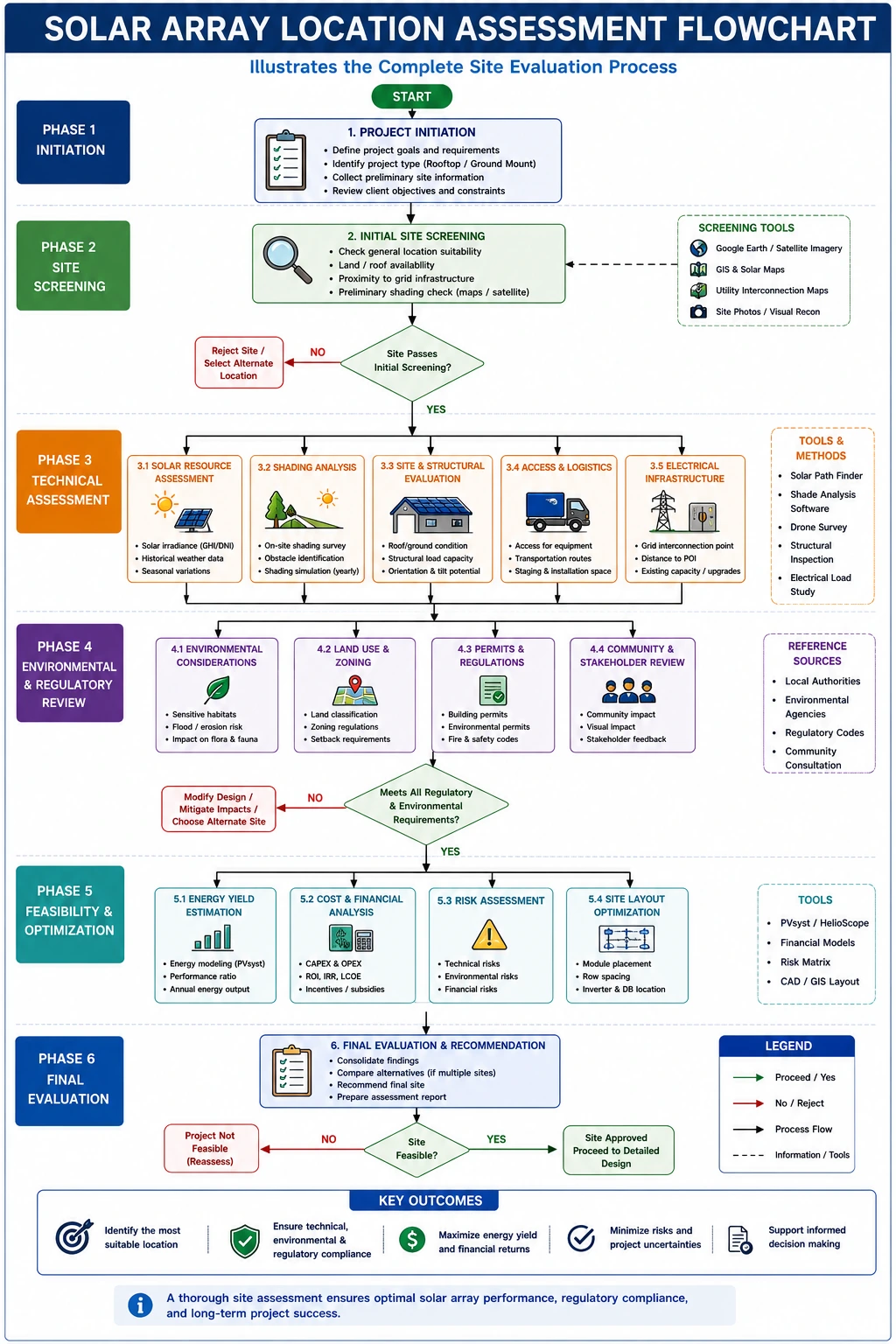
Key Factors to Evaluate When Assessing Array Location
1. Solar Resource Availability
The primary requirement for a solar PV system is access to adequate sunlight.
Evaluate:
- Daily sunlight exposure
- Seasonal variations
- Local climate conditions
- Historical solar irradiance data
Locations with higher solar radiation typically produce more energy and improve renewable solar system performance.
2. Shading Analysis
Shading is one of the biggest causes of energy loss in solar PV systems.
Potential shading sources include:
- Buildings
- Trees
- Water tanks
- Chimneys
- Utility poles
- Communication towers
Even partial shading can significantly reduce the array output.
Types of Shading
Temporary Shading
Caused by:
- Moving vehicles
- Temporary structures
- Construction equipment
Seasonal Shading
Caused by:
- Tree growth
- Sun position changes
Permanent Shading
- Caused by fixed structures.
3. Array Orientation
Orientation refers to the direction the solar modules face. Proper orientation helps maximize sunlight capture throughout the year.
Key considerations include:
- Geographic location
- Seasonal solar path
- Energy consumption patterns
Correct orientation improves solar electricity generation and system efficiency.
4. Tilt Angle Assessment
The tilt angle affects how much solar radiation reaches the PV modules.
Factors affecting tilt angle selection:
- Site latitude
- Seasonal energy requirements
- Mounting structure type
Proper tilt improves annual energy production.
5. Available Installation Area
Determine whether sufficient space exists for the planned system size.
Evaluate:
- Roof dimensions
- Ground area availability
- Obstructions
- Equipment placement requirements
Adequate space is necessary for efficient array layout and maintenance access.
6. Structural Suitability
The installation surface must support the weight of:
- Solar modules
- Mounting structures
- Cables
- Additional equipment
Assess:
- Roof condition
- Structural integrity
- Load-bearing capacity
Structural deficiencies should be addressed before installation.
Roof-Based Array Location Assessment
For rooftop solar installations, additional factors must be evaluated.
Roof Type
Common roof types include:
- Flat roofs
- Sloped roofs
- Metal roofs
- Concrete roofs
- Tile roofs
Each roof type requires specific mounting solutions.
Roof Condition
Inspect for:
- Cracks
- Water leakage
- Corrosion
- Structural deterioration
The roof should remain serviceable throughout the expected life of the solar system.
Roof Accessibility
Ensure safe access for:
- Installation
- Inspection
- Maintenance
Poor accessibility increases maintenance costs and safety risks.
Ground-Mounted Array Location Assessment
Ground-mounted systems require evaluation of additional site characteristics.
Land Availability
Assess:
Total usable area
Future expansion potential
Site boundaries
Soil Conditions
Evaluate:
- Soil bearing capacity
- Soil type
- Drainage characteristics
These factors influence foundation design.
Terrain Analysis
Determine:
- Ground slope
- Surface irregularities
- Erosion risks
Level sites generally reduce construction complexity.
Environmental Factors to Consider
Temperature Conditions
High temperatures can reduce module efficiency.
Evaluate:
- Average temperatures
- Seasonal variations
Wind Exposure
Strong winds affect:
- Structural design
- Mounting requirements
Wind loading should be considered during site selection.
Flood Risk
Avoid locations prone to:
- Flooding
- Water accumulation
- Poor drainage
Corrosion Risk
Assess exposure to:
- Coastal environments
- Industrial pollution
- Chemical contaminants
Corrosion can reduce equipment lifespan.
Electrical Infrastructure Assessment
The solar array location should support efficient electrical integration.
Evaluate:
- Distance to inverter location
- Cable routing options
- Utility interconnection points
- Grounding system requirements
Shorter cable runs help reduce losses and optimize solar panel system cost.
Safety Considerations During Site Assessment
Assess potential safety risks, including:
- Fall hazards
- Electrical hazards
- Structural instability
- Restricted access areas
Safety planning should begin during site evaluation.
Tools Required for Array Location Assessment
Measuring Tape
Used for:
- Roof dimensions
- Ground area measurements
Compass
- Determines array orientation.
Solar Pathfinder or Shading Analysis Tool
- Evaluates shading patterns.
Laser Distance Meter
- Provides accurate distance measurements.
Digital Camera
- Documents site conditions.
Drone (Where Applicable)
Useful for:
- Large sites
- Rooftop inspections
- Utility-scale projects
Inclinometer
- Measures roof slope and tilt angle.
Step-by-Step Procedure for Assessing Array Location
Step 1 – Review Project Requirements
Determine:
- System size
- Energy production targets
- Client requirements
Step 2 – Conduct Site Visit
- Perform a physical inspection of the proposed installation area.
Step 3 – Measure Available Space
Record:
- Roof dimensions
- Ground area
- Obstruction locations
Step 4 – Perform Shading Analysis
Identify:
- Current shading sources
- Potential future shading risks
Step 5 – Assess Orientation and Tilt
- Determine whether the site supports optimal array positioning.
Step 6 – Evaluate Structural Conditions
Verify:
- Load-bearing capacity
- Structural integrity
Step 7 – Assess Electrical Integration
Review:
- Inverter placement
- Cable routing
- Utility connection points
Step 8 – Document Findings
- Prepare a detailed site survey report.
Conclusion
A thorough array location assessment is the foundation of every successful solar PV installation. By carefully evaluating sunlight availability, shading, orientation, tilt angle, structural suitability, environmental conditions, and electrical infrastructure, installers can maximize system performance and long-term reliability.
Proper site assessment is a critical component of renewable solar project planning and solar electricity generation. Additionally, following recommendations and best practices promoted by the Ministry of New and Renewable Energy helps ensure high-quality and compliant solar installations.
By conducting comprehensive site evaluations and documenting findings accurately, solar professionals can optimize solar panel system cost, improve renewable energy technology performance, and contribute to the successful implementation of residential, commercial, industrial, and utility-scale solar projects.
FAQs
Q1. Why is array location assessment important in solar PV systems?
Ans: It helps maximize energy generation, reduce shading losses, improve system efficiency, and ensure safe installation.
Q2. What is the most important factor when selecting a solar array location?
Ans: Access to unobstructed sunlight throughout the day is one of the most critical factors.
Q3. How does shading affect solar panel performance?
Ans: Shading reduces energy production and can significantly impact the performance of solar modules and strings.
Q4. Why should structural conditions be evaluated before installation?
Ans: The installation surface must safely support the weight of solar equipment throughout the system’s lifespan.
Q5. Does proper site assessment reduce solar panel system cost?
Ans: Yes. Proper assessment reduces design errors, installation challenges, maintenance costs, and long-term operational expenses.
Solar PV Array Troubleshooting Guide: Diagnose & Fix Issues
Discover how to troubleshoot solar PV arrays with a step-by-step guide to diagnosing common faults, performing electrical tests, identifying damaged modules, and restoring optimal solar system performance.

Researchers Propose New Way to Make Nuclear Power Plants Safer
Researchers propose innovative methods to enhance the safety of nuclear power plants, aiming to reduce risks and improve operational security.

500 kW Solar Power Plant Cost in Rajasthan | Latest Price, Benefits and Payback Period
Planning to install a 500 kW solar power plant in Rajasthan? Discover the 2025 price estimate, government subsidy options, and ROI potential. Learn how industries and businesses can cut electricity costs and earn long-term returns through solar energy investments.
Solar System Grounding Conductor Size Guide
A complete guide to determining grounding conductor size for solar PV systems, ensuring safe, compliant, and reliable installations.

Is Your Solar PV Rooftop System Safe & Protected?
Worried about the safety of your solar rooftop system? Explore key tips, maintenance practices, and protection strategies to keep your Solar PV system secure and efficient

Open Circuit Voltage (Voc) Testing Guide for Solar PV Systems
A complete guide to measuring open circuit voltage (Voc) in solar PV systems, including testing procedures, safety guidelines, and performance evaluation techniques.

Breakthrough in Solar Technology: 33.2% Efficient Perovskite-Silicon Cell
Scientists achieve a breakthrough in solar technology with a perovskite-silicon tandem cell reaching a record 33.2% efficiency for higher energy output.

Save on Electricity in Haryana Using Net Metering: A Complete Guide
Learn how to save on electricity in Haryana with net metering. Step-by-step guide on benefits, installation, and cost savings for your home or business