Warehouses and shopping malls are among the fastest-growing commercial electricity consumers in India. With large rooftops, extended operating hours, and continuous power requirements for lighting, HVAC, refrigeration, elevators, and digital systems, energy costs significantly impact profitability. This makes solar for warehouses and malls one of the most effective solutions to control operational expenses while supporting sustainability goals.
By installing solar panel systems on expansive roofs or adjacent land, commercial facilities can shift toward renewable energy and solar energy, reducing grid dependency and long-term electricity costs.
Why Solar for Warehouses and Malls is ideal
Both warehouses and malls operate heavily during daytime—exactly when solar electricity generation is highest. This natural alignment maximizes self-consumption, shortens payback periods, and improves system efficiency.
Key advantages include:
- Major reduction in monthly power bills
- Productive use of large idle rooftops
- Protection against rising grid tariffs
- Lower carbon footprint and green branding
- Improved ESG and compliance positioning
- Contribution to renewable energy technology adoption
Solar power also enhances corporate sustainability profiles, making malls more attractive to tenants and warehouses more appealing to logistics partners.
Types of Solar for Warehouses and Malls
1. Rooftop Solar Panel Systems
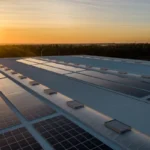
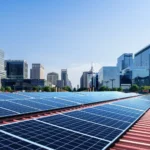
A solar panel in rooftop installation is the most common approach for warehouses and malls due to large, unobstructed roof surfaces.
2. Ground-Mounted Solar Plants
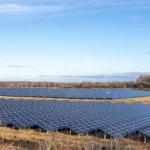
Facilities with surplus land can install ground-mounted solar to meet higher commercial loads.
3. Hybrid Solar Systems
Hybrid plants combine solar with batteries to ensure partial power backup for critical operations.
Solar for Warehouses and Malls – Installation Cost
The solar panel system cost depends on plant capacity, structure design, equipment selection, and project complexity.
Cost considerations often evaluated by commercial clients include:
- Solar installation cost per kWh
- Solar energy installation cost
- Solar roof installation cost
- Total cost of solar installation
- Cost of solar per kWh installed
- Solar module price per watt
- Home roof solar panels cost (for office sections)
Large commercial systems benefit from economies of scale, significantly reducing per-unit cost.
Area Requirement and Feasibility Planning
Before installation, a professional feasibility study is essential. It evaluates:
- Solar panel area per kW
- Roof strength and waterproofing
- Shadow analysis
- Tilt and orientation
- Fire safety and maintenance access
Warehouses and malls typically offer ideal structural conditions for high-capacity rooftop solar plants.
Power Generation and Savings Potential
Depending on location and system design, commercial solar plants can generate substantial energy annually, enabling:
- 40-80% offset of daytime consumption
- Significant reduction in demand charges
- Long-term stabilization of energy budgets
Over a 25-year lifecycle, solar power provides one of the lowest average cost of solar panels on a house or commercial building, ensuring strong financial returns.
Government Support and Commercial Solar Growth
Although direct capital subsidies are limited for large commercial projects, government initiatives continue to support commercial solar through:
- Net metering and gross metering frameworks
- Open access solar policies
- Accelerated depreciation benefits
- State-level duty exemptions
- Grid interconnection facilitation
These programs, aligned with the broader government solar subsidy scheme, indirectly support subsidised solar panels for home and commercial premises.
Smart Technology Integration in Commercial Solar Plants
Modern warehouse and mall solar plants use advanced technologies such as:
- High-efficiency mono PERC and TOPCon modules
- Smart inverters with MPPT
- Centralised monitoring dashboards
- Predictive fault detection
- Automated performance analytics
With continuous innovation in renewable energy technology, commercial solar assets are becoming smarter, safer, and more efficient.
Making Solar Energy Economical for Commercial Spaces
The rapid decline in the cost of solar panels combined with rising electricity tariffs has made solar one of the most reliable methods of making solar energy economical for commercial real estate.
Warehouses benefit from reduced logistics operating costs, while malls benefit from lower common-area electricity expenses, increasing tenant retention and profitability.
Conclusion
Solar for warehouses and malls is no longer just an environmental initiative, it is a strategic commercial investment. It transforms unused rooftops into high-return energy assets, stabilizes operating costs, and strengthens brand sustainability.
For facility owners, developers, and operators seeking long-term efficiency, resilience, and regulatory alignment, solar power offers a future-ready energy solution.
FAQs
Q1. Can solar handle the continuous lighting needs of warehouses?
Ans: Yes, solar significantly offsets daytime lighting loads, reducing grid dependency.
Q2. Is rooftop solar safe for large mall structures?
Ans: Yes, after structural audits, commercial roofs are well-suited for high-capacity installations.
Q3. Can malls provide solar power to individual shops?
Ans: Yes, through internal distribution systems, subject to regulatory and design approvals.
Q4. Will solar affect mall aesthetics?
Ans: Modern mounting systems are designed to maintain visual appeal and roof integrity.
Q5. Can solar power cold storage units in warehouses?
Ans: Yes, solar systems are widely used to support refrigeration and cooling loads.