
In solar photovoltaic (PV) projects, accurately transferring the solar design layout to the actual site is a crucial step that directly impacts structural stability, system performance, and installation efficiency. One of the most important aspects of this process is the correct positioning of footings for solar mounting structures.
Footings act as the foundation of the entire solar plant. Any error in their location can lead to misalignment, structural instability, shading issues, and increased solar installation charges. Precise marking and alignment of footings are essential for successful solar PV installations.
This blog provides a complete guide on locating footings from design to site execution, ensuring accuracy, efficiency, and optimized solar panel system cost.
Importance of Locating Footings Correctly
Accurate footing placement ensures:
- Proper alignment of solar panels
- Structural stability
- Optimal solar electricity generation
- Efficient use of available space
- Reduced rework and cost
Incorrect positioning can lead to shading losses, structural issues, and increased solar energy installation cost.
Understanding Solar Design Drawings
Before marking footings on-site, installers must study solar design documents such as:
- General Arrangement (GA) drawings
- Layout plans
- Structural drawings
These documents define:
- Panel layout
- Row spacing
- Tilt angle
- Footing positions
Key Parameters for Footing Location
1. Row Spacing
Ensures no shading between rows of panels.
2. Tilt Angle
Affects the distance between rows and the height of structures.
3. Orientation
Panels should be aligned for maximum sunlight exposure.
4. Module Dimensions
Panel size influences spacing and footing placement.
5. Site Boundaries
Ensure installation stays within the solar designated area.
Tools Required for Footing Marking
1. Measuring Tape
Used for accurate distance measurement.
2. Chalk Line
Used for marking straight lines on the ground.
3. Total Station / Survey Equipment
Used for precise alignment and positioning.
4. Spirit Level
Ensures level marking.
5. Pegs and Markers
Used to mark footing positions.
Step-by-Step Process for Locating Footings
Step 1 – Site Preparation
- Clear the site
- Remove obstacles
- Level the ground if required
Step 2 – Establish Reference Points
- Identify baseline and reference points
- Use site coordinates
These points guide the entire layout process.
Step 3 – Transfer Layout from Solar Design
- Mark rows and columns based on drawings
- Use measuring tools for accuracy
Step 4 – Mark Footing Positions
- Use pegs or markers
- Ensure correct spacing and alignment
Step 5 – Verify Alignment
- Cross-check measurements
- Ensure straight rows and proper angles
Step 6 – Check for Shading and Obstacles
- Ensure no shading from nearby objects
- Adjust positions if required
Step 7 – Final Approval
- Inspect the layout before excavation
- Get approval from the project engineer
Common Methods for Footing Layout
1. Manual Measurement Method
- Uses measuring tape and chalk
- Suitable for small projects
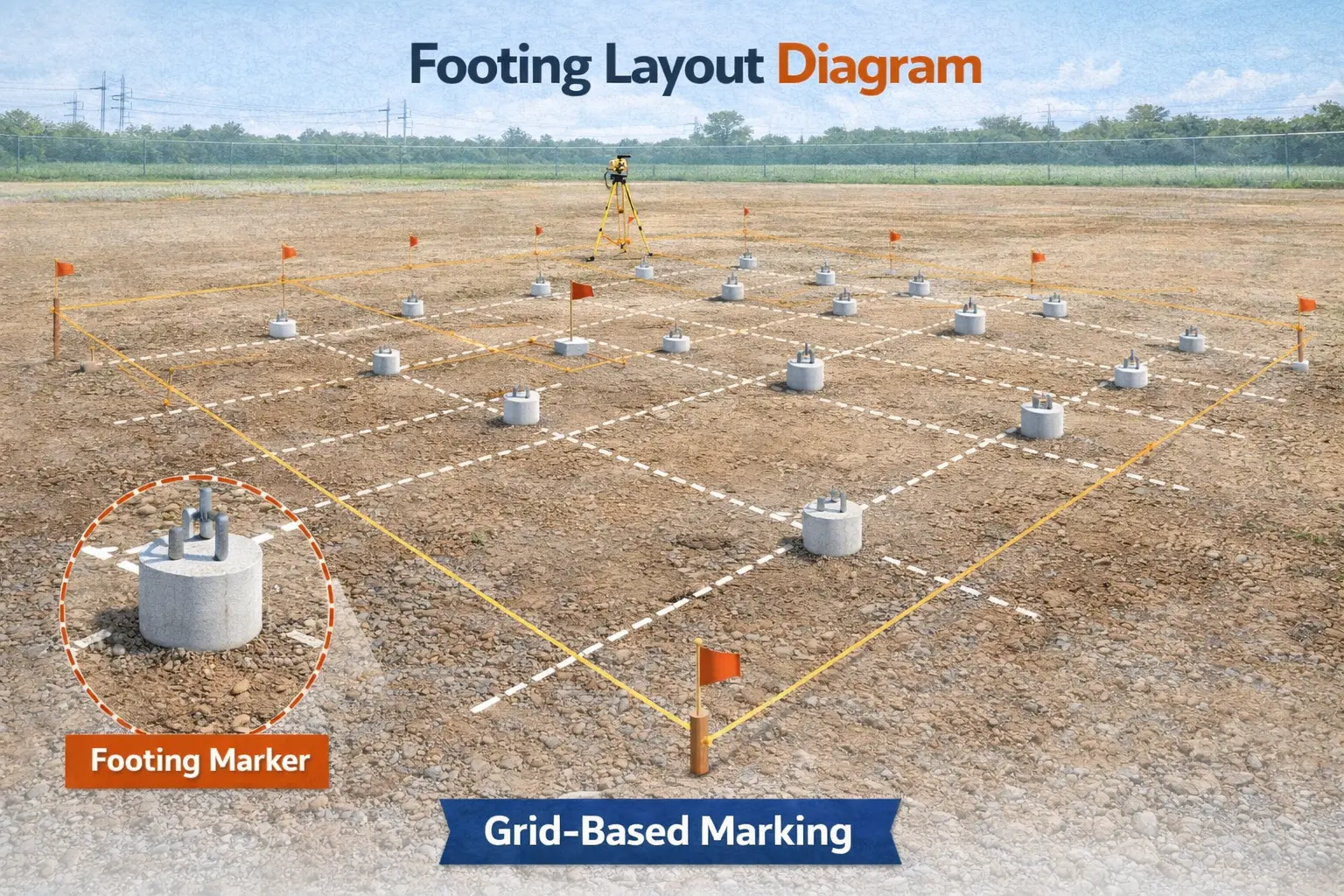
2. Grid Layout Method
- Divides the site into grids
- Ensures uniform spacing
3. Survey-Based Method
- Uses advanced equipment
- High accuracy for large solar plants
Impact on Solar Panel System Cost
Accurate footing placement helps:
- Reduce installation errors
- Avoid rework
- Improve system efficiency
- Optimize the cost of solar per kWh installed
Incorrect layout increases material wastage and labor cost.
Conclusion
Transferring solar design layouts to the actual site and accurately locating footings is a fundamental step in solar PV installation. By understanding solar design parameters, using appropriate tools, and following a structured process, installers can ensure precise footing placement. This not only enhances structural stability but also improves solar electricity generation and reduces installation errors.
Accurate layout and marking are essential for efficient solar installations. Additionally, adherence to standards set by the Ministry of New and Renewable Energy ensures safety and quality in renewable solar projects.
With proper planning and execution, solar professionals can optimize solar panel system cost, improve system reliability, and contribute to sustainable solar energy for home use and large-scale renewable solar solutions.
FAQs
Q1. Why is accurate footing location important in solar PV systems?
Ans: It ensures proper alignment, stability, and efficient system performance.
Q2. What tools are used for marking footing positions?
Ans: Measuring tape, chalk line, survey equipment, and pegs.
Q3. How does row spacing affect solar systems?
Ans: Proper spacing prevents shading and improves energy generation.
Q4. What happens if footings are incorrectly placed?
Ans: It can lead to misalignment, reduced efficiency, and increased costs.
Q5. Which method is best for large solar projects?
Ans: Survey-based methods using advanced equipment provide high accuracy.

Solar for Warehouses and Malls: Cost, Benefits, Installation & ROI in India
A complete guide on solar for warehouses and malls in India covering installation cost, benefits, ROI, system sizing, and installation process.
Solar Electrical Installation Toolkit: Inspection & Usage Guide
A complete guide to the electrical installation toolkit for solar installers, including inspection procedures, tool usage, and safety practices.

Sanctioned Load & Rooftop Solar: Everything You Need to Know
Learn why sanctioned load is crucial before rooftop solar installation. Understand its role, process, and impact on solar panel efficiency and subsidy eligibility.
Selecting Solar Panels: Best Guide for Homes and Factories
Solar panels are a hot topic these days, as the cost of solar is finally approaching what the average family can afford.

Affordable Solar Systems and Plants for Small and Medium Enterprises
Learn how SMEs can harness solar energy through tailored solar systems and plants to reduce electricity bills, improve sustainability, and boost efficiency.

SECI Sets Record in Renewable Energy Trading, Surpasses ₹100 Billion
SECI achieves record renewable power trading revenue surpassing ₹100 billion, marking a milestone in India’s clean energy growth and solar market expansion.

Solar Chankya: Complete Guide to Solar Systems and Components
Discover the key components of solar systems—from panels to inverters and batteries—and how they work together for efficient energy solutions
What to Expect from a Solar PV System
A complete guide to preparing solar PV system handover documentation, covering technical records, commissioning reports, equipment warranties, operating instructions, and maintenance documents for customers.