
Before installing a solar plant, one of the most common questions people ask is:
“How much electricity will my solar system actually generate?”
Solar energy generation is not a guess. It is calculated using scientific data like sunlight availability, system size, and losses. These calculations directly affect solar installation charges, solar panel system cost, project ROI, and even whether your project qualifies under a government solar subsidy scheme.
Understanding this process helps homeowners and businesses plan smarter investments and truly benefit from renewable energy and solar energy.
What Does Solar Energy Generation Mean?
Solar energy generation refers to the amount of electrical energy produced by a solar power system over a given time, usually measured in:
- Units (kWh) per day
- Units per month
- Units per year
These values help determine:
- Monthly electricity savings
- Payback period
- Total cost of solar installation
- Battery sizing
- Export potential to the grid
Accurate calculation ensures correct decisions on solar panel in rooftop, system capacity, and long-term feasibility.
Main Factors Used to Calculate Solar Energy Generation
Solar generation depends on multiple technical and environmental factors working together.
1. Solar Plant Capacity (kW/kWp)
This is the rated power of your system. For example, a 5kW plant installed for solar energy for home use will produce far less energy than a 100kW commercial system.
Capacity influences:
- Solar panel area per kW
- Inverter size
- Mounting structure
- Solar roof installation cost
2. Solar Radiation at the Location
Sunlight availability is measured through values like GHI (Global Horizontal Irradiance). Locations with higher sunlight receive more energy and generate more electricity.
Radiation values impact:
- Expected yearly output
- Cost of solar per kWh installed
- System efficiency
- Overall plant feasibility
This is why generation in Rajasthan is higher than many coastal or hill regions.
3. Performance Ratio (PR)
Performance ratio represents system efficiency after accounting for real-world losses like:
- Temperature loss
- Dust and shading
- Inverter loss
- Cable loss
A healthy solar plant typically operates between 75% to 85% PR. This number has a major impact on solar electricity output and long-term system health.
Standard Formula Used to Calculate Solar Generation
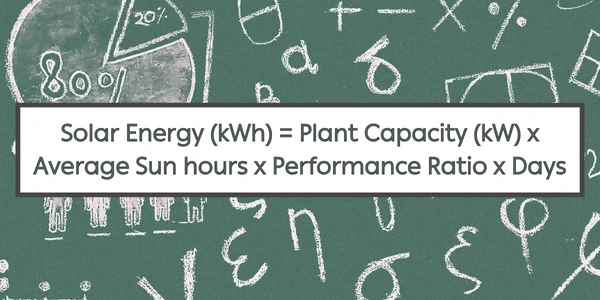
The most widely used simplified formula is:
Example:
5kW × 5 sun hours × 0.80 × 30 days = 600 units/month (approx)
This calculation helps estimate:
- Monthly savings
- System ROI
- Average cost of solar panels on a house
- Long-term plant economics
What Are Peak Sun Hours?
- Peak sun hours represent the time when sunlight intensity equals 1000 W/m².
- India’s average peak sun hours range from 4 to 6 hours per day, depending on region.
Peak sun hours directly affect:
- System size
- Battery selection
- Solar energy installation cost
- Expected annual production
How Losses Are Accounted in Calculation
No solar system operates at 100%. Losses are always included to maintain realistic generation estimates.
Major losses include:
- Temperature rise
- Dust accumulation
- Shading
- Cable length
- Inverter conversion loss
- Degradation over years
These losses are why designers use PR while estimating output and solar installation cost per kWh.
Why Solar Energy Generation Calculation Is Important Before Installation
Accurate calculation helps:
- Avoid system oversizing
- Prevent underperformance
- Select correct inverter and structure
- Optimize solar module price per watt
- Improve payback
- Increase long-term reliability
It ensures customers truly benefit from renewable solar instead of making emotional investments.
How Solar Energy Generation Impacts Cost Planning
Solar output decides:
- Financial returns
- Monthly savings
- Export income
- Battery ROI
- Home roof solar panels cost
- Smart solar panel price justification
Higher generation lowers effective unit cost and improves sustainability under renewable energy technology.
How Engineers Calculate Solar Output Professionally
Professional solar designers use:
- Satellite radiation data
- PV simulation software
- On-site shadow analysis
- Tilt and azimuth studies
- Historical weather data
This ensures precise forecasting for:
- Residential projects
- Industrial plants
- Large solar farms
- Subsidised solar panels for home planning
- Government approvals
Conclusion
Solar energy generation is calculated using system size, sunlight availability, and real-world efficiency factors. It is the backbone of every solar investment decision and directly impacts savings, performance, and long-term success.
At Smart Roof Solar, we perform professional generation analysis before every project to ensure accurate forecasting, optimized system design, and truly economical solar solutions.
FAQs
Q1. Does panel orientation matter even if capacity is correct?
Ans: Yes, incorrect tilt or direction can reduce generation despite having the right system size.
Q2. How does roof shape affect solar generation calculations?
Ans: Irregular or sloped roofs can limit panel placement and reduce effective generation capacity.
Q3. Are solar generation calculations different for net-metering systems?
Ans: Yes, export limits and grid availability can affect usable energy even if generation is high.
Q4. Does inverter oversizing improve solar energy generation?
Ans: Slight oversizing can improve low-light performance, but excessive oversizing causes energy clipping.
Q5. How does humidity affect solar electricity output?
Ans: High humidity reduces sunlight penetration and can slightly lower real-world generation.

Workmanship Inspection and Tool Proficiency in Solar PV Projects
A complete guide to solar PV workmanship and tool proficiency, helping installers maintain quality standards and demonstrate technical competency.

Solar Panel Cleaning Guide for Maximum Performance
A complete guide on how to clean solar PV modules, including safe cleaning techniques, recommended tools, maintenance schedules, and best practices to maximize energy output.
Benefits of Site Survey in Solar PV Installation
Shadow analysis is a critical step in solar site assessment. It helps solar installers identify shading obstacles and optimize panel placement for maximum energy generation.

Solar Power System Efficiency: How to Calculate for Residential, Industrial & Commercial Use
Understand and measure your solar system’s performance. Maximize energy output at home, industrial units, and commercial buildings

UP Government Incentive: Stamp Duty Exemption for Solar Land
Uttar Pradesh offers stamp duty exemption on land for solar projects, encouraging investment and growth in renewable energy.

Battery Bank Installation in Solar Projects: Site Selection & Best Practices
Battery banks are essential for energy storage in solar projects. This guide explains site selection, installation procedures, safety measures, and best practices for solar battery systems.
How to Connect a Solar Panel to an MPPT Charge Controller: Step-by-Step Guide
This guide explains how to connect a solar panel to an MPPT charge controller step by step. Learn correct wiring, safety tips, and best practices to ensure efficient and reliable solar power performance.

How to Connect Solar Panels to Battery: Step-by-Step Guide
Connecting solar panels to a battery is essential for storing solar energy and ensuring power availability when sunlight is low. This step-by-step guide explains how to connect solar panels to a battery safely using a charge controller, wiring diagrams, and best practices for beginners and professionals alike.