
Installing a solar plant is not just about mounting panels and connecting an inverter. A successful renewable solar project begins with proper customer requirement assessment. Without understanding the client’s energy consumption, financial expectations, rooftop condition, and long-term goals, even a technically sound system may fail to deliver expected performance.
Before finalizing solar panel system cost, solar installation charges, and estimating the cost of solar per kWh installed, installers must conduct systematic evaluation procedures. Professional solar technicians must be trained in customer assessment techniques before designing a solar energy system.
This blog explains the different key assessment methods used to identify customer requirements prior to installing a solar plant.
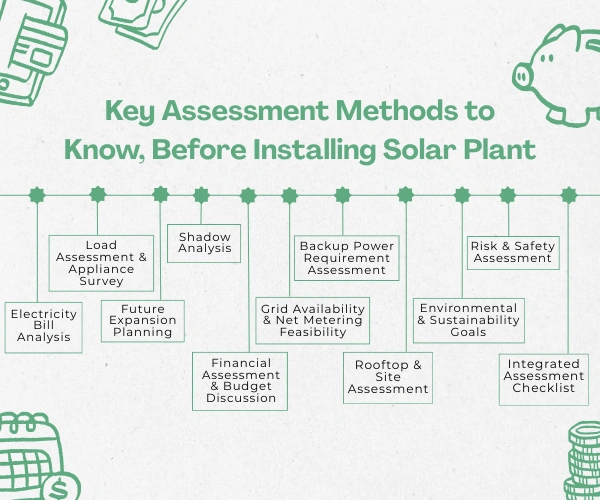
Electricity Bill Analysis
Purpose
Electricity bill analysis is the first and most important step in understanding customer requirements.
What to Assess
- Monthly energy consumption (kWh)
- Sanctioned load (kW)
- Tariff category (residential/commercial)
- Billing pattern (average, seasonal variation)
Why It Is Important
- Deciding optimal solar plant capacity
- Estimating solar electricity generation
- Calculating payback period
- Reducing the cost of solar per kWh installed
For example:
- If a home consumes 600 units per month, the system capacity must be designed accordingly for efficient solar energy for home use.
Load Assessment and Appliance Survey
What It Involves
Installers must evaluate:
- Type of appliances
- Rated power of each appliance
- Daily usage hours
- Peak load demand
Importance
- Load assessment ensures:
- Correct inverter sizing
- Battery selection (for hybrid/off-grid systems)
- Avoidance of system overloading
Incorrect load estimation increases solar installation charges due to redesign.
Rooftop and Site Assessment
For solar panels in rooftop installations, physical inspection is essential.
Key Parameters to Evaluate
- Available shadow-free area
- Roof orientation (South-facing preferred in India)
- Tilt angle suitability
- Structural strength
- Obstructions (water tanks, antennas, trees)
Importance
- Proper site assessment:
- Maximizes solar electricity output
- Reduces shading losses
- Improves renewable solar performance
- Optimizes solar panel system cost
Shadow Analysis
Shadow from:
- Adjacent buildings
- Trees
- Parapet walls can significantly reduce system output.
Installers may use:
- Shadow analysis tools
- Solar path diagrams
- Manual observation methods
Proper shading assessment ensures:
- Reduced energy loss
- Lower cost of solar per kWh installed
- Improved renewable energy technology efficiency
Financial Assessment and Budget Discussion
Understanding the customer’s financial capacity is critical.
What to Assess
- Budget range
- Interest in loan or EMI options
- Awareness of the government solar subsidy scheme
- Payback period expectations
Importance
- Financial assessment helps in:
- Recommending an appropriate system size
- Deciding between an on-grid, off-grid, or hybrid system
- Aligning the smart solar panel price with customer affordability
Grid Availability and Net Metering Feasibility
For grid-connected renewable solar systems:
- Check grid stability
- Confirm net metering eligibility
- Verify local DISCOM regulations
This ensures:
- Compliance under the government solar subsidy scheme
- Proper approval process
- Accurate solar energy installation cost estimation
Backup Power Requirement Assessment
Some customers prioritize backup during power cuts.
Installers must determine:
- Required backup load
- Backup duration
- Battery capacity requirement
This affects:
- Inverter type selection
- Solar panel system cost
- Solar installation charges
Future Expansion Planning
Customers may plan:
- Electric vehicle charging
- Additional appliances
- Commercial expansion
Considering future expansion:
- Prevents redesign
- Saves long-term cost
- Improves renewable solar scalability
Environmental and Sustainability Goals
Some customers aim to:
- Reduce carbon footprint
- Achieve energy independence
- Adopt renewable energy technology
Understanding motivation helps in designing an appropriate solar plant configuration.
Risk and Safety Assessment
Installers must evaluate:
- Earthing requirement
- Lightning protection need
- Roof waterproofing
- Fire safety compliance
Proper risk assessment reduces maintenance costs and improves solar electricity system reliability.
Integrated Assessment Checklist
Before finalizing a solar energy for home use system, ensure:
- Electricity bill analysis completed
- Load survey conducted
- Rooftop measured and inspected
- Shadow analysis done
- Budget discussed
- Grid feasibility checked
- Safety inspection performed
Impact on Solar Panel System Cost
Accurate assessment helps to:
- Avoid undersizing or oversizing
- Reduce unnecessary solar installation charges
- Improve system ROI
- Optimize the cost of solar per kWh installed
- Enhance performance under subsidised solar panels for home projects
Improper assessment leads to:
- Performance dissatisfaction
- Reduced solar electricity output
- Increased service cost
Conclusion
A solar plant installation begins long before panels are mounted. Comprehensive customer requirement assessment ensures technical accuracy, financial feasibility, and long-term satisfaction. From electricity bill analysis and load survey to rooftop inspection and financial discussion, each assessment method plays a critical role in determining solar panel system cost and overall project success.
Professional installers must master these evaluation techniques to deliver efficient renewable solar systems. Accurate assessment minimizes solar installation charges, optimizes the cost of solar per kWh installed, and ensures reliable solar energy for home use performance.
By conducting systematic and structured customer requirement analysis, installers can enhance renewable energy technology adoption and build trust in sustainable solar plant solutions across residential and commercial sectors.
FAQs
Q1. Why is electricity bill analysis important before installing a solar plant?
Ans: It helps determine the correct system capacity and estimate solar electricity generation accurately.
Q2. How does rooftop assessment affect solar panel system cost?
Ans: Proper site evaluation maximizes panel placement and reduces shading losses, improving cost efficiency.
Q3. What happens if the load assessment is incorrect?
Ans: Incorrect load calculation can cause inverter mismatch, increasing solar installation charges.
Q4. Is shadow analysis mandatory for rooftop solar systems?
Ans: Yes. Shading directly reduces renewable solar output and increases the cost of solar per kWh installed.
Q5. How does financial assessment help customers?
Ans: It aligns system design with budget, loan options, and government solar subsidy scheme benefits.
Understanding Solar Cells and Modules: A Complete Guide
Understand solar cells and modules, their functioning, and advantages for residential and commercial solar installations.

New Loan Scheme for solar rooftop projects by IREDA
Solar installation for petrol pumps offers huge savings and energy independence. This 2025 guide explains system cost, subsidy, ROI, and installation process.

Connection in Series and Parallel: Meaning, Differences, Formula & Applications
Understanding the difference between single-phase and three-phase voltage is essential for solar PV installers. While single-phase supply is common in residential systems, three-phase power is widely used in commercial and industrial solar projects. This complete guide explains electrical phase differences, applications in solar installations, and how choosing the right phase connection impacts system efficiency, safety, and performance.

Solar Financing for Businesses: Complete Guide to Funding Commercial & Industrial Solar Projects in India
Discover solar financing options for businesses in India, including CAPEX, OPEX, PPA models, solar loans, ROI, and funding strategies for commercial and industrial solar projects.
How to Prepare a Bill of Material (BOM) for Solar PV Systems: Step-by-Step Installer Guide
Learn how to prepare a detailed Bill of Material (BOM) for solar PV systems using design documents like SLDs and layouts. This step-by-step guide helps installers ensure accurate material planning, reduce errors, and improve project execution.
Why Solar Energy Makes Sense for the Healthcare Industry
Explore how the healthcare industry can leverage solar energy to reduce electricity bills, enhance reliability, and support green initiatives.
Poor vs Good Solar Installation: Key Differences Explained
A solar system’s performance depends heavily on installation quality. This blog explains the clear differences between a poor and good solar installation — from wiring practices and panel alignment to mounting structures and system safety — helping you make an informed choice and ensure long-term efficiency.

Commercial Solar Power Plant Subsidy in India: What Businesses Need to Know
Businesses in India can reduce their solar installation costs through various MNRE-backed subsidies and state incentives. Learn eligibility, benefits, and the application process for commercial solar plants.