
A safe work environment is essential for the successful installation, commissioning, operation, testing, troubleshooting, and maintenance of solar photovoltaic (PV) systems. As the demand for renewable solar energy continues to increase worldwide, solar professionals frequently work in environments that present electrical, mechanical, environmental, and occupational hazards. Whether installing rooftop solar panels, maintaining utility-scale solar farms, testing inverters, handling battery storage systems, or inspecting electrical equipment, creating a safe work area is critical for protecting workers, ensuring equipment reliability, and maintaining uninterrupted solar electricity generation.
Solar PV projects involve various high-risk activities such as working at heights, handling energized DC circuits, lifting heavy equipment, operating power tools, working in harsh weather conditions, and performing electrical testing. A poorly organized or unsafe work area can lead to electrical shock, falls, fires, equipment damage, project delays, and serious injuries. Therefore, before any work begins, technicians and supervisors must identify workplace hazards, assess risks, implement safety controls, and ensure that the work area complies with organizational safety policies and industry standards.
Creating a safe work environment goes beyond wearing Personal Protective Equipment (PPE). It includes proper housekeeping, controlled access to work zones, safe storage of materials, effective communication, emergency preparedness, correct use of tools, adequate lighting, weather monitoring, hazard signage, and compliance with documented safety procedures. A well-managed work area enhances productivity, minimizes downtime, reduces maintenance costs, and extends the lifespan of solar equipment.
Identifying workplace hazards and creating a safe working environment are fundamental responsibilities for solar installers, commissioning engineers, EPC contractors, supervisors, and Operations & Maintenance (O&M) professionals.
This comprehensive guide explains the requirements for establishing a safe work area in solar PV projects, hazard identification, workplace organization, risk control measures, documentation, and industry best practices.
Why Is a Safe Work Area Important?
A properly organized work area helps to:
- Prevent workplace accidents
- Reduce electrical hazards
- Protect workers and visitors
- Improve work quality
- Prevent equipment damage
- Increase productivity
- Reduce downtime
- Improve solar electricity generation through safer installation and maintenance practices
A safe work environment also supports long-term operational efficiency and helps optimize the overall solar panel system cost.
Common Hazards in Solar PV Work Areas
Technicians may encounter:
- Electric shock
- Arc flash
- DC electrical hazards
- AC electrical hazards
- Falls from rooftops
- Slips, trips, and falls
- Falling tools and materials
- Manual handling injuries
- Fire hazards
- Battery chemical exposure
- High temperatures
- Sharp edges on mounting structures
- Dust and debris
- Poor lighting
- Adverse weather conditions
- Confined spaces
Every hazard should be identified before work begins.
Requirements for a Safe Work Area
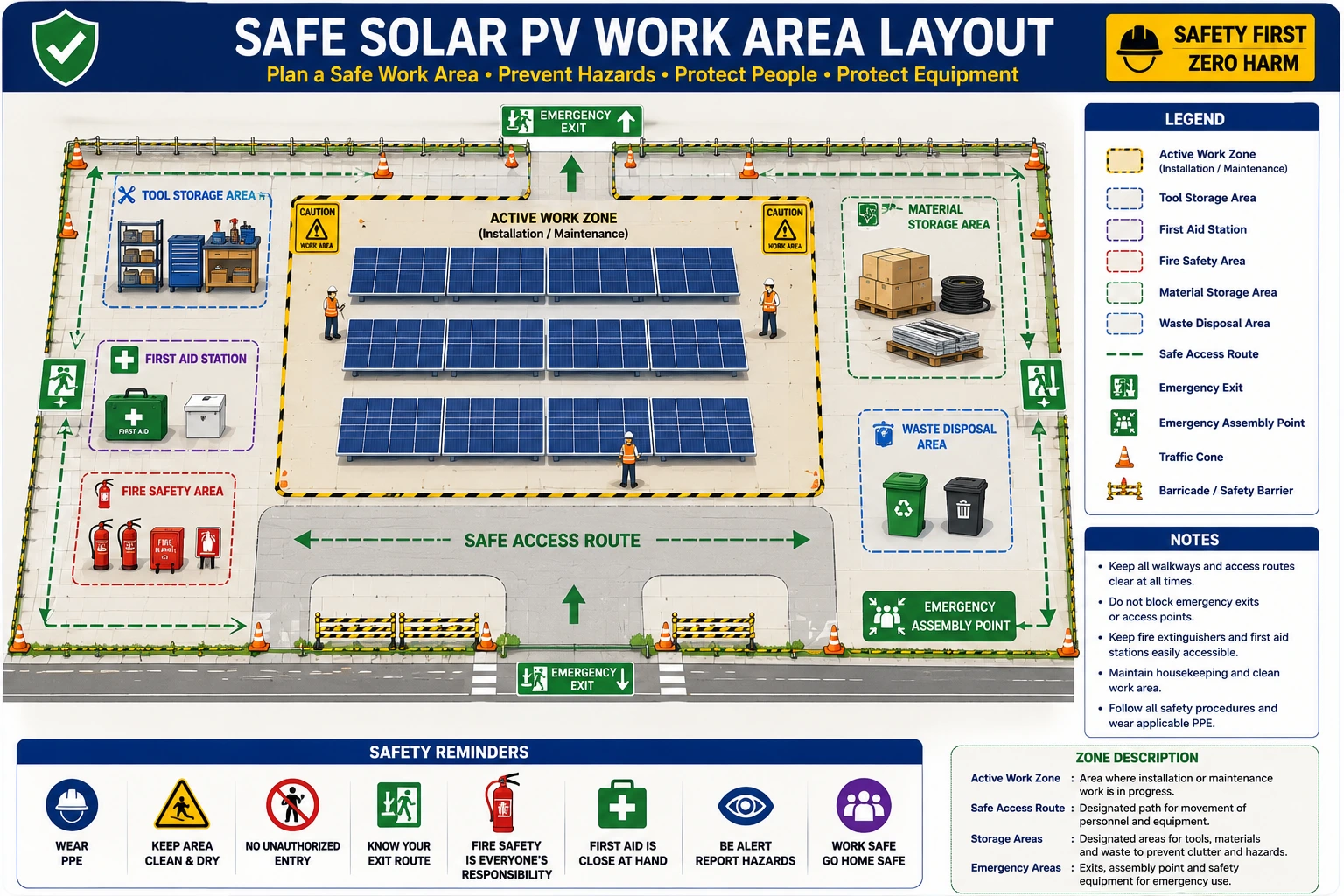
A safe solar PV work area should include:
- Hazard-free access routes
- Stable working platforms
- Adequate lighting
- Proper ventilation
- Clearly marked work zones
- Safety warning signs
- Emergency exits
- Fire extinguishers
- First aid kits
- Safe storage for tools and materials
- Emergency communication facilities
These requirements reduce risks and improve overall workplace efficiency.
Personal Protective Equipment (PPE)
Every technician should wear appropriate PPE, including:
- Safety helmet
- Electrical insulating gloves
- Safety glasses or face shield
- High-visibility vest
- Safety footwear
- Flame-resistant clothing where required
- Fall arrest harness for rooftop work
- Hearing protection when necessary
PPE should always be inspected before use.
Step-by-Step Guide to Creating a Safe Work Environment
Step 1 – Conduct a Site Inspection
Before starting work:
- Inspect the work location.
- Identify hazards.
- Assess structural conditions.
- Verify safe access points.
- Check weather conditions.
No work should begin until the area has been evaluated.
Step 2 – Perform Hazard Identification and Risk Assessment
Identify risks related to:
- Electrical systems
- Working at heights
- Heavy equipment
- Environmental conditions
- Mechanical hazards
- Battery systems
Implement appropriate control measures before work begins.
Step 3 – Define and Secure the Work Area
Clearly establish the work zone by:
- Installing safety barricades
- Using warning tape
- Displaying caution signs
- Restricting unauthorized access
This prevents accidental entry into hazardous areas.
Step 4 – Ensure Good Housekeeping
Maintain a clean work environment by:
- Removing unnecessary materials
- Organizing tools properly
- Keeping walkways clear
- Cleaning spills immediately
- Managing waste effectively
Good housekeeping significantly reduces workplace accidents.
Step 5 – Inspect Tools and Equipment
Before use:
- Check insulated tools for damage.
- Verify calibration of measuring instruments.
- Inspect ladders and scaffolding.
- Ensure lifting equipment is safe.
Defective tools should be removed from service immediately.
Step 6 – Verify Electrical Safety
Before handling electrical equipment:
- Follow Lockout/Tagout (LOTO) procedures where applicable.
- Verify absence of hazardous voltage.
- Confirm grounding integrity.
- Inspect insulation.
- Use approved test instruments.
Remember that solar PV modules generate electricity whenever exposed to sunlight.
Step 7 – Ensure Safe Material Storage
Store materials safely by:
- Keeping heavy equipment stable.
- Protecting electrical components from moisture.
- Separating hazardous materials.
- Organizing cables and connectors.
Proper storage reduces equipment damage and trip hazards.
Step 8 – Establish Emergency Preparedness
Ensure availability of:
- First aid kits
- Fire extinguishers
- Emergency contact numbers
- Emergency exits
- Spill response equipment
- Rescue equipment for rooftop work
Emergency response procedures should be communicated to all personnel.
Step 9 – Maintain Effective Communication
Workers should:
- Participate in toolbox talks.
- Understand assigned responsibilities.
- Report unsafe conditions immediately.
- Stay in contact with supervisors.
Good communication enhances workplace safety.
Step 10 – Monitor Environmental Conditions
Continuously monitor:
- Rain
- Lightning
- Strong winds
- Excessive heat
- Poor visibility
Outdoor work should be suspended when conditions become unsafe.
Step 11 – Verify Safe Completion of Work
Before leaving the site:
- Remove temporary barriers where appropriate.
- Restore equipment safely.
- Remove waste materials.
- Inspect the work area.
- Confirm that no hazards remain.
Step 12 – Document Safety Activities
Record:
- Site inspections
- Hazard assessments
- Toolbox talks
- Equipment inspections
- Corrective actions
- Incident reports
- Safety observations
Documentation supports future safety improvements.
Safe Work Area Requirements for Rooftop Solar Installations
Rooftop work areas should include:
- Certified fall protection systems
- Secure ladders
- Roof edge protection
- Weather monitoring
- Clearly defined access routes
- Proper anchor points
- Safe material handling procedures
Safe Work Area Requirements for Utility-Scale Solar Plants
Large solar plants require:
- Controlled vehicle movement
- Designated pedestrian walkways
- Equipment exclusion zones
- Emergency assembly points
- Communication systems
- Fire protection equipment
Benefits of Creating a Safe Work Environment
Improved Worker Safety
Hazard control significantly reduces workplace injuries.
Increased Renewable Solar System Reliability
Safe work practices improve installation quality and equipment longevity.
Higher Solar Electricity Generation
Proper installation and maintenance reduce faults and improve system performance.
Reduced Downtime
Preventing accidents and equipment damage minimizes operational interruptions.
Lower Maintenance Costs
Safe workplaces reduce repair expenses, insurance claims, and project delays while protecting the value of the solar panel system cost.
Conclusion
Establishing a safe work area and maintaining a safe work environment are essential responsibilities in every solar PV project. By systematically identifying hazards, assessing risks, implementing appropriate control measures, organizing the workplace, maintaining good housekeeping, ensuring proper use of PPE, preparing for emergencies, and following approved safety procedures, organizations can protect workers, reduce operational risks, and improve project quality. A safe workplace not only prevents accidents but also contributes to greater efficiency, higher equipment reliability, and long-term operational success.
Workplace safety should be integrated into every stage of solar PV installation, testing, commissioning, operation, and maintenance. Additionally, organizations should align their workplace safety practices with the guidance provided by the Ministry of New and Renewable Energy, applicable occupational safety regulations, manufacturer recommendations, and recognized electrical standards to ensure safe and compliant operations.
By fostering a proactive safety culture, conducting regular inspections, maintaining organized work areas, investing in employee training, documenting safety activities, and continuously improving workplace practices, solar professionals can optimize solar panel system cost, improve renewable solar system reliability, maximize solar electricity generation, reduce the cost of solar per kWh installed, lower the solar installation cost per kWh, and ensure the long-term success of renewable energy and solar energy projects across residential, commercial, industrial, and utility-scale applications.
FAQs
Q1. Why is a safe work area important in solar PV projects?
Ans: A safe work area helps prevent workplace accidents, protects workers from electrical and mechanical hazards, improves work quality, minimizes equipment damage, and supports reliable solar electricity generation.
Q2. What are the key requirements for creating a safe work environment?
Ans: Essential requirements include hazard identification, risk assessment, proper housekeeping, adequate lighting, safe access routes, warning signage, PPE, emergency equipment, secure material storage, and effective communication.
Q3. What hazards are commonly found in solar PV work areas?
Ans: Common hazards include electric shock, arc flash, falls from height, slips and trips, manual handling injuries, battery chemical exposure, fire hazards, poor weather conditions, and improperly stored materials.
Q4. How does good housekeeping improve workplace safety?
Ans: Good housekeeping reduces trip hazards, prevents equipment damage, improves accessibility, enhances productivity, and minimizes the risk of workplace accidents.
Q5. How often should solar PV work areas be inspected?
Ans: Work areas should be inspected before work begins each day, after significant weather events, following major work activities, and whenever site conditions change to ensure that hazards are identified and controlled promptly.
Safety Hazard Identification & Mitigation in Solar PV
A complete guide to identifying and mitigating safety hazards in solar PV systems, including risk assessment, hazard control, preventive measures, and workplace safety practices.
Environmental Hazards in Solar PV Installations Guide
A complete guide to identifying and mitigating safety hazards in solar PV systems, including risk assessment, hazard control, preventive measures, and workplace safety practices.

Difference Between Single-Phase and Three-Phase Voltage and Its Use for Solar PV Installer – Complete Guide
Understanding the difference between single-phase and three-phase voltage is essential for solar PV installers. While single-phase supply is common in residential systems, three-phase power is widely used in commercial and industrial solar projects. This complete guide explains electrical phase differences, applications in solar installations, and how choosing the right phase connection impacts system efficiency, safety, and performance.

How to Check Materials Received on Site for Solar PV Projects: Complete Inspection Checklist
Ensuring the quality of materials received at site is critical for successful solar PV installation. This guide provides a detailed inspection checklist to verify solar components before installation.
Solar Energy Myths vs. Facts: What You Should Know
Solar power myths often mislead homeowners. Learn the facts about cost, efficiency, and reliability of solar energy.

Save on Electricity in Haryana Using Net Metering: A Complete Guide
Learn how to save on electricity in Haryana with net metering. Step-by-step guide on benefits, installation, and cost savings for your home or business
Corporate Safety Policies for Solar PV Workplaces
A complete guide to establishing and following safe work procedures in solar PV systems, ensuring worker safety during installation, testing, commissioning, operation, and maintenance.

Solar Site Assessment: Shadow Analysis for Maximum Energy Generation
Shadow analysis is a critical step in solar site assessment. It helps solar installers identify shading obstacles and optimize panel placement for maximum energy generation.