
Workplace safety is a shared responsibility in every solar photovoltaic (PV) project. From residential rooftop installations to large utility-scale solar power plants, maintaining a safe working environment requires strict adherence to corporate safety policies, regulatory requirements, and established operational procedures. However, despite comprehensive safety programs and regular training, workplace safety violations can still occur. These may include failure to use Personal Protective Equipment (PPE), bypassing Lockout/Tagout (LOTO) procedures, unsafe electrical practices, improper use of tools, working at heights without fall protection, or ignoring emergency protocols.
When safety policies are violated, it is essential that employees know exactly whom to contact and how to report the issue. Prompt reporting helps prevent accidents, protects workers and equipment, ensures regulatory compliance, and promotes a strong safety culture. Delayed or ignored reporting can result in serious injuries, equipment failures, project delays, legal consequences, and reduced solar electricity generation due to avoidable incidents.
Every organization involved in renewable solar projects should establish a clear reporting hierarchy that identifies responsible personnel for handling workplace safety concerns. Depending on the severity of the violation, reports may be directed to supervisors, site managers, Health, Safety, and Environment (HSE) officers, project managers, safety committees, human resources personnel, or senior management. Employees should also understand emergency reporting procedures for situations involving immediate danger, such as electrical accidents, fires, structural failures, or medical emergencies.
A transparent reporting process encourages employees to report hazards, near misses, unsafe conditions, and policy violations without fear of retaliation. Organizations that promote open communication and proactive reporting experience fewer workplace incidents, better compliance, improved employee confidence, and more reliable solar electricity production.
Recognizing unsafe practices and reporting them through the proper channels is an essential responsibility for solar installers, commissioning engineers, EPC contractors, supervisors, and Operations & Maintenance (O&M) professionals.
This comprehensive guide explains who should be contacted when workplace safety policies are violated, the reporting process, employee responsibilities, documentation requirements, and best practices for maintaining a safe solar PV work environment.
Why Is Reporting Safety Policy Violations Important?
Reporting workplace safety violations helps to:
- Prevent accidents and injuries
- Protect employees and contractors
- Reduce equipment damage
- Improve regulatory compliance
- Encourage proactive hazard management
- Strengthen organizational safety culture
- Maintain uninterrupted solar electricity generation
Timely reporting prevents small issues from becoming major incidents.
Common Workplace Safety Policy Violations
Examples include:
- Failure to wear required PPE
- Ignoring Lockout/Tagout (LOTO) procedures
- Working on energized equipment without authorization
- Unsafe work at heights
- Improper ladder or scaffolding use
- Damaged or uncalibrated tools
- Poor housekeeping
- Unauthorized access to restricted areas
- Bypassing safety devices
- Improper battery handling
- Unsafe lifting practices
- Failure to report hazards or incidents
Each violation should be addressed promptly.
Who Should Be Contacted?
The appropriate contact depends on the organization’s reporting structure and the seriousness of the violation.
1. Immediate Supervisor
The first point of contact is usually the immediate supervisor.
Responsibilities include:
- Assessing the situation
- Correcting unsafe behavior
- Ensuring work is stopped if necessary
- Initiating corrective actions
Minor safety concerns should normally be reported to the supervisor first.
2. Site Supervisor
On construction sites, the site supervisor is responsible for:
- Monitoring daily safety compliance
- Conducting inspections
- Coordinating corrective measures
- Ensuring adherence to safety procedures
3. Health, Safety, and Environment (HSE) Officer
The HSE officer plays a key role in workplace safety.
Responsibilities include:
- Investigating safety violations
- Conducting risk assessments
- Providing safety training
- Reviewing corrective actions
- Monitoring compliance with corporate policies
Serious or repeated violations should be reported to the HSE officer.
4. Project Manager
The project manager oversees overall project execution and safety performance.
Responsibilities include:
- Allocating resources
- Supporting corrective actions
- Reviewing incident investigations
- Ensuring compliance with contractual and regulatory requirements
5. Safety Committee
Large organizations often establish safety committees to:
- Review workplace incidents
- Recommend improvements
- Monitor safety performance
- Promote employee participation
Employees may raise recurring concerns through the committee.
6. Human Resources (HR)
HR departments may become involved when safety violations involve:
- Employee misconduct
- Policy enforcement
- Disciplinary action
- Workplace grievances
7. Senior Management
- Serious safety issues affecting multiple workers, significant equipment damage, or repeated non-compliance should be escalated to senior management.
- Management demonstrates leadership by ensuring corrective measures are implemented.
8. Emergency Services
If a violation results in an immediate threat to life or property, such as fire, electric shock, structural collapse, or medical emergencies, emergency services should be contacted immediately in accordance with company emergency procedures.
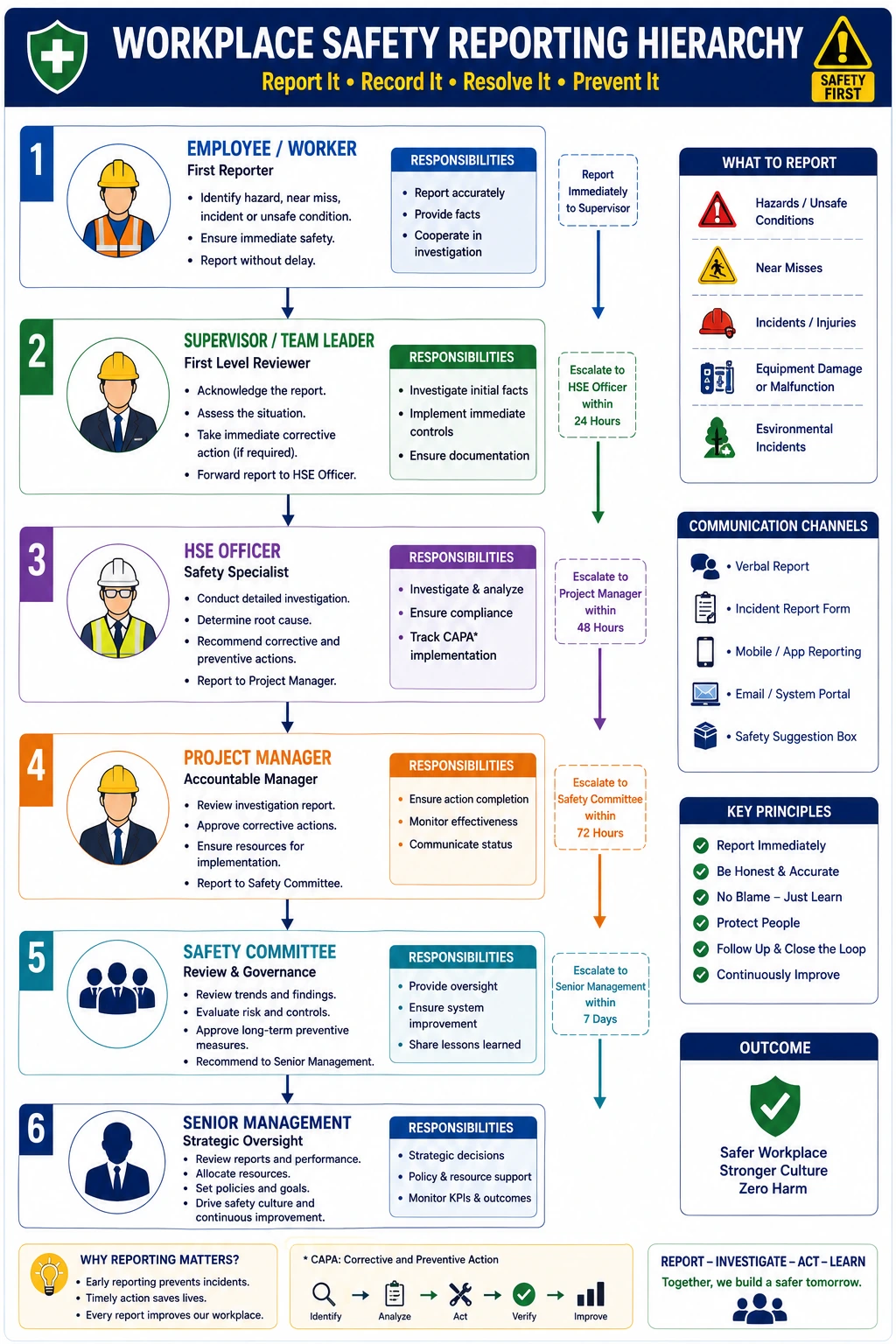
Reporting Hierarchy
A typical reporting chain is:
Employee → Immediate Supervisor → Site Supervisor → HSE Officer → Project Manager → Senior Management
Emergencies may require bypassing this sequence to obtain immediate assistance.
What Information Should Be Reported?
Reports should include:
- Date and time
- Location
- Description of the violation
- Persons involved
- Equipment affected
- Immediate hazards
- Corrective actions taken
- Supporting photographs if available
- Witness information
Accurate information supports effective investigations.
Incident Investigation Process
After receiving a report:
- Secure the area.
- Assess immediate risks.
- Collect evidence.
- Interview witnesses.
- Determine root causes.
- Recommend corrective actions.
- Document findings.
- Monitor implementation.
The goal is prevention, not assigning blame.
Benefits of Effective Reporting
Improved Worker Safety
- Early reporting helps prevent injuries and fatalities.
Enhanced Renewable Solar System Reliability
- Correcting unsafe practices improves installation quality and equipment performance.
Increased Solar Electricity Generation
- Reducing safety-related interruptions helps maintain consistent power production.
Reduced Downtime
- Prompt corrective actions minimize delays caused by accidents or equipment failures.
Lower Operational Costs
Preventing incidents reduces repair costs, insurance claims, and project delays while protecting the long-term value of the solar panel system cost.
Conclusion
Recognizing workplace safety policy violations and reporting them to the appropriate contact person is a critical responsibility for everyone involved in solar PV projects. Whether reporting unsafe work practices, equipment defects, or hazardous conditions, timely communication helps prevent accidents, protects workers, safeguards valuable assets, and ensures that corrective actions are implemented before incidents escalate. A well-defined reporting hierarchy, supported by strong leadership and open communication, is essential for building a positive and proactive safety culture.
Every solar professional should understand the importance of reporting hazards and following established workplace safety procedures. Furthermore, organizations should align their reporting systems with guidance issued by the Ministry of New and Renewable Energy, applicable occupational safety regulations, manufacturer recommendations, and recognized electrical standards to ensure effective safety management and regulatory compliance.
By encouraging prompt reporting, conducting thorough investigations, implementing timely corrective actions, maintaining accurate documentation, and continuously improving workplace safety practices, organizations can optimize solar panel system cost, enhance renewable solar system reliability, maximize solar electricity generation, reduce the cost of solar per kWh installed, lower the solar installation cost per kWh, and support the long-term success of renewable energy and solar energy projects across residential, commercial, industrial, and utility-scale applications.
FAQs
Q1. Why is it important to report workplace safety policy violations?
Ans: Reporting safety violations helps prevent accidents, protects workers and equipment, ensures compliance with company policies and regulations, and supports a proactive safety culture.
Q2. Who should employees contact first when they observe a safety violation?
Ans: In most organizations, employees should first report the issue to their immediate supervisor or site supervisor. Serious or repeated violations should also be escalated to the Health, Safety, and Environment (HSE) officer or project manager, depending on company procedures.
Q3. What information should be included in a safety violation report?
Ans: A report should include the date, time, location, description of the unsafe act or condition, people involved, equipment affected, immediate risks, corrective actions taken, and supporting evidence such as photographs if available.
Q4. Can employees report safety concerns without fear of retaliation?
Ans: Organizations should encourage open reporting and establish policies that protect employees from retaliation when they report hazards, unsafe conditions, or policy violations in good faith.
Q5. How does reporting workplace safety violations improve solar project performance?
Ans: Prompt reporting enables early hazard correction, reduces accidents, minimizes equipment damage and downtime, improves work quality, enhances solar electricity generation, and contributes to the long-term reliability of renewable solar systems.

How Total Solar PV Power Affects Solar System Efficiency
Total solar PV power represents the combined power output of a solar photovoltaic system. This guide explains its meaning, calculation, and how it directly impacts solar performance, efficiency, and long-term energy generation.

Solar for Manufacturing Units: Cost, Benefits, ROI & Installation in India
A detailed guide on 1 MW solar plant for industry covering installation cost, area requirement, power generation, ROI, and long-term savings in India.
Is Your Solar PV Rooftop System Safe & Protected?
Worried about the safety of your solar rooftop system? Explore key tips, maintenance practices, and protection strategies to keep your Solar PV system secure and efficient
Installation of DC Energy Meters in Solar PV Systems: Step-by-Step Guide
DC energy meters are used in solar PV systems to measure generated DC power and energy. This guide explains installation, wiring, testing, and safety procedures for solar installers.
Solar Panel Wattage, Output & Ratings: Complete Buyer Guide
Solar panel wattage and ratings decide how much electricity you generate. This guide explains panel output, efficiency, and how to choose the right solar panel for your needs.
What Is a Solar Power Generating System? | Complete Guide
A solar power generating system converts sunlight into electricity for residential, industrial, and commercial use. This blog explains the components, working, and benefits of solar systems, helping you understand how to harness solar energy efficiently and sustainably.

Minimum Land Requirement for Solar Power Plants in India
Understanding the land requirement for solar plant projects in India is essential for accurate planning and approvals. This article explains minimum land needed per kW and MW, key influencing factors, and differences between rooftop and ground-mounted solar plants.
Why Is Investing In Grade A Panels Important?
Investing in Grade A solar panels guarantees superior performance, safety, and maximum return on your solar investment.