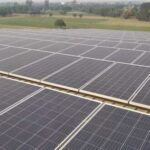
Solar cells, which turn sunlight into electricity, have long been advocated as a source of renewable energy. Even though individual cells are relatively tiny, when they are combined to form modules, they can be utilized to power lights and recharge batteries. They may eventually serve as a building’s main source of energy.
However, compared to more conventional power sources, solar cells that are now on the market are more expensive to manufacture since they utilize silicon.
That is where the perovskite solar cells, a relatively recent addition to science, come in. Their crystalline structure, located at the core of a solar cell, similarly transforms light into electricity, but at a considerably less expensive rate than silicon.
But, can we achieve higher efficiencies with perovskite cells? And can they be the future of the solar industry? Let us explore perovskite solar panels and how they might energize our future.
What is perovskite?
A group of substances known as perovskites shares a characteristic crystal structure with the mineral of the same name, which was first found in Russia in 1839. The name Perovskite, which comes from the name of Lev Perovski, a mineralogist, was given to a substance known as calcium titanium oxide. Although calcium titanium oxide is not one of the perovskite chemicals used to create solar cells, they do have a similar crystalline structure.
Perovskites come in many different forms, but the ones that are most intriguing to the solar business are crystals made of organic and inorganic molecules joined to lead or tin atoms.
It has a grid of 8-sided molecules called lead halides. A lead halide is an atom of lead connected to 6 halogen atoms of either iodine, chlorine, or bromine. This lead halide structure then surrounds a smaller molecule called a methylammonium cation.
How are perovskite solar cells made?
A perovskite solar cell is a particular kind of solar cell that uses an organic-inorganic hybrid material based on lead or tin halide as the light-harvesting active layer. Methylammonium lead halides, for example, are inexpensive and relatively easy to make into perovskite materials.
Perovskites are particularly attractive materials for solid-state solar cells because of their inherent features, which include a broad absorption spectrum, quick charge separation, long transport distances for electrons and holes, long carrier separation lifetime, and more.
Advantages of perovskite solar cells
Perovskite solar cells show promise in terms of high efficiency. Because of the wide bandgap, the conversion efficiency of perovskite-based solar cells is higher when compared to their silicon and cadmium counterparts.
Furthermore, the ability of perovskite PVs to react to different light wavelengths allows them to convert more of the sunlight that falls on their surface into power. This gives them a significant edge over conventional solar technology.
Perovskite solar cells are easy to manufacture, flexible, lightweight, and easy to install. Researchers and electronics designers are confident that such properties will enable solar cells to be used in a wide variety of new applications.
Drawbacks of perovskite solar cells
Perovskite solar cells can replace silicon-based solar cells because of their low manufacturing costs and high device efficacy, but they also have several significant drawbacks. Toxicology and stability of the perovskite material are two significant obstacles that must be removed before it can be widely commercialized. Concerns about the environment arise from the use of poisonous solvents in perovskite.
The hazardous solvents involved in manufacturing adversely impact health and the environment. In addition to being poisonous, perovskite solar cells’ long-term stability is a significant obstacle to realizing their tremendous potential.
These organic-inorganic hybrid perovskite solar cells, which have high efficiency, are extremely sensitive to moisture in the surrounding air. Moisture causes the perovskite coating to degrade, which results in material degradation and the loss of photovoltaic properties.
Future of perovskite solar cells
While major challenges do exist, perovskite solar cells are still promoted as the PV technology of the future, and much development work and research are invested in making this a reality. Scientists and businesses are attempting to improve effectiveness and stability, extend longevity, and substitute safer materials for harmful ones.
Scientists in Germany came up with a solution to eliminating the use of toxic solvents in the production of perovskite solar cells, replacing them with an eco-friendlier material called dimethyl sulfoxide (DMSO). With DMSO as the sole solvent, the team successfully showed a scalable blade coating method and achieved cell efficiencies that were comparable to those attained with more hazardous materials.