
For an industrial facility, deciding the right solar PV plant capacity is an important step before starting a solar energy installation. A plant that is too small may not provide enough electricity savings, while an oversized system may not make the best use of available space, investment, or permitted grid-export capacity.
The optimum capacity is therefore not simply the maximum number of solar panels that can fit on a factory roof. It should be determined by studying electricity consumption, load profile, available area, tariff structure, solar resource, grid connection, applicable regulations, and the customer’s financial objectives.
For industrial and commercial consumers, proper capacity planning can help reduce electricity costs while improving the long-term value of the solar installation cost.
1. Analyse the Industrial Facility’s Electricity Consumption
The first step is to understand how much electricity the facility actually consumes.
Collect at least 12 months of electricity bills, if available, and examine:
- Monthly energy consumption
- Maximum demand
- Contract demand
- Electricity tariff
- Peak and off-peak consumption
- Power factor
- Existing rooftop or ground-mounted solar generation
- Export or net-metering information, where applicable
Monthly consumption provides a useful starting point, but annual consumption alone is not enough. An industrial facility may consume large amounts of electricity during certain operating hours or production seasons.
2. Study the Load Profile
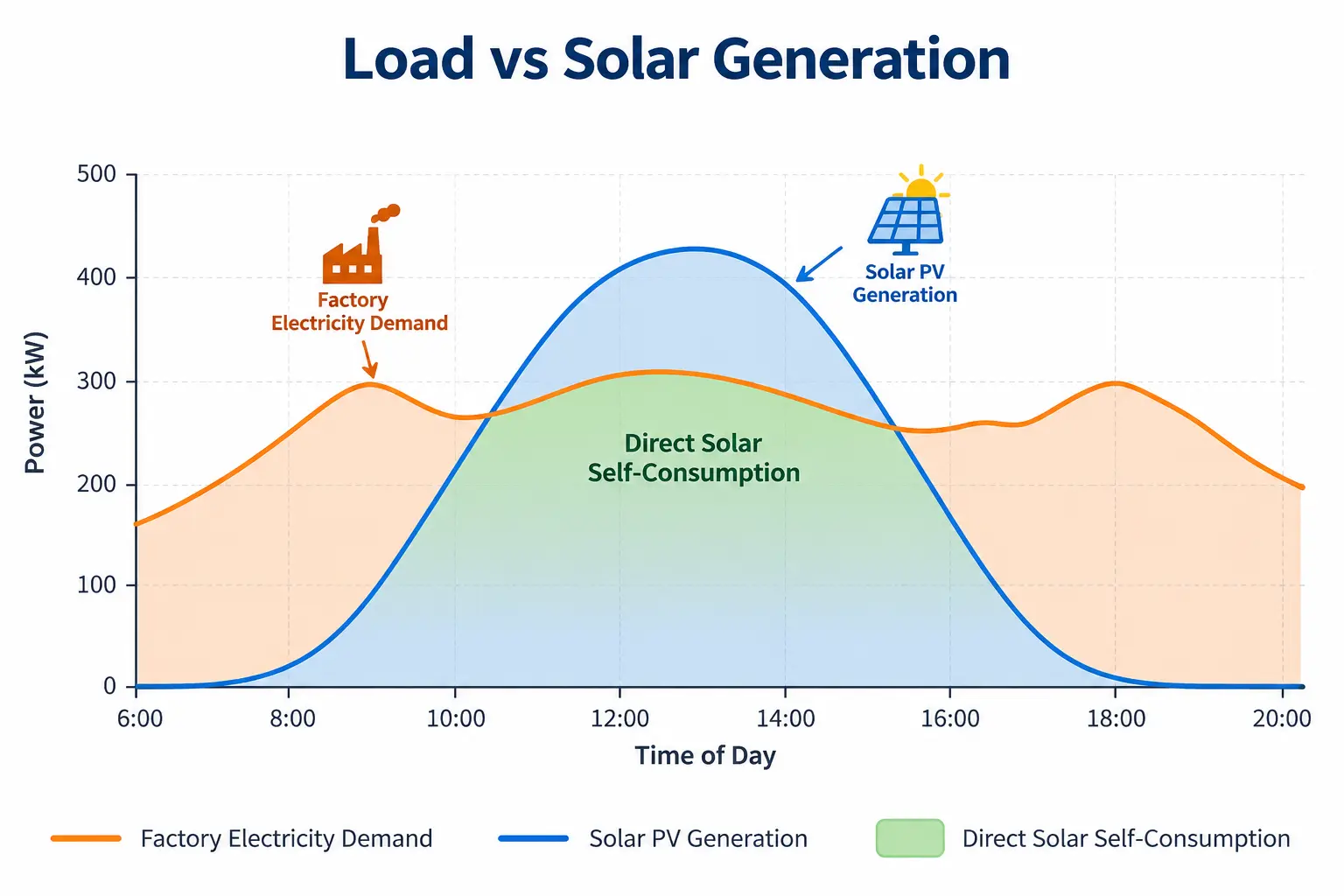
The load profile shows when electricity is being consumed.
For example, a factory operating mainly from 9 AM to 6 PM may have strong daytime consumption that matches solar generation. Another facility operating continuously for 24 hours may have a different requirement.
Compare:
- Industrial Load Profile ↔ Solar Generation Profile
The closer these two profiles are, the greater the opportunity for direct consumption of solar electricity.
A load profile should ideally be studied using interval data such as 15-minute or 30-minute readings, where available.
3. Determine the Available Installation Area
The next consideration is the space available for the PV plant.
For a rooftop project, inspect:
- Roof area
- Roof orientation
- Structural condition
- Shading
- Roof obstructions
- Maintenance access
- Fire and safety pathways
For a ground-mounted project, consider:
- Available land
- Topography
- Soil conditions
- Shading
- Access roads
- Drainage
- Evacuation infrastructure
- Land-use restrictions
The usable area, rather than the total area, should be considered for capacity estimation.
4. Estimate the Solar PV Capacity
Once the usable area has been established, the approximate plant capacity can be estimated using the selected module technology, module wattage, row spacing, access requirements, and mounting arrangement.
A simplified approach is:
- Estimated Capacity = Usable Area ÷ Area Required per kW
However, this is only an initial estimate. Detailed engineering should consider module dimensions, mounting configuration, shading, spacing, setbacks, cable routes, inverter arrangement, and safety requirements.
The final capacity should therefore be confirmed through a proper site survey and engineering design.
5. Compare Solar Generation with Energy Consumption
The expected annual solar generation should be compared with the facility’s annual electricity consumption.
For example, if a facility consumes significantly more electricity than the proposed PV plant can generate, there may be scope for a larger system—provided that space, grid, regulatory, and financial conditions permit it.
However, the objective should not automatically be to maximize installed capacity.
The more important question is:
“How much solar electricity can the facility effectively use or export under the applicable arrangement?”
6. Consider Self-Consumption
Self-consumption is particularly important for industrial solar projects.
If the factory is consuming electricity while the PV system is generating it, solar power can directly reduce electricity purchased from the grid.
A simplified energy flow is:
- PV Generation → Factory Loads → Reduced Grid Consumption
A system designed around strong daytime industrial demand can therefore provide significant value.
If generation frequently exceeds facility demand, surplus electricity may need to be exported, stored, curtailed, or managed according to the applicable electricity arrangement.
7. Check Grid and Regulatory Requirements
The optimum capacity is also influenced by the permitted grid connection and applicable regulations.
The project developer should verify requirements related to:
- Net metering or other applicable arrangements
- Open access, where applicable
- Captive or group-captive structures
- Grid connectivity
- Maximum export
- Synchronization
- Protection systems
- Metering
- DISCOM or utility approvals
These requirements can differ depending on the state, project category, voltage level, and system configuration.
Therefore, regulatory feasibility should be checked before finalizing the plant size.
8. Evaluate Roof and Structural Conditions
For rooftop industrial solar, structural assessment is essential.
The roof should be evaluated for:
- Load-bearing capacity
- Existing structural condition
- Corrosion
- Roof age
- Waterproofing
- Wind loading
- Mounting requirements
There is little value in selecting a large PV capacity if the available roof cannot safely support the proposed installation.
9. Consider the Financial Objective
The optimum capacity should also make commercial sense.
The assessment can consider:
- Solar installation cost
- Expected annual generation
- Electricity tariff
- Self-consumption
- Export value
- Operation and maintenance cost
- Financing cost
- Payback period
- Return on investment
- Project life
For many industrial consumers, a capacity that provides strong daytime self-consumption may offer a better financial outcome than simply installing the largest possible plant.
10. Consider Future Electricity Demand
Industrial facilities may expand production, add machinery, or increase operating hours. Therefore, the capacity study should consider expected future electricity consumption.
For example:
- Current Load → Planned Expansion → Future Load → Solar Capacity
A future-oriented approach can prevent the PV system from becoming undersized soon after installation.
However, future demand should be based on realistic expansion plans rather than uncertain assumptions.
11. Use a Detailed Energy and Financial Model
The final capacity should ideally be evaluated using an energy model.
Different capacities can be compared, such as:
- 1 MW vs 2 MW vs 3 MW vs 5 MW
For each option, evaluate:
- Annual solar generation
- Self-consumption
- Grid import reduction
- Exported energy
- Investment
- Operating cost
- Savings
- Payback
- Long-term financial return
The optimum capacity is the option that provides the best combination of technical feasibility, energy utilization, financial performance, and regulatory compliance.
Simplified Capacity Selection Process
A practical industrial assessment can follow this sequence:
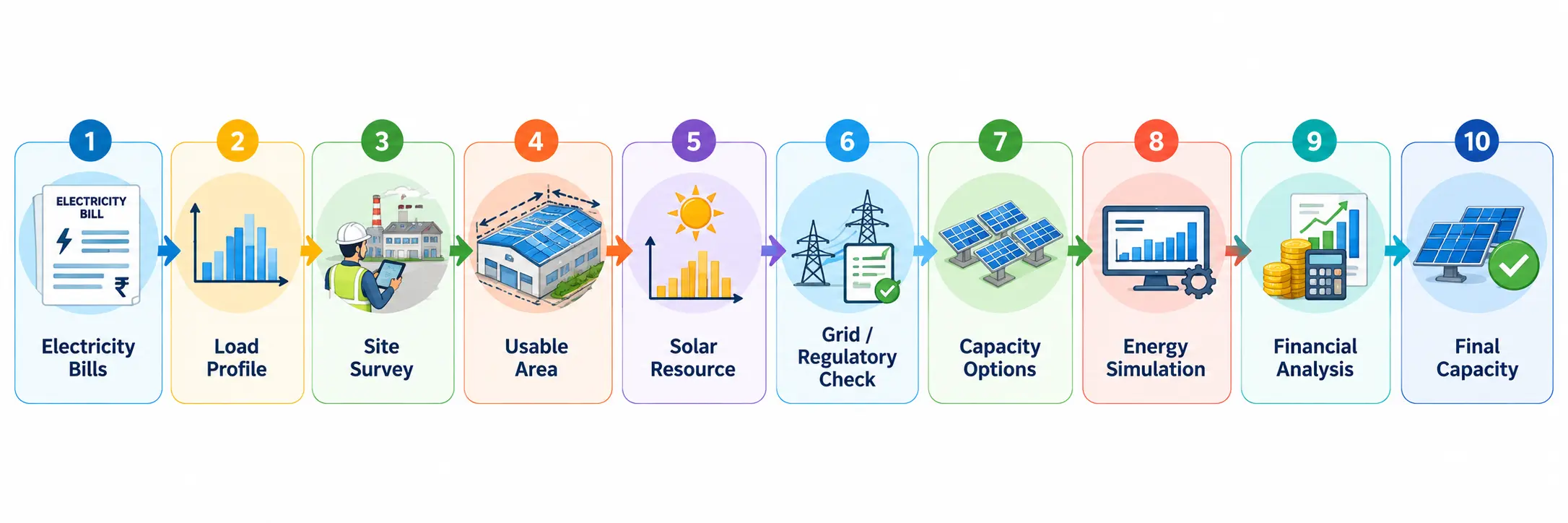
This process helps prevent capacity decisions based only on available roof area or module quantity.
Key Factors to Consider
Before finalizing an industrial solar plant, check:
- Annual electricity consumption
- Daytime load
- Maximum demand
- Available roof/land
- Shading
- Solar irradiation
- Structural feasibility
- Grid connection
- Export limitations
- Applicable regulations
- Investment budget
- Future expansion
- Expected savings
- Operation and maintenance requirements
Conclusion
Determining the optimum solar plant capacity for an industrial facility requires much more than calculating how many solar panels can fit on a roof. The decision should begin with a detailed understanding of electricity consumption and the facility’s load profile, followed by assessment of usable installation area, solar resource, structural conditions, grid connectivity, applicable regulations, financial objectives, and future expansion plans.
For industrial and C&I consumers, matching solar generation with daytime electricity demand is particularly important because greater self-consumption can increase the value of the generated solar electricity. At the same time, export arrangements, grid limitations, battery storage, and regulatory requirements must be considered before selecting the final capacity.
A structured approach, load analysis, site survey, capacity estimation, energy modelling, regulatory assessment, and financial evaluation, allows different capacity options to be compared objectively. This helps the customer avoid both an undersized system that cannot meet the desired energy requirements and an oversized system that may not provide the expected financial value.
Whether the project involves rooftop solar for a factory or a larger ground-mounted solar plant, the final capacity should be based on actual project conditions rather than a standard formula. Proper sizing supports efficient use of the available investment, improves renewable-energy utilization, and helps control the overall solar installation cost and long-term solar energy installation cost.
Ultimately, the right industrial PV system is not necessarily the biggest one. It is the one that achieves the best balance between energy demand, solar generation, self-consumption, available space, grid conditions, investment, and long-term financial performance. Careful capacity planning therefore forms the foundation of a reliable and economically effective solar energy project for industrial facilities.
FAQs
Q1. How is the optimum solar capacity for an industrial facility determined?
Ans: It is determined by analysing electricity consumption, load profile, available installation area, solar resource, grid arrangements, regulations, financial objectives, and future demand.
Q2. Should an industrial facility install the maximum possible solar capacity?
Ans: Not necessarily. The most suitable capacity is the one that provides the best combination of energy utilization, financial return, technical feasibility, and regulatory compliance.
Q3. Why is the industrial load profile important?
Ans: It shows when electricity is consumed and helps determine how much solar generation can be directly used by the facility.
Q4. Can rooftop area alone determine solar plant capacity?
Ans: No. Usable roof area is only one factor. Structural capacity, shading, access pathways, mounting arrangement, electrical infrastructure, and safety requirements must also be considered.
Q5. Does future expansion affect solar plant sizing?
Ans: Yes. Expected increases in production or electricity consumption can be considered when evaluating the appropriate capacity.
PV System Maintenance Tools & Equipment Guide
A complete guide to performing the solar PV anti-islanding test, ensuring safe grid-connected operation, regulatory compliance, and reliable inverter performance.
Yes, I Have Installed an Optimized Solar PV Rooftop System at My Premises
A solar power generating system converts sunlight into electricity for residential, industrial, and commercial use. This blog explains the components, working, and benefits of solar systems, helping you understand how to harness solar energy efficiently and sustainably.
Solar PV Mounting Structures: Types & Installation Guide
A complete guide to solar mounting structures types in PV systems, covering fixed tilt, tracking, and rooftop installations for installers.
AC Combiner Box Installation in Solar PV Systems Guide
A step-by-step guide to AC combiner box installation in solar PV systems, covering setup, wiring, and safety best practices.
Different Types of Solar Photovoltaic Systems: Complete Guide
Earthing and lightning protection are critical safety components in solar PV installations. This guide explains their importance, types, components, and best practices for solar installers.
China’s Solar Industry Poised for Continued Growth in 2023 and Beyond
China’s solar industry is set for continued growth in 2023 and beyond, driving global renewable energy expansion and technological advancements.
Unintentional Islanding Test for Solar PV Systems
A complete guide to performing the solar PV anti-islanding test, ensuring safe grid-connected operation, regulatory compliance, and reliable inverter performance.
How Azimuth Angle Impacts Solar Panel Efficiency for Homes, Industries, and Commercial Buildings
Discover how solar panel azimuth impacts energy generation in homes, industries, and commercial buildings. Maximize efficiency with correct orientation.