
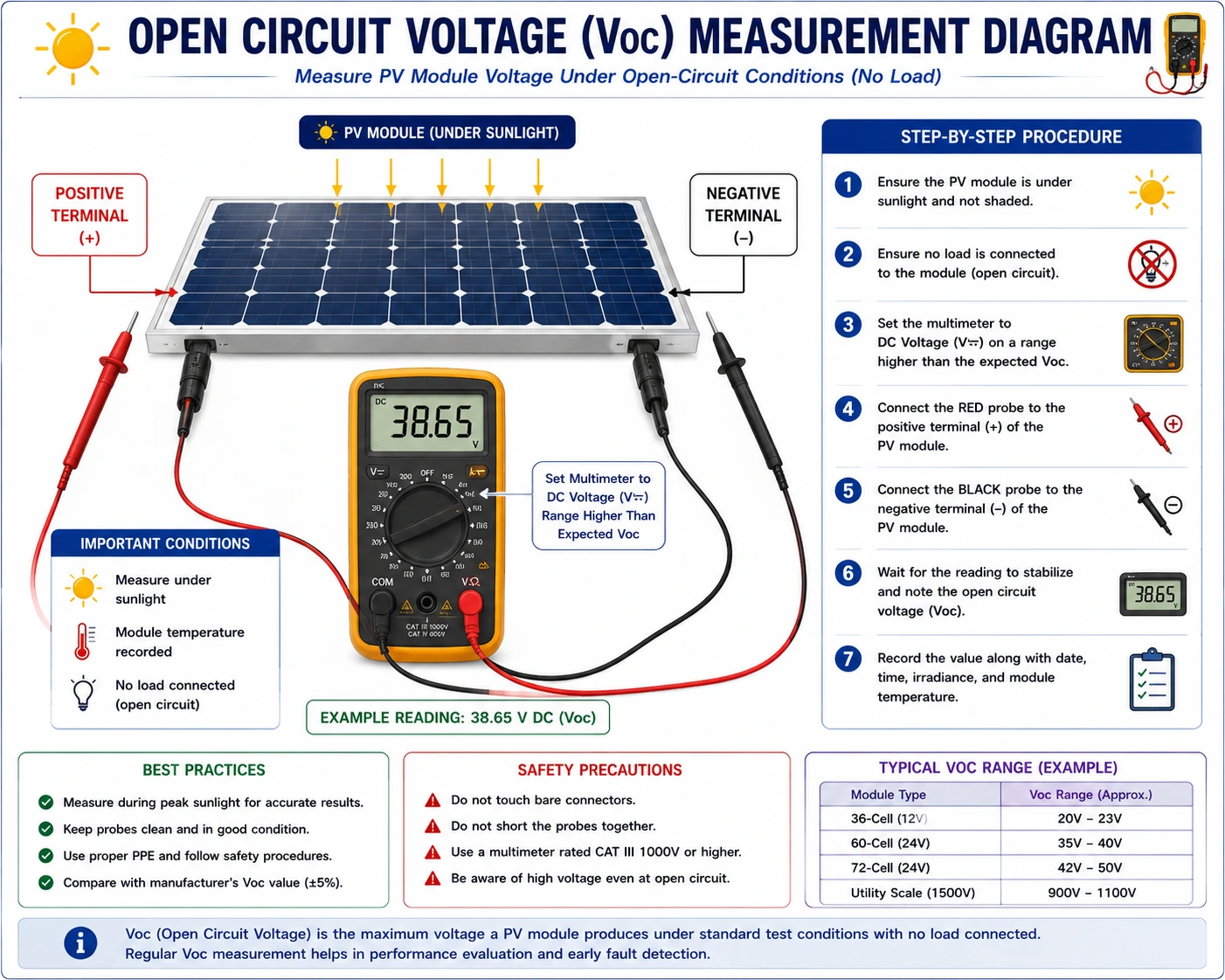
Open Circuit Voltage (Voc) is one of the most important electrical parameters measured during the installation, commissioning, inspection, troubleshooting, and maintenance of solar photovoltaic (PV) systems. It represents the maximum voltage produced by a solar PV module or string when no electrical load is connected to the circuit. Measuring Voc helps verify proper module operation, detect wiring errors, identify faulty modules, and confirm that the solar array is performing according to the manufacturer’s specifications.
Whether in residential rooftop systems, commercial solar installations, industrial plants, or utility-scale solar farms, regular measurement of open-circuit voltage is an essential preventive maintenance practice. It allows solar installers, commissioning engineers, EPC contractors, and operations and maintenance (O&M) professionals to identify abnormalities before they develop into major system failures. A significant deviation from the expected Voc value may indicate issues such as damaged modules, loose connections, incorrect string configuration, shading, or degradation.
Since solar PV systems generate direct current (DC) electricity whenever sunlight is available, measuring Voc requires strict adherence to electrical safety procedures. Using calibrated instruments, following manufacturer guidelines, and recording test results accurately are essential for obtaining reliable measurements and ensuring safe work practices.
Measuring open-circuit voltage is a fundamental test carried out during commissioning and maintenance to verify the electrical health and performance of solar PV modules and strings.
This comprehensive guide explains the meaning of open circuit voltage, factors affecting Voc, required tools, testing procedures, interpretation of results, safety precautions, and industry best practices.
What is Open Circuit Voltage (Voc)?
Open Circuit Voltage (Voc) is the voltage available at the terminals of a solar PV module or string when no load is connected and no current is flowing.
It represents the highest voltage the module can produce under existing environmental conditions.
Voc is typically specified by the manufacturer under Standard Test Conditions (STC), which include:
- Solar irradiance of 1000 W/m²
- Cell temperature of 25°C
- Air mass (AM) of 1.5
Actual field measurements may differ from STC values because environmental conditions vary.
Why is Measuring Open Circuit Voltage Important?
Voc measurement provides valuable information about the condition of the PV system.
It helps:
- Verify correct installation
- Detect faulty modules
- Identify wiring errors
- Confirm string configuration
- Support preventive maintenance
- Improve the renewable solar system reliability
- Assist in troubleshooting
- Validate commissioning results
Routine Voc measurements help prevent unexpected system failures.
Factors Affecting Open Circuit Voltage
Several environmental and operational factors influence Voc.
These include:
- Solar irradiance
- Module temperature
- Module age
- Cell degradation
- Partial shading
- Manufacturing tolerances
- Loose electrical connections
- Cable resistance
Understanding these factors is essential for accurate interpretation.
Typical Open Circuit Voltage Values
Voc varies depending on:
- Module technology
- Number of cells
- Manufacturer
- System design
For example:
PV Module Type | Typical Voc Range |
36-cell module | 20–23 V |
60-cell module | 36–40 V |
72-cell module | 44–50 V |
For strings, the total Voc is approximately the sum of the Voc values of all series-connected modules, adjusted for environmental conditions.
Always compare measured values with manufacturer specifications.
Tools Required for Measuring Voc
Proper testing requires suitable equipment.
Common tools include:
- Digital multimeter (DC voltage range)
- PV analyzer
- Clamp meter (for additional testing)
- Inspection checklist
- Temperature sensor
- Pyranometer (optional for irradiance measurement)
- Personal protective equipment (PPE)
Use calibrated instruments for accurate results.
Personal Protective Equipment (PPE)
Technicians should wear:
- Safety helmet
- Electrical insulating gloves
- Safety glasses
- Safety shoes
- Arc-rated protective clothing is required where
Safety is critical because PV modules generate voltage whenever exposed to sunlight.
Step-by-Step Procedure for Measuring Open Circuit Voltage
Step 1 – Review System Documentation
Before beginning:
Review:
- Electrical drawings
- Single-line diagrams
- Manufacturer specifications
- Previous inspection reports
This helps determine expected Voc values.
Step 2 – Verify Safe Working Conditions
Ensure:
- Good weather
- Safe rooftop access
- Proper fall protection
- Suitable lighting
- Electrical safety procedures are in place
Step 3 – Perform Visual Inspection
Inspect:
- PV modules
- DC cables
- Connectors
- Junction boxes
- Combiner boxes
Look for:
- Cracks
- Loose connectors
- Corrosion
- Damaged insulation
- Burn marks
Correct visible defects before electrical testing.
Step 4 – Isolate the Circuit
Disconnect the module or string according to approved procedures so that no electrical load is connected.
This creates the open-circuit condition required for measurement.
Follow lockout/tagout procedures where applicable.
Step 5 – Set the Multimeter
Configure the digital multimeter to measure:
- DC Voltage
Select an appropriate voltage range based on the expected system voltage.
Step 6 – Connect the Test Leads
Connect:
- Red probe to the positive terminal
- Black probe to the negative terminal
Ensure firm contact with the terminals. Avoid short-circuiting the conductors.
Step 7 – Record the Open Circuit Voltage
Read the displayed voltage.
Record:
- Voc value
- Module or string identification
- Date
- Time
- Weather conditions
- Irradiance (if measured)
- Module temperature
Documentation is essential for future comparisons.
Step 8 – Compare Results with Expected Values
Compare measured Voc with:
- Manufacturer specifications
- Design documents
- Previous maintenance records
Small variations are normal due to environmental conditions. Large deviations require further investigation.
Step 9 – Investigate Abnormal Results
Low Voc may indicate:
- Damaged cells
- Loose connectors
- Wiring errors
- Partial shading
- Moisture ingress
- Module degradation
Higher-than-expected values may result from:
- Very low module temperatures
- Incorrect string configuration
Further testing may be necessary.
Step 10 – Complete Documentation
Update the maintenance logbook with:
- Test results
- Observations
- Corrective actions
- Technician details
- Recommendations
Accurate records support preventive maintenance.
Common Causes of Low Open Circuit Voltage
Reduced Voc may result from:
- Cracked PV modules
- Cell degradation
- Loose electrical connections
- Incorrect wiring
- Corrosion
- Faulty connectors
- Water ingress
- Excessive shading
Prompt corrective action minimizes energy losses.
Conclusion
Measuring open circuit voltage is a fundamental electrical test that plays a vital role in the installation, commissioning, preventive maintenance, and troubleshooting of solar PV systems. Accurate Voc measurements help verify system integrity, identify electrical faults, confirm proper string configuration, and ensure that PV modules operate according to design specifications. Regular voltage testing also supports preventive maintenance by enabling early detection of degradation, loose connections, and damaged components before they significantly impact system performance.
Routine measurement of open-circuit voltage is an essential practice for solar installers, commissioning engineers, EPC contractors, and operations and maintenance professionals. Furthermore, following technical recommendations and electrical safety practices promoted by the Ministry of New and Renewable Energy, together with manufacturer guidelines, helps ensure safe, standards-compliant, and accurate testing of renewable solar systems.
By using calibrated instruments, maintaining detailed test records, considering environmental conditions during analysis, following safe testing procedures, and addressing abnormal voltage readings promptly, solar professionals can optimize solar panel system cost, maximize renewable solar system reliability, improve long-term energy generation, and ensure the continued success of residential, commercial, industrial, and utility-scale solar energy projects.
FAQs
Q1. What is the open-circuit voltage (Voc) in a solar PV module?
Ans: Open circuit voltage (Voc) is the maximum voltage produced by a solar PV module or string when no electrical load is connected and no current is flowing.
Q2. Why is measuring Voc important?
Ans: Measuring Voc helps verify correct installation, detect faulty modules, identify wiring errors, confirm string configuration, and assess the electrical health of the solar PV system.
Q3. Which instrument is commonly used to measure open-circuit voltage?
Ans: A calibrated digital multimeter set to the DC voltage range is the most commonly used instrument. PV analyzers may also be used for advanced testing.
Q4. Why can measured Voc differ from the manufacturer’s rated value?
Ans: The manufacturer’s rating is specified under Standard Test Conditions (STC). Actual field measurements vary depending on solar irradiance, module temperature, weather conditions, module age, and installation environment.
Q5. What should be recorded during a Voc test?
Ans: Technicians should record the measured Voc, module or string identification, date, time, weather conditions, irradiance (if measured), module temperature, observations, technician details, and any corrective actions in the maintenance logbook.
Single Line Diagram (SLD) in Solar PV Systems: Complete Guide to Design, Symbols & Reading
Learn how to fetch a Bill of Material (BOM) for a solar PV system directly from design documents like SLD, layout, and GA drawings. This step-by-step guide helps installers and EPCs ensure accurate material estimation and efficient project execution.
How to Calculate Savings from Rooftop Solar Solutions: A Complete Guide
Calculating savings from rooftop solar solutions is essential for planning your investment. This guide explains how to estimate cost reduction, return on investment, and long-term financial benefits for residential, commercial, and industrial solar projects.

Solar Panel Cleaning Guide for Maximum Performance
A complete guide on how to clean solar PV modules, including safe cleaning techniques, recommended tools, maintenance schedules, and best practices to maximize energy output.
Solar Module Support & Racking Frame Installation
A practical guide to solar racking frame installation, covering module support structures, alignment, and best practices for reliable PV systems.
Hazard Mitigation Measures for Solar PV Systems
A complete guide to mitigation measures after hazards occur in solar PV systems, covering emergency response, hazard control, incident reporting, corrective actions, and follow-up inspections.

500 kW Solar Power Plant Cost in UP 2025 | Latest Price, Subsidy & ROI
Thinking of setting up a 500 kW solar power plant in Uttar Pradesh? Discover the 2025 cost estimate, available subsidies, and expected ROI. Learn how commercial and industrial projects in UP can reduce energy expenses and achieve long-term savings with solar energy.
India Solar Energy Policies: Key Updates and Government Initiatives
India is one of the leading countries in terms of solar energy development, having become the fastest-growing market for solar power globally.
How to Monitor Power Generation in Solar PV Systems
A complete guide to measuring short circuit current (Isc) in solar PV systems, including testing methods, safety guidelines, and performance evaluation for accurate system assessment.