
Cables, connectors, and switches form the electrical backbone of every solar photovoltaic (PV) system. They ensure the safe and efficient transmission of electricity from solar PV modules to inverters, battery banks, combiner boxes, distribution panels, and ultimately to the electrical load or utility grid. Although solar panels and inverters often receive the most attention, the overall performance and safety of a renewable solar system heavily depend on the condition of its electrical wiring and switching components.
Over time, environmental exposure, UV radiation, moisture, dust, temperature fluctuations, corrosion, rodents, vibration, and improper installation can degrade cables, connectors, and switches. Damaged insulation, loose terminals, corroded connectors, overheated switchgear, or faulty disconnect switches can result in power losses, reduced system efficiency, equipment damage, electrical faults, arc flash hazards, and even fire.
Routine inspection and preventive maintenance help identify these issues before they affect system performance. Proper maintenance ensures reliable power transmission, reduces downtime, extends equipment lifespan, and maintains compliance with electrical safety standards and manufacturer recommendations.
Regular inspection and maintenance of cables, connectors, and switches are essential activities during the operation and maintenance (O&M) of solar PV systems to ensure long-term safety, reliability, and efficient solar electricity generation.
This comprehensive guide explains the importance of maintaining cables, connectors, and switches, inspection procedures, testing methods, required tools, documentation practices, safety precautions, and industry best practices.
Importance of Cables, Connectors, and Switches in Solar PV Systems
These components perform essential functions within a solar PV installation.
Solar Cables
Carry DC and AC electrical power between system components.
Connectors
Provide secure electrical connections between PV modules and other equipment.
Switches
Enable safe isolation, protection, maintenance, and emergency shutdown of electrical circuits.
Failure of any of these components can interrupt solar electricity generation and compromise system safety.
Why is Maintenance Important?
Routine maintenance helps to:
- Prevent electrical failures
- Improve renewable solar system efficiency
- Reduce energy losses
- Detect insulation damage
- Prevent overheating
- Extend equipment lifespan
- Improve electrical safety
- Reduce maintenance costs
Preventive maintenance minimizes unexpected system downtime.
Components Covered During Maintenance
Routine inspections should include:
- DC solar cables
- AC power cables
- PV module connectors
- MC4 connectors
- Battery cables
- Combiner box connections
- DC isolator switches
- AC disconnect switches
- Circuit breakers
- Distribution panel connections
Each component should be inspected according to manufacturer recommendations.
Common Problems Found During Inspection
Routine maintenance may identify:
- Loose cable terminations
- Damaged insulation
- UV degradation
- Corrosion
- Moisture ingress
- Burn marks
- Cracked connectors
- Overheated switches
- Rodent damage
- Incorrect cable routing
Early detection helps avoid costly failures.
Causes of Cable and Connector Failures
Electrical components may deteriorate because of:
- Poor installation
- Incorrect cable sizing
- Mechanical stress
- Excessive bending
- UV exposure
- Water ingress
- Loose terminals
- High operating temperatures
- Chemical contamination
- Aging
Understanding these causes helps improve maintenance planning.
Tools Required for Maintenance
Common inspection tools include:
- Digital multimeter
- Clamp meter
- Insulation resistance tester
- Continuity tester
- Infrared thermal camera
- Torque wrench
- Cable identification labels
- Cleaning brush
- Contact cleaner
- Personal protective equipment (PPE)
Use calibrated testing instruments for accurate measurements.
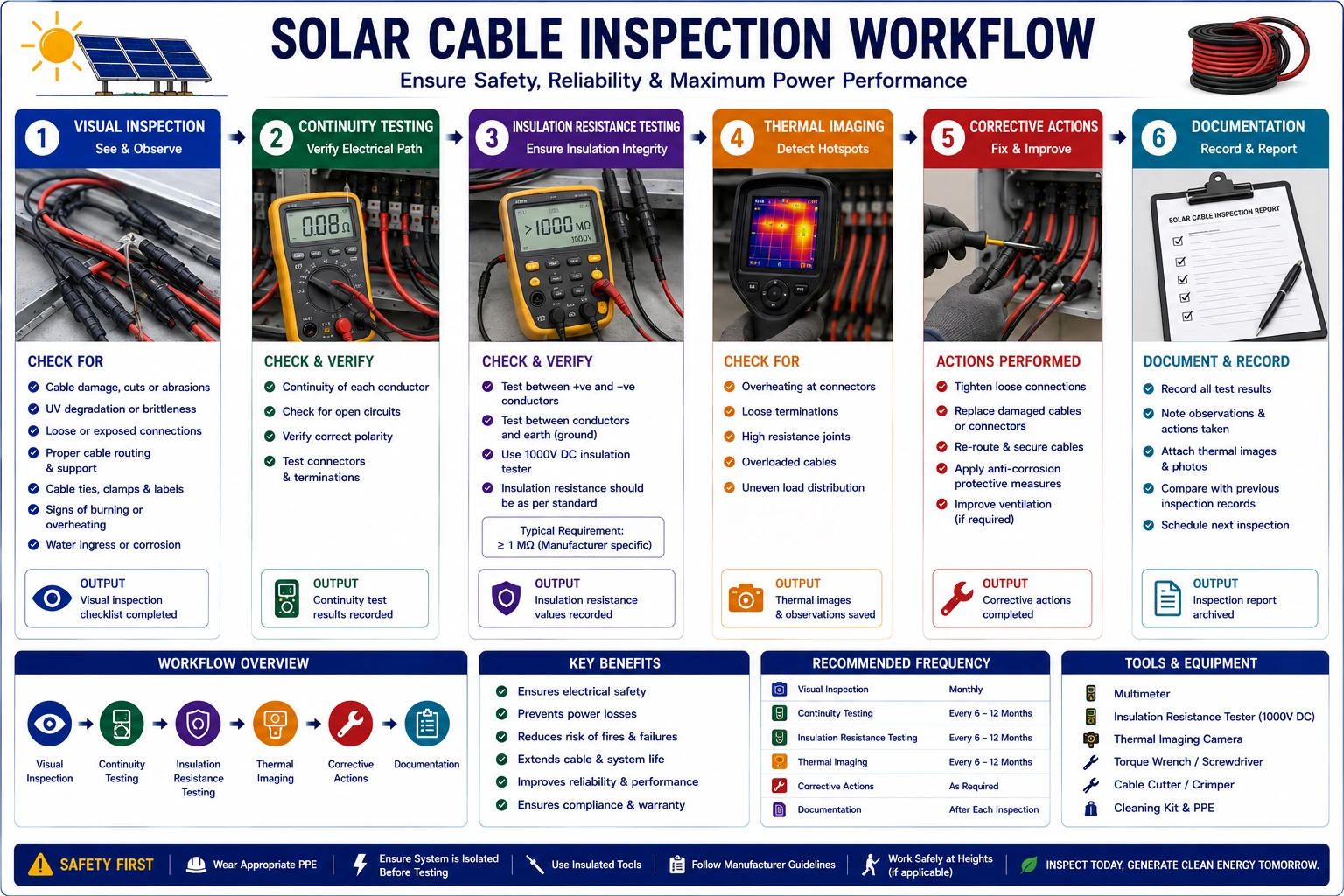
Step-by-Step Maintenance Procedure
Step 1 – Review Maintenance Records
Before inspection:
Review:
- Previous inspection reports
- Fault history
- Electrical drawings
- Manufacturer recommendations
Historical records assist fault diagnosis.
Step 2 – Ensure Safe Working Conditions
Verify:
- Safe weather
- Proper PPE
- Safe access
- Electrical isolation where necessary
Follow lockout/tagout procedures before working on de-energized circuits.
Step 3 – Perform Visual Inspection
Inspect:
- Cable insulation
- Connectors
- Switches
- Junction boxes
- Combiner boxes
Look for:
- Cracks
- Cuts
- Abrasion
- Corrosion
- Loose fittings
- Moisture
- Burn marks
Document all observations.
Step 4 – Inspect Cable Routing
Verify:
- Proper support
- Secure fastening
- Correct bend radius
- Separation from sharp edges
- Protection against rodent damage
Improper cable routing can reduce cable life.
Step 5 – Check Cable Identification
Ensure all cables are:
- Clearly labeled
- Properly color-coded
- Easy to identify
- Consistent with electrical drawings
Correct labeling improves maintenance efficiency.
Step 6 – Inspect Electrical Connections
Check:
- Connector tightness
- Terminal torque
- Corrosion
- Oxidation
- Contact quality
Loose connections increase electrical resistance and heat generation.
Step 7 – Perform Electrical Testing
Measure:
- Cable continuity
- Insulation resistance
- Voltage drop (where applicable)
- Earth continuity
Compare measurements with design specifications.
Step 8 – Perform Thermal Inspection
Use an infrared thermal camera to inspect:
- Cable joints
- Connectors
- Switches
- Circuit breakers
Hotspots often indicate loose or overloaded connections.
Step 9 – Inspect Switches
Verify operation of:
- DC isolator switches
- AC disconnect switches
- Circuit breakers
- Changeover switches
Ensure smooth operation without excessive wear or overheating.
Step 10 – Clean and Tighten Components
Clean:
- Dust
- Dirt
- Oxidation
Tighten electrical terminals according to the manufacturer’s specified torque values. Never overtighten electrical connections.
Step 11 – Replace Damaged Components
Replace immediately if any component shows:
- Severe corrosion
- Melted insulation
- Burn marks
- Broken connectors
- Cracked switch housings
- Excessive wear
Use only manufacturer-approved replacement parts.
Step 12 – Record Maintenance Activities
Document:
- Inspection results
- Electrical measurements
- Components replaced
- Corrective actions
- Technician details
Maintain complete maintenance records.
Preventive Maintenance Activities
Routine maintenance includes:
- Cleaning connectors
- Tightening terminals
- Inspecting insulation
- Continuity testing
- Thermal imaging
- Switch operation testing
- Cable identification verification
- Replacement of damaged components
Preventive maintenance improves long-term system reliability.
Recommended Maintenance Frequency
General recommendations include:
Maintenance Activity | Typical Frequency |
Visual inspection | Monthly |
Electrical inspection | Every 6 months |
Thermal inspection | Annually |
Continuity testing | Annually |
Comprehensive maintenance | Annually |
Always follow manufacturer recommendations.
Benefits of Routine Maintenance
Improved Renewable Solar System Efficiency
Healthy electrical connections minimize energy losses.
Better Safety
Routine inspections reduce electrical hazards and fire risks.
Reduced Downtime
Early fault detection minimizes unexpected failures.
Longer Equipment Lifespan
Proper maintenance extends the service life of cables, connectors, and switches.
Lower Maintenance Costs
Preventive maintenance reduces expensive emergency repairs.
Conclusion
Cables, connectors, and switches are essential electrical components that ensure the safe and efficient transfer of power throughout a solar PV system. Regular inspection and preventive maintenance help identify loose connections, damaged insulation, corrosion, overheating, moisture ingress, and other issues before they lead to equipment failure or reduced system performance. By maintaining clean, secure, and properly tested electrical connections, technicians can improve system reliability, minimize downtime, and maximize long-term energy generation.
Routine maintenance of cables, connectors, and switches is a fundamental responsibility of solar installers, commissioning engineers, EPC contractors, and operations and maintenance professionals. Furthermore, following technical recommendations and safety practices promoted by the Ministry of New and Renewable Energy, together with manufacturer guidelines, helps ensure safe, standards-compliant, and efficient operation of renewable solar systems.
By implementing preventive maintenance schedules, using calibrated testing instruments, performing thermal inspections, maintaining detailed inspection records, and replacing damaged components promptly, solar professionals can optimize solar panel system cost, improve renewable solar system reliability, maximize solar electricity generation, reduce the cost of solar per kWh installed, and ensure the long-term success of residential, commercial, industrial, and utility-scale solar energy projects.
FAQs
Q1. Why is maintenance of cables, connectors, and switches important in a solar PV system?
Ans: Routine maintenance helps prevent electrical faults, reduce energy losses, improve safety, extend equipment lifespan, and ensure reliable operation of the solar PV system.
Q2. What should be checked during cable and connector inspections?
Ans: Technicians should inspect cable insulation, connector condition, terminal tightness, corrosion, burn marks, moisture ingress, cable routing, labeling, and overall mechanical condition.
Q3. How can overheating in electrical connections be detected?
Ans: Infrared thermal imaging is one of the most effective methods for identifying hotspots caused by loose terminals, overloaded circuits, poor connections, or damaged components.
Q4. How often should cables, connectors, and switches be inspected?
Ans: Visual inspections are generally recommended monthly, while detailed electrical inspections, continuity testing, thermal imaging, and comprehensive preventive maintenance should be carried out according to the manufacturer’s recommendations and maintenance schedule.
Q5. What are the most common causes of cable and connector failure?
Ans: Common causes include UV exposure, loose electrical connections, corrosion, moisture ingress, mechanical damage, incorrect cable sizing, poor installation practices, rodent damage, excessive heat, and aging.
Solar PV String Voltage and Current Measurement Guide
A complete guide to DC voltage and current testing for solar PV strings and arrays, ensuring accurate performance verification during commissioning.

How to Assess Solar PV Array Location for Maximum Energy
A complete guide to battery bank enclosure and rack installation, including site verification, setup procedures, and safety practices for solar PV systems.
Haryana and UP Face Delays in Solar Net Metering Approvals
Net metering for rooftop solar in Haryana and Uttar Pradesh faces procedural delays, affecting solar adoption and efficiency for residential and commercial consumers
Electrical Hazards in Solar PV Systems: Identification, Prevention & Safety
A complete guide to identifying electrical hazards in solar PV systems and implementing effective prevention and safety measures for installation, testing, operation, and maintenance.
Rajasthan Rooftop Solar Subsidy: What Homeowners Need to Know
Rajasthan homeowners can save big with the 2025 rooftop solar subsidy. Learn about the updated rates, eligibility criteria, and benefits to make your switch to solar more affordable.

PPA Model Solar for Manufacturing Units: A Complete Guide
The PPA model allows factories to use solar power without any capital investment. Under a Power Purchase Agreement, industries buy clean electricity at a fixed, lower tariff while the solar developer owns, operates, and maintains the plant—making solar adoption simple, risk-free, and cost-effective.

Solar for Manufacturing Units: Cost, Benefits, ROI & Installation in India
A detailed guide on 1 MW solar plant for industry covering installation cost, area requirement, power generation, ROI, and long-term savings in India.
How to Test Current Output of Solar PV Strings
A complete guide to solar PV string current testing, including current measurement, comparison of string outputs, fault identification, and troubleshooting techniques for optimal system performance.