
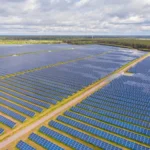
India’s Solar Capacity Growth Slows Down in Q1 2023
According to the recently released Q1 2023 India Solar Market Update, India witnessed a decrease in solar capacity growth during the first quarter of the calendar year. The country added 1.9 GW of solar capacity during this period, marking a 30% decline compared to the 2.7 GW installed in the previous quarter of 2022. Furthermore, this figure represents a significant 48% decrease year-over-year in comparison to the 3.6 GW added in Q1 2022.
Out of the total solar installations in Q1 2023, 1.4 GW was attributed to large-scale solar projects, which experienced a 37% decline from the previous quarter and a substantial 56% decline year-over-year. Large-scale solar installations accounted for 74% of the total installations, while rooftop solar made up the remaining 26%.
With the addition of 1.9 GW in Q1 2023, India’s cumulative installed solar capacity has now reached 64.5 GW. However, it is important to note that the growth rate is expected to be lower in 2023 due to delayed commissioning deadlines for several projects, as well as challenges related to land and transmission issues, along with projects facing obstacles in the habitat of the Great Indian Bustard.
As of March 2023, India’s utility-scale project development pipeline consisted of 58 GW, with an additional 58 GW of projects tendered and awaiting auction.
The top states for solar installations in Q1 2023 were Rajasthan and Karnataka, accounting for 42% and 21% of installations, respectively. Gujarat secured the third position with 19% of the total installations.
Renewable energy sources accounted for approximately 41% of India’s power mix in Q1 2023, with solar alone contributing to over 45% of the new power capacity added during the quarter.
Suggested Articles

COP27: Harnessing Solar Energy for a Sustainable Future
COP27 is the latest in a long line of global climate conferences, which have been held regularly since 1994. The United Nations Framework Convention on Climate Change (UNFCCC) was created at the 1992 Rio Earth Summit.

Solar Energy Myths vs. Facts: What You Should Know
Solar power myths often mislead homeowners. Learn the facts about cost, efficiency, and reliability of solar energy.
Steps Required for Conducting a Site Assessment Prior to Solar Installation
A solar site assessment helps installers evaluate location, shading, structure, and energy requirements before installation. This guide explains the essential steps for accurate solar system planning.

Solar ROI vs Payback Period Explained for Commercial & Industrial Projects
Compare payback period and ROI for solar systems. Discover how businesses should evaluate solar investments effectively.
7 Common Myths about Solar Energy in India
Solar power is not only less expensive, but it is also the most abundant source of clean energy.

Researchers Propose New Way to Make Nuclear Power Plants Safer
Researchers propose innovative methods to enhance the safety of nuclear power plants, aiming to reduce risks and improve operational security.

Difference Between an On-Grid Inverter and a Hybrid Solar Inverter
Confused between an on-grid inverter and a hybrid solar inverter? This blog explains their differences, advantages, and which solar inverter is right for you.
Financing made easy for the Rooftop Solar Projects
Switching to solar is easier than ever with flexible financing options. This guide explains how to fund your rooftop solar project through loans, subsidies, and government schemes to make clean energy more affordable and sustainable.