
Safety is a fundamental requirement in every solar photovoltaic (PV) installation. Despite proper planning, training, and preventive measures, hazards can still occur during installation, operation, inspection, maintenance, or troubleshooting. Electrical faults, fires, falls, equipment damage, chemical exposure, and extreme weather events can affect workers and solar PV equipment.
When a hazard occurs, the priority should shift from prevention to immediate response, hazard control, recovery, and corrective action. Appropriate mitigation measures can reduce injuries, prevent the situation from becoming more serious, protect the PV system, and help prevent similar incidents in the future.
This article explains the key measures to be taken after a hazard occurs in a solar PV system while supporting safe and reliable solar electricity generation.
What Is Hazard Mitigation?
Hazard mitigation refers to the actions taken to control or reduce the consequences of a hazardous event after it has occurred. It may involve:
- Protecting people from further exposure
- Isolating hazardous equipment
- Providing emergency assistance
- Controlling secondary hazards
- Reporting the incident
- Investigating the root cause
- Repairing damaged equipment
- Implementing corrective measures
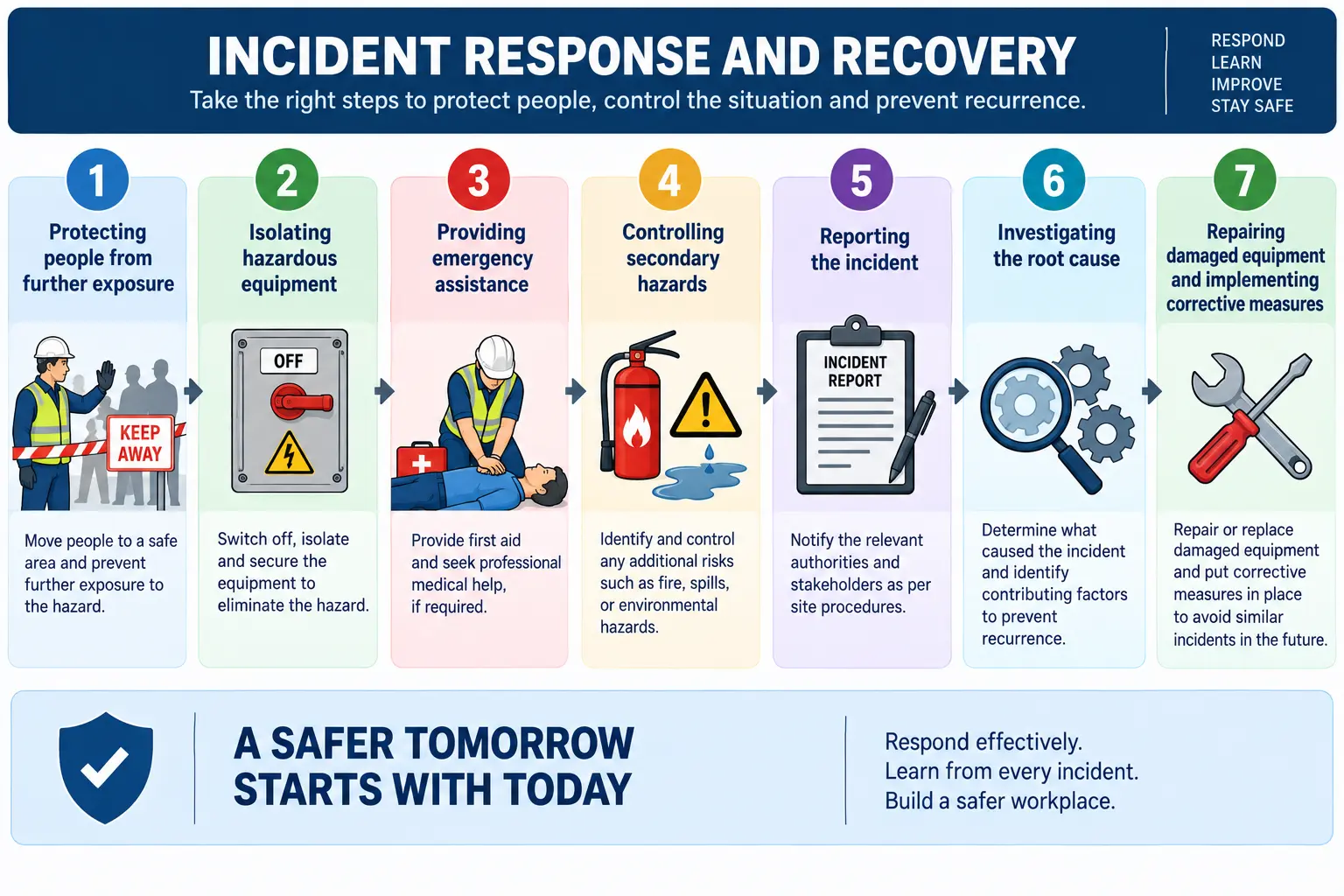
The response should always follow the site’s emergency procedures, applicable regulations, and instructions from qualified personnel.
1. Protect People First
The first priority after a hazard occurs is human safety.
Workers should immediately move away from the hazardous area if remaining there creates additional risk. Personnel should not attempt to investigate equipment while an active electrical, fire, structural, or other hazard remains present.
Depending on the incident, the area may need to be:
- Evacuated
- Restricted
- Barricaded
- Clearly marked
- Isolated from unauthorized personnel
Emergency assistance should be requested according to the site’s established procedure.
2. Stop the Hazard Where It Is Safe to Do So
If it can be done safely and by authorized personnel, the source of the hazard should be controlled.
For example:
- Isolate an electrical circuit.
- Shut down affected equipment.
- Disconnect an appropriate energy source.
- Stop a maintenance activity.
- Secure unstable equipment.
- Prevent access to a damaged area.
Workers should never put themselves at additional risk while attempting to control a hazard.
3. Isolate Electrical Energy
Electrical incidents require particular caution because PV modules can continue producing DC electricity when exposed to sunlight.
After an electrical hazard, qualified personnel should identify and isolate all relevant sources, which may include:
- PV arrays
- Inverters
- Grid supply
- Batteries
- Generators
- Backup circuits
Where required, lockout/tagout procedures should be applied to prevent accidental re-energization.
The equipment should not be considered safe until the appropriate isolation and verification procedures have been completed.
4. Respond to Fire or Smoke
If smoke, burning smells, sparks, or fire are observed, personnel should follow the site’s emergency and fire-response procedures.
Important actions include:
- Raise the alarm.
- Evacuate personnel from the danger area.
- Restrict access.
- Contact the designated emergency response team.
- Isolate electrical sources only if safe and authorized.
- Do not approach severely damaged electrical equipment unnecessarily.
A damaged inverter, battery, or electrical enclosure should not be reopened simply to determine the cause of the fire.
5. Provide First Aid and Emergency Assistance
If an injury has occurred, first aid should be provided by trained personnel according to the site’s emergency procedure.
Potential incidents in PV installations include:
- Electric shock
- Burns
- Cuts
- Falls
- Heat-related illness
- Chemical exposure
- Impact injuries
Medical assistance should be obtained when required. Even when an electrical injury appears minor, the incident should be treated seriously and handled according to established workplace procedures.
6. Secure the Incident Area
Once the immediate danger is controlled, the area should be secured.
This prevents:
- Additional injuries
- Unauthorized access
- Accidental equipment operation
- Disturbance of evidence required for investigation
Warning signs, barricades, or restricted-access measures may be used as appropriate.
7. Report the Hazard or Incident
Every significant hazard, near miss, injury, equipment failure, or safety violation should be reported according to the organization’s procedures.
The report should contain relevant information such as:
- Date and time
- Location
- Equipment involved
- Description of the incident
- People involved
- Immediate actions taken
- Injuries or damage
- Witness information where applicable
- Photographs or other evidence where appropriate
Accurate reporting helps management understand what happened and determine suitable corrective actions.
8. Inspect and Assess Equipment Damage
After the area is declared safe, qualified personnel should inspect affected equipment.
For a solar PV system, this may include:
- PV modules
- Cables
- Connectors
- Inverters
- Batteries
- Switches
- Circuit breakers
- Distribution boards
- Mounting structures
- Earthing systems
Damaged components should not be returned to service without appropriate inspection and testing.
9. Identify the Root Cause
Corrective action should address the underlying cause rather than only the visible damage.
Possible root causes include:
- Incorrect installation
- Poor maintenance
- Loose connections
- Inadequate protection
- Equipment failure
- Human error
- Poor housekeeping
- Inadequate training
- Unsafe work procedures
- Environmental conditions
A root-cause investigation can help prevent recurrence.
10. Implement Corrective and Preventive Actions
Following the investigation, appropriate actions should be implemented.
These may include:
- Repairing or replacing damaged equipment
- Improving electrical protection
- Modifying work procedures
- Providing additional training
- Improving PPE requirements
- Updating warning signs
- Improving cable management
- Revising inspection schedules
- Strengthening emergency procedures
The objective is to reduce the likelihood and severity of a similar incident in the future.
11. Test Before Returning the System to Service
A repaired PV system should not be energized immediately.
Depending on the affected equipment, testing may include:
- Visual inspection
- Continuity testing
- Insulation resistance testing where appropriate
- Voltage measurements
- Polarity verification
- Earthing checks
- Protection-device checks
- Inverter testing
Only qualified personnel should authorize restoration of the system.
12. Document the Corrective Action
All repairs and corrective measures should be recorded.
Documentation may include:
- Fault identified
- Root cause
- Equipment affected
- Repair performed
- Replacement components
- Test results
- Date of restoration
- Person responsible for the work
Good records support future maintenance and troubleshooting and help improve the reliability of the solar plant.
Mitigation Measures Checklist
After a hazard occurs:
- Protect personnel from further exposure.
- Raise the alarm where required.
- Isolate the hazard safely.
- Restrict access to the affected area.
- Provide first aid or emergency assistance.
- Isolate electrical energy.
- Report the incident.
- Inspect damaged equipment.
- Identify the root cause.
- Implement corrective actions.
- Test repaired equipment.
- Document the outcome.
- Review procedures to prevent recurrence.
Conclusion
Hazards in solar PV systems require immediate, organized, and safety-focused responses. Once a hazard occurs, the objective should be to protect personnel, control the immediate danger, isolate energy sources, secure the area, report the incident, and prevent further damage.
For electrical incidents, particular attention must be given to PV DC voltage, AC supplies, batteries, and other possible energy sources. Damaged equipment should never be returned to operation without appropriate inspection and testing.
Effective mitigation does not end when the immediate hazard is controlled. A proper investigation should identify the root cause, followed by corrective and preventive actions such as equipment repair, procedure improvements, additional training, or changes to maintenance practices.
These measures are important for residential solar energy for home use, commercial and industrial systems, and large-scale solar plants. A strong post-incident response protects workers, improves system reliability, and supports uninterrupted solar electricity generation.
Ultimately, effective hazard mitigation creates a continuous safety cycle: respond, isolate, report, investigate, correct, test, document, and improve. By following this approach, solar PV organizations can reduce recurring risks while building safer and more reliable renewable energy and solar energy systems.
FAQs
Q1. What should be done first after a hazard occurs?
Ans: The first priority is to protect people from further danger. The area should be evacuated or secured if necessary.
Q2. Why is electrical isolation important after a PV incident?
Ans: PV modules can continue producing DC electricity in sunlight, while inverters, batteries, and grid connections can provide additional energy sources. Proper isolation prevents further electrical exposure.
Q3. Should damaged solar equipment be switched on to check whether it works?
Ans: No. Damaged equipment should be assessed and tested by qualified personnel before being returned to service.
Q4. Why should hazards and near misses be reported?
Ans: Reporting helps identify unsafe conditions, determine root causes, and implement corrective measures before similar incidents occur.
Q5. What is root-cause analysis?
Ans: Root-cause analysis identifies the underlying reason an incident occurred rather than focusing only on the immediate visible failure.

How to Connect a Solar Panel to an MPPT Charge Controller: Step-by-Step Guide
This guide explains how to connect a solar panel to an MPPT charge controller step by step. Learn correct wiring, safety tips, and best practices to ensure efficient and reliable solar power performance.
Go Off-Grid with Solar Energy: A Complete Guide
Living off-grid, more commonly defined as not having a dependence on public utilities such as electricity, sounds appealing for a lot of reasons. The idea of being self-sufficient, powering your own home with solar energy, and maybe even building that home with your own two hands can sound like a dream and a challenge for people who wish to live life on their terms.

Solar ROI vs Payback Period Explained for Commercial & Industrial Projects
Compare payback period and ROI for solar systems. Discover how businesses should evaluate solar investments effectively.
Top Solar Companies & Suppliers in Delhi/NCR – A Complete Guide
Looking for trusted solar panel suppliers in Delhi/NCR? Explore leading solar companies serving Gurgaon, Noida, Faridabad, Manesar, and Ghaziabad. Compare product quality, technology, and services to choose the right solar partner for your home, business, or factory.
Different Components of a Solar PV System: Importance and Operation
Earthing and lightning protection are critical safety components in solar PV installations. This guide explains their importance, types, components, and best practices for solar installers.

How MPPT Works in an Inverter: A Simple Guide for Solar Users
This simple guide explains how MPPT works in a solar inverter, helping users understand how it maximizes power output and improves system efficiency.

Everything You Need to Know About Net Metering
Discover everything about net metering – how it works, benefits, installation process, and how it helps you save on electricity bills.
How Quickly Can Solar Panels Pay for Themselves? Payback Period Explained
Learn how the solar panel payback period works, factors that affect ROI, and how soon you can recover your solar investment.