
Solar photovoltaic (PV) installation frequently involves working at height, particularly on rooftops, elevated structures, platforms, and large solar mounting systems. Falls from height are among the most serious hazards faced by PV installers and maintenance personnel. A properly designed and installed fall-protection system can significantly reduce the risk of severe injury.
Fall protection should not be treated as an optional accessory. It should form part of the planning, site assessment, installation, inspection, and maintenance process. Before workers access an elevated work area, the available fall-protection arrangements should be inspected to ensure that they are suitable, secure, and appropriate for the intended activity.
This guide explains the key principles involved in inspecting and installing fall protection for solar PV work.
Why Is Fall Protection Important in Solar PV Installation?
PV systems may be installed on:
- Residential rooftops
- Commercial and industrial roofs
- Elevated structures
- Carports
- Ground-mounted structures with elevated work areas
- Maintenance platforms
Workers may encounter roof edges, openings, fragile surfaces, slippery areas, uneven surfaces, and changing weather conditions.
A fall can result in fractures, head injuries, spinal injuries, or even fatality. Preventing the fall is therefore preferable to relying solely on emergency response after an accident.
1. Conduct a Work-at-Height Assessment
Before installing or inspecting a fall-protection system, the work area should be assessed.
The assessment should identify:
- Height of the work area
- Roof edges
- Openings and skylights
- Fragile surfaces
- Access and exit points
- Potential falling-object hazards
- Weather conditions
- Available anchorage points
- Areas where workers will move
The assessment should determine the appropriate fall-protection method for the specific site.
2. Select the Appropriate Fall-Protection System
Different PV sites require different approaches. Depending on the design and applicable requirements, fall protection may include:
- Guardrails
- Safety nets
- Personal fall-arrest systems
- Anchorage systems
- Lifelines
- Travel-restraint systems
- Roof-access protection
The selected system should be suitable for the work activity and installed according to the manufacturer’s instructions and applicable safety requirements.
3. Inspect Fall-Protection Equipment Before Use
All fall-protection equipment should be inspected before workers rely on it.
Inspect components such as:
- Harnesses
- Lanyards
- Lifelines
- Connectors
- Carabiners
- Anchorage points
- Guardrails
- Safety nets
Look for cuts, fraying, corrosion, deformation, damaged stitching, broken components, or other signs of deterioration.
Any equipment showing damage or questionable condition should be removed from service and assessed by a competent person.
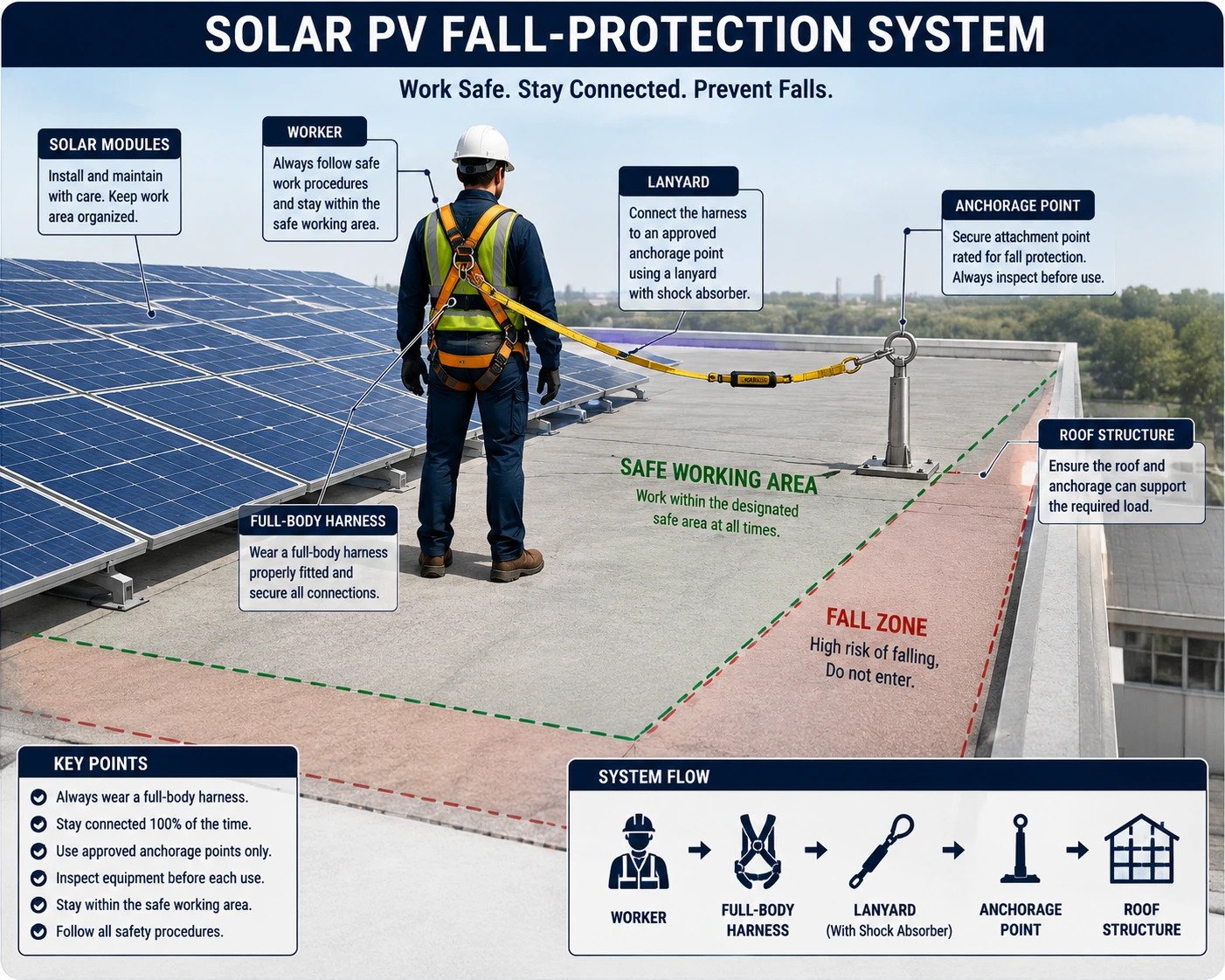
4. Inspect Anchorage Points
Anchorage points are critical components of personal fall-protection systems.
Before use, installers should verify that the anchorage:
- Is designed for the intended fall-protection application.
- Is securely installed.
- Is free from visible damage or corrosion.
- Is located appropriately for the work activity.
- Has the required documentation or approval where applicable.
An ordinary structural component should not automatically be assumed to be a suitable fall-protection anchor.
5. Install Guardrails Where Appropriate
Guardrails can provide collective protection by preventing workers from reaching an unprotected edge.
Where designed and permitted for the application, guardrail systems should be:
- Securely installed
- Stable
- Appropriately positioned
- Free from significant damage
- Designed to withstand the expected loads
Guardrails should not create additional trip or access hazards.
6. Use Personal Fall-Arrest Systems Correctly
Where a personal fall-arrest system is required, workers should use compatible equipment as a complete system.
A typical arrangement may include:
Full-Body Harness → Connecting Device → Anchorage/Lifeline
Workers should be trained to correctly wear, connect, inspect, and use the equipment. A fall-arrest system is not simply a harness. Every component must work together as intended.
7. Check Harnesses and Lanyards
Before use, the worker should inspect the harness and connecting equipment.
Check for:
- Torn webbing
- Damaged stitching
- Cuts
- Burn marks
- Chemical damage
- Deformed hardware
- Corrosion
- Damaged connectors
The equipment should be used only according to the manufacturer’s instructions.
8. Consider the Fall Zone
Installing fall protection is not enough; the potential fall path must also be considered.
The area below should be checked for:
- Ground-level obstacles
- Machinery
- Sharp objects
- Structural members
- Electrical equipment
- Other workers
The fall-arrest arrangement should be planned so that a worker cannot strike a lower surface or obstruction during a fall.
9. Prevent Suspension and Rescue Hazards
A worker who falls while attached to a fall-arrest system may remain suspended until rescued. Therefore, a suitable rescue plan should be established before work begins.
The plan should identify:
- Who will respond
- How the worker will be reached
- What rescue equipment is available
- How emergency communication will occur
- How access for emergency responders will be maintained
Workers should not simply rely on emergency services without considering the site’s specific rescue requirements.
10. Account for Weather Conditions
Weather can significantly increase fall risks during PV work.
Rain can make surfaces slippery, while strong winds can affect workers carrying modules and materials. Lightning creates an additional hazard for outdoor and rooftop work.
Work should be stopped or appropriately controlled whenever environmental conditions make the activity unsafe.
11. Prevent Falling Tools and Materials
Fall protection also involves protecting people below from falling objects.
PV installers should:
- Secure tools when working at height.
- Keep materials away from roof edges.
- Use suitable tool bags.
- Establish exclusion zones below elevated work.
- Avoid throwing tools or materials.
This is especially important when installing solar panels, mounting structures, cables, and other components.
12. Document Inspection and Maintenance
Fall-protection equipment should be inspected and maintained according to the manufacturer’s instructions and applicable workplace requirements.
Records may include:
- Inspection date
- Equipment identification
- Condition
- Defects identified
- Corrective action
- Inspector’s details
- Next inspection requirement
Proper records help ensure that defective equipment is not accidentally returned to service.
Fall-Protection Inspection Checklist
Before starting work, verify:
- Work-at-height assessment completed
- Appropriate fall-protection system selected
- Anchorage points checked
- Harness inspected
- Lanyards/lifelines inspected
- Connectors functioning properly
- Guardrails secure where applicable
- Fall zone assessed
- Rescue plan established
- Weather conditions checked
- Tools and materials secured
- Workers trained and authorized
Conclusion
Inspecting and installing appropriate fall protection is a critical responsibility in solar PV installation and maintenance. Rooftops, elevated mounting structures, roof edges, fragile surfaces, and changing weather conditions can expose PV installers to significant fall risks.
A safe approach begins with a work-at-height assessment, followed by selection of an appropriate protection system. Harnesses, lanyards, lifelines, anchorage points, guardrails, and other equipment should be inspected before use and maintained according to applicable requirements and manufacturer instructions. Workers should also understand how to use the equipment correctly and should have access to a suitable rescue plan.
Fall protection should be combined with safe access, good housekeeping, secure tools, appropriate PPE, and proper work procedures. These practices are important whether installing solar energy for home use, commercial PV systems, or large-scale solar plants.
By making fall prevention an integral part of PV installation rather than an afterthought, organizations can protect workers, reduce accidents and downtime, and support the safe development of renewable energy and solar energy. A properly protected workforce ultimately contributes to safer installations, dependable solar electricity generation, and better long-term management of the solar installation cost and overall solar energy installation cost.
FAQs
Q1. Why is fall protection necessary for PV installers?
Ans: PV installation often involves elevated work, roof edges, and fragile surfaces. Fall protection reduces the risk of serious injuries caused by falls.
Q2. What types of fall protection can be used?
Ans: Depending on the site and applicable requirements, systems may include guardrails, safety nets, travel restraint, personal fall-arrest systems, lifelines, and suitable anchorage systems.
Q3. How often should fall-protection equipment be inspected?
Ans: Equipment should be inspected before use and at intervals specified by the manufacturer and applicable workplace requirements. Damaged equipment should be removed from service immediately.
Q4. Can any roof structure be used as an anchorage point?
Ans: No. An anchorage should be specifically suitable for the intended fall-protection application and meet the applicable requirements.
Q5. Why is a rescue plan necessary?
Ans: A worker suspended after a fall may face additional risks. A planned rescue procedure helps ensure that assistance can be provided promptly.
India and IMT-GT JBC Sign MoU to Boost Energy Efficiency in Southeast Asia
The first meeting of the G20 Energy Transitions Working Group was held in Bengaluru, India, and was a success, with participants sharing a consensus on the priority areas of energy security and diversified supply chains.
Solar Rooftop: अपने घर को बनाओ खुद का पावर हाउस | Complete Guide
सौर रूफटॉप सिस्टम आपके घर को पावर हाउस बना सकता है। यह न केवल बिजली के बिलों में बचत करता है, बल्कि साफ और नवीकरणीय ऊर्जा भी प्रदान करता है। जानें सौर पैनल की इंस्टालेशन प्रक्रिया, लागत, लाभ और कैसे यह आपके घर को आत्मनिर्भर ऊर्जा का स्रोत बना सकता है।
Solar Net Metering in Industrial Units: Opportunities and Risks
Solar net metering can help factories save on energy costs, but there are key pitfalls to consider. Learn the challenges and best practices for industrial adoption

How to Connect Solar Panels to Battery: Step-by-Step Guide
Connecting solar panels to a battery is essential for storing solar energy and ensuring power availability when sunlight is low. This step-by-step guide explains how to connect solar panels to a battery safely using a charge controller, wiring diagrams, and best practices for beginners and professionals alike.

Everything You Should Know About Solar Batteries
Discover how solar batteries store excess energy, maximize your solar system’s efficiency, and provide reliable power during outages. Learn about the types, benefits, lifespan, and maintenance tips to make the most of your solar investment.
Solar EPC Installation Tools & Consumables Guide for Civil & Mechanical Work
A complete Solar EPC guide covering essential tools and consumables required for civil and mechanical installation to ensure smooth and efficient project execution.

Solar Installation Cost in Haryana: Pricing, Savings & Subsidy Guide
Solar installation cost in Haryana varies by system size, components, and subsidy eligibility. This guide explains per-kW pricing, government incentives, and how much owners can save with rooftop solar in 2025, helping you choose the right system at the right budget.
Best Solar Panels for Rooftop Projects: How to Choose the Right One
Selecting the right solar panel is crucial for rooftop project success. This guide explains how to evaluate panel types, efficiency, warranties, and performance to ensure maximum power output and long-term savings for your home or business.