
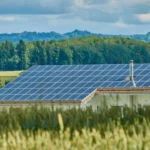
China’s Solar Industry Poised for Continued Growth in 2023 and Beyond
China’s solar industry exports surged by 64% to $52 billion in 2022, despite global trade tensions. The country’s low-cost supply and technological expertise were key factors in this growth.
Europe was the top export market for Chinese solar modules, accounting for 56% of total exports. Southeast Asia was the second-largest export market, with a 31% share.
The U.S. tariffs on Chinese-made modules have driven module production to Southeast Asia, where manufacturers rely on imported cells from China.
Wood Mackenzie, a global research and consultancy group, found that Chinese photovoltaic (PV) modules were up to 57% cheaper than the modules produced in the U.S. and EU. The primary reason for this price gap is the cost of materials. China has low energy costs, scaling advantages, and government support, which give local manufacturing an edge over the U.S. and EU counterparts.
The U.S. goal to produce 100% U.S.-made modules by 2026 will be difficult to achieve due to the significant lack of wafer and cell production. Even the incentives rolled out by the government will not be able to fully bridge the manufacturing cost gap with the Chinese-manufactured modules.
The China-targeted PV trade policies by the U.S. have benefited the Southeast Asia region, which has developed a mature supply chain and large production capacity for export. Chinese manufacturers account for 55% of the region’s PV manufacturing capacity, which builds on Chinese-produced components.
The EU and India have also set ambitious targets for domestic PV manufacturing, but they are facing challenges in meeting these targets. The EU is advocating trade restrictions to secure its domestic PV manufacturing, but specific policies to drive capacity building and displace imports are missing. India has suspended the Approved List of Models and Manufacturers regulations for a year, citing the lack of larger capacity solar modules in the country as the reason.
China’s domestic solar PV industry continues to invest in upstream sectors, which are more profitable than modules. The available export module capacity in the country is expected to grow to 149 GW by 2026. Wood Mackenzie suggests that companies outside of China, even with multiple opportunities, will find it challenging to compete with China’s low-cost supply chain and pool of expertise, which it has developed over a decade.
The European Commission has published the Green Deal Industrial Plan, which will utilize €250 billion (~$269.51 billion) of existing EU funds to safeguard and enhance the competitiveness of its clean energy industry.
India exported solar cells and modules worth $479 million (~₹39.5 billion) in the first quarter of the calendar year 2023, a staggering increase of 6,293% year-over-year.
Suggested Articles

CAPEX or OPEX? How to Choose the Best Solar Ownership Model
Choosing between the CAPEX and OPEX models can greatly impact your solar savings and ownership benefits. This guide explains both models to help you make the right decision.
Solar Panel Selection Demystified: How to Choose the Right Panels for Solar Installation
Choosing the right solar panels can be confusing with so many options in the market. This guide simplifies solar panel selection by comparing types, efficiency ratings, and cost factors. Whether for your home, business, or industry, learn how to make an informed decision and maximize the return on your solar investment.
Are Colleges and Schools ready to take up Solar challenge?
Adopting solar energy can help schools and colleges reduce electricity costs and promote sustainability. This guide explores how educational institutions can implement rooftop solar projects, the benefits, and what steps are needed to take on the solar challenge effectively.

Sustainable Solar Panel Disposal: Recycling for a Greener Future
Sustainable solar panel disposal ensures old or damaged panels are recycled responsibly, reducing waste and environmental harm. By adopting eco-friendly recycling and reuse practices, we can recover valuable materials, lower carbon impact, and make solar energy truly sustainable from installation to end-of-life.
New IREDA Loan Scheme for Solar Rooftop Projects: Benefits, Eligibility & Interest Rates
India’s renewable energy push gets a major boost with the new IREDA loan scheme for solar rooftop projects. This scheme offers low-interest financing, simplified approvals, and better support for residential, commercial, and industrial consumers. Here’s a detailed look at its benefits, eligibility, interest rates, and how to apply for funding.

500 kW Solar System Price in Haryana: Latest Cost, Benefits & Savings
Looking to install a 500 kW solar system in Haryana? Discover the latest 2025 price range, government incentives, and key benefits for commercial and industrial users. Learn how adopting solar can cut electricity bills and boost long-term savings.

AVANCIS Pushes CIGS Thin-Film Solar Modules Beyond 20% Efficiency
AVANCIS achieves a breakthrough in solar technology, pushing CIGS thin-film modules beyond 20% efficiency for higher performance and energy output.
Solar Rooftop: अपने घर को बनाओ खुद का पावर हाउस | Complete Guide
सौर रूफटॉप सिस्टम आपके घर को पावर हाउस बना सकता है। यह न केवल बिजली के बिलों में बचत करता है, बल्कि साफ और नवीकरणीय ऊर्जा भी प्रदान करता है। जानें सौर पैनल की इंस्टालेशन प्रक्रिया, लागत, लाभ और कैसे यह आपके घर को आत्मनिर्भर ऊर्जा का स्रोत बना सकता है।