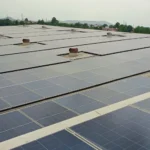
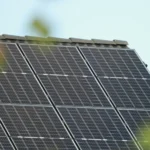
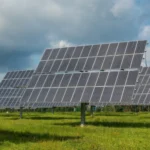
Recently our team was involved in a project “Design, Installation and Commissioning of 50 kWp Solar PV Rooftop Power Plant”. Out of the total capacity of 50 kWp, 40 kWp was installed on an industrial site at Faridabad and 10 kWp was installed at residential site at Sainik Farm at New Delhi.
In this blog we will be discussing the complications faced by our team during the execution of two projects.
The Installers or Project Developers should be prepared for such difficulties and at the same time customer should understand the difficulties faced by an installer and should support them in the execution of the project.
Let us discuss the sites one by one.
50 kWp Industrial site at Faridabad
The project was finalised to be installed at two different rooftops of the same industry. This was a Grid connected Solar PV project. Below are the difficulties faced by our team.
Access to the rooftop
The very first difficulty faced by our team was of access to both the rooftops. There was no means of access to the rooftops, other than a wooden ladder that too was very weak and straight.
The labors had to lift the material (including Solar PV Panels, inverters, structures, civil materials) using the same ladder was standing on a small window making it almost impossible to approach the roof.
Delayed Dispatch of Solar PV Modules and Inverters
In spite of full advance payment to both the Solar PV panel manufacturing company and the Grid tie inverter manufacturing company, the dispatch of the products was delayed. So, project developers or system integrators need to be very clear in their terms of payment and delivery even with the reputed vendors.
Type of roof
We were informed by the customer that the roof is a normal RCC roof and it was inspected by our staff also. But when our team went to the site for installing the module mounting structure (mentally prepared for a RCC roof), and started drilling, we found that the situation was different. There was a covering of tiles and sand above the RCC roof.
So, we had to first cut the tiles and remove the sand to find the RCC roof and start our process of installation, which added 2-3 days in our expected time frame for the installation.
Strength of the Building
After completion of installation of the module mounting structure on upper(one) roof, when our team started to work on the lower (second) roof, then immediately after start of work on lower roof stage we got complaints from the customer, that due to our installation process his roof is damaged from inside (though actually it was not the case).
We surveyed the building and checked that the building had cracks all over even where no work of module mounting was taken up. Finally after talking to the owner it was decided to install on another roof which was 50 meters away. We planned to shift the structure but since the distance between the roofs was now 50 meters vis-a-vis earlier 2.5 meters, we had to re-layout the whole plan. Earlier on the upper roof there were 96 panels and 64 on lower roof connecting to two inverters of 20 KW each.
In the changed plan we had to mount 80panels on each roof to reduce the DC losses, therefore, we had to remove structure from the upper roof for 16 panels. And remount on the other roof.. This not only delayed the project time line by 3-4 days’ time, since the components was to be shifted from upper & lower roof to the other distant roof (again with no direct means of access) it also had a lot of financial impact by way of cable length, two times installation of 16 panels, one time removal and sealing of 16 panels, extra earthing, LA etc..
10 kWp Residential site at New Delhi
This was a Grid connected Solar PV project with a Net metering connection.
Below are the difficulties faced by our team.
Delivery of Material to the site:
The site was at Sainik farm, and our team faced difficulties in taking the raw material for civil construction, module mounting structures, conduit for cables and even Solar PV Panels to the customer site, since local authorities and the NDMC people didn’t allowed our team to take the material inside the premises of Sainik farm , in the name of some court order banning new construction in Sainik farm area.
Though Central government is having an ambitious solar target of 40 GW for Rooftop Solar PV Systems and the Delhi government has released the draft solar policy, still Solar PV EPC contractors and developers have to face such difficulties in transferring raw material and components to the site requiring extra efforts/expenses to get these types of clearances.
Delayed Dispatch of Solar PV Modules and Inverters
This is the same issue as discussed above.
Ordered something, Delivered something
Our team procured 250 Wp Solar PV panels for tier 1 Solar panel manufacturing company. The datasheet available at the company’s website and the one they had sent to us had a blurred mechanical dimension description.
On enquiry the solar panel manufacturing company advised to refer to their old drawings. Based on their previous delivered panels (for some other project), we designed the module mounting structure and gave a distance of 819 mm for hole to hole pitch (which was as per the distance in their previous lot). But on site when the PV panels were received, we found that this time the distance was not 819mm, rather it was 860 mm and the capacity was also 255 Wp rather than 250 Wp as ordered by us.
The structure had already been mounted and now mounting of these panels on structure was not possible. We had two options either to make holes on the Solar PV Panels frame itself, or to make holes on the mounting structure.
Making holes on the Solar PV Panel’s frame was a risky task, since the process may damage the PV panels and/or the customer may loose the warranty of panels (Manufacturer may say that since the panels have been tempered we will not extend warranty).
Other way was to make holes in the structure itself, but this idea was also dropped because if extra holes are drilled then such holes will be without galvanization and exposed to atmosphere. And if structure is dismantled and taken back to the fabricator for making holes and putting it again through the process of Galvanizing , the cost was prohibitive, also transportation of material to SAINIK FARM is a big issue.
After a complete analysis, our engineers came out with a innovative solution of addition of few new clits and angles to the structure to adjust the hole distance to 860 mm without drilling any holes and maintaining the structure strength. These components were designed tested on S/W , manufactured, tried in one panel and then mass manufactured and implemented on site.