
In solar photovoltaic (PV) systems, batteries play a crucial role in storing solar electricity for backup and continuous power supply. However, the efficiency and reliability of a battery bank depend heavily on proper terminal preparation and correct installation of battery interconnection cables.
Loose or poorly prepared battery terminals can lead to overheating, voltage drops, corrosion, power loss, and even fire hazards. Similarly, improper interconnection cable installation can reduce battery efficiency and increase solar installation charges due to maintenance and replacements.
Proper battery connection practices are essential for safe and efficient renewable solar installations.
This blog provides a complete step-by-step guide to preparing battery terminals and installing battery interconnection cables, along with safety measures, best practices, and quality checks for solar PV systems.
Importance of Proper Battery Terminal Preparation
Correct terminal preparation helps:
- Improve electrical conductivity
- Reduce resistance losses
- Prevent overheating
- Increase battery life
- Improve solar electricity generation reliability
Poor preparation may lead to system inefficiencies and increased solar installation cost per kWh.
Importance of Battery Interconnection Cables
Battery interconnection cables are used to connect batteries in:
- Series configuration
- Parallel configuration
- Series-parallel configuration
These cables ensure smooth current flow between batteries and connected solar plant components.
Components Required for Battery Interconnection
1. Battery Interconnection Cables
Use cables with:
- Proper current rating
- Flexible insulation
- Heat resistance
2. Cable Lugs/Terminals
Used for secure battery connections.
3. Heat Shrink Sleeves
Provide insulation and protection.
4. Anti-Corrosion Grease
Prevents terminal corrosion.
5. Battery Terminal Covers
Improve safety and insulation.
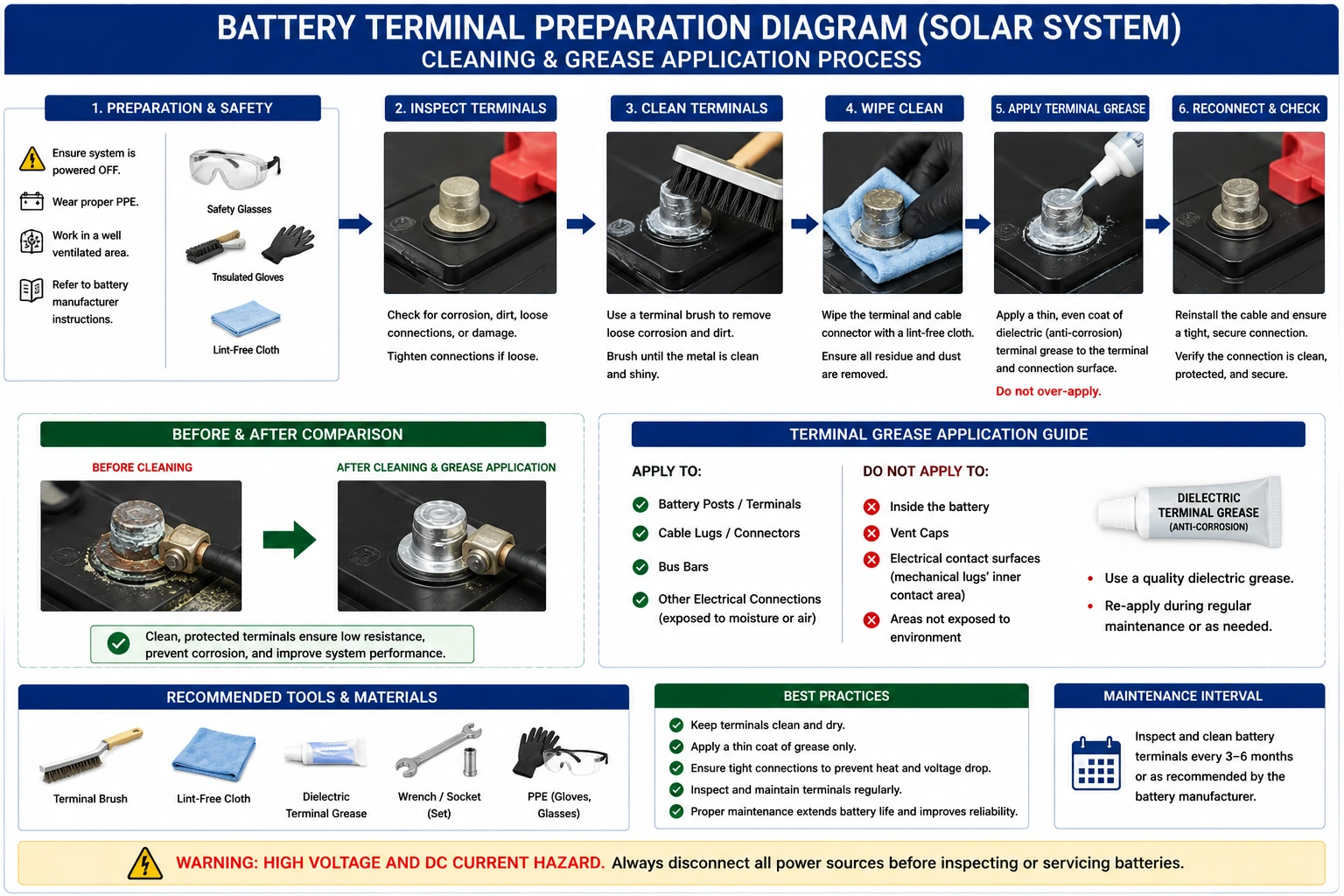
Pre-Installation Preparation
1. Review Battery Bank Design
Understand:
- Battery arrangement
- Cable routing
- Series and parallel connections
2. Verify Cable Size
Ensure cable capacity matches:
- System current
- Voltage requirements
Incorrect cable sizing increases solar energy installation cost through power losses.
3. Inspect Battery Terminals
Check for:
- Corrosion
- Dirt
- Physical damage
Step-by-Step Process for Preparing Battery Terminals
Step 1 – Disconnect Power Sources
* Ensure the battery bank is isolated before work.
Step 2 – Clean Battery Terminals
Use a cleaning brush to remove:
- Dust
- Corrosion
- Oxidation
Clean terminals improve conductivity.
Step 3 – Inspect Terminal Condition
Check for:
- Cracks
- Loose connectors
- Burn marks
Replace damaged parts immediately.
Step 4 – Apply Anti-Corrosion Compound
Use terminal grease to prevent corrosion buildup.
Step 5 – Verify Polarity Markings
Ensure positive and negative terminals are clearly identified.
Step-by-Step Process for Installing Battery Interconnection Cables
Step 1 – Measure and Cut Cable Length
Avoid excessive cable length to minimize losses.
Step 2 – Strip Cable Insulation
Use proper stripping tools to avoid conductor damage.
Step 3 – Crimp Cable Lugs
- Use hydraulic crimping tool
- Ensure strong and secure crimping
Poor crimping causes overheating.
Step 4 – Install Heat Shrink Sleeves
Provide insulation and mechanical protection.
Step 5 – Connect Cables to Battery Terminals
- Maintain correct polarity
- Tighten securely using torque wrench
Step 6 – Route Cables Properly
Avoid:
- Sharp bends
- Loose hanging cables
- Contact with hot surfaces
Step 7 – Install Terminal Covers
Protect against accidental contact and short circuits.
Step 8 – Perform Electrical Testing
Check:
- Voltage continuity
- Connection tightness
- Voltage drop
Common Battery Connection Configurations
1. Series Connection
Increases voltage.
Example:
- 12V + 12V = 24V
2. Parallel Connection
Increases current capacity.
Example:
- 100Ah + 100Ah = 200Ah
3. Series-Parallel Connection
Used for larger battery banks.
Quality Checks After Installation
1. Tightness Verification
- Check all terminal connections.
2. Polarity Verification
- Ensure correct positive and negative connections.
3. Voltage Testing
- Verify expected voltage output.
4. Cable Routing Inspection
- Ensure neat and safe arrangement.
Applications in Solar Projects
1. Residential Solar Systems
- Used for backup power storage.
2. Commercial Solar Plants
- Supports a continuous power supply.
3. Off-Grid Solar Systems
- Essential for energy storage and reliability.
Conclusion
Proper preparation of battery terminals and installation of battery interconnection cables are essential for ensuring safe, reliable, and efficient operation of solar PV battery systems. By following correct procedures, maintaining clean and secure connections, and implementing proper safety measures, installers can improve system performance and battery lifespan.
Proper battery connection techniques are fundamental for renewable solar installations. Additionally, adherence to standards from the Ministry of New and Renewable Energy ensures safe and standardized installation practices.
With proper installation methods, solar professionals can optimize solar panel system cost, improve solar electricity storage reliability, and support sustainable solar energy for home use and advanced renewable energy technology applications.
FAQs
Q1. Why is battery terminal preparation important?
Ans: It improves conductivity and prevents corrosion.
Q2. What happens if battery connections are loose?
Ans: Loose connections can cause overheating and power loss.
Q3. Why is proper cable sizing important?
Ans: It prevents voltage drop and overheating.
Q4. Does proper installation affect solar panel system cost?
Ans: Yes, it improves efficiency and reduces maintenance costs.
Q5. What safety precautions should be followed?
Ans: Use PPE, insulated tools, and ensure proper polarity.

Latest MNRE List: Approved Solar Module Manufacturers
Check the latest MNRE-approved list of solar module manufacturers to ensure quality and compliance for your solar projects in India.

Solar PPA for Commercial Buildings: Cost, Benefits & Savings
Looking to cut electricity bills without investing in solar assets? Commercial Solar PPA providers offer zero-investment solar solutions where businesses pay only for the power generated—simple, risk-free, and cost-effective.

Solar Energy Myths vs. Facts: What You Should Know
Solar power myths often mislead homeowners. Learn the facts about cost, efficiency, and reliability of solar energy.

Solar PV Maximum Working Voltage: Limits & Design Guide
A complete guide to maximum working voltage in solar PV systems, covering limits, calculations, and key design considerations.

Solar ROI for Commercial & Industrial Projects in India: Cost, Payback & Profits
Learn how commercial and industrial solar projects deliver strong ROI for businesses in India through lower energy costs, faster payback, and long-term profit generation.
Industrial Solar Plants with Diesel Generator Backup: What You Need to Know
Discover how industries can efficiently run rooftop solar plants alongside diesel generators (DG). Learn the benefits, setup tips, and hybrid system strategies to ensure uninterrupted power and maximize energy savings.
Rooftop Solar: Reduce Your Electricity Bill and Increase Savings
Discover how installing a rooftop solar system can help you save on electricity bills, reduce peak demand charges, and take advantage of government incentives.
CAPEX or OPEX? How to Choose the Best Solar Ownership Model
Choosing between the CAPEX and OPEX models can greatly impact your solar savings and ownership benefits. This guide explains both models to help you make the right decision.