
Installing a solar plant for an industrial facility is only the beginning. Once the system starts generating electricity, its performance must be monitored regularly to make sure it is producing the expected amount of energy.
An industrial solar plant represents a significant investment. Even a small reduction in generation, if left unnoticed for months, can result in considerable energy and financial losses. This is why solar plant performance monitoring is an important part of operation and maintenance (O&M).
Monitoring helps identify faults, generation losses, equipment problems, and unusual performance trends before they become major issues.
What Does Solar Plant Performance Monitoring Mean?
Solar plant performance monitoring means continuously or regularly checking the plant’s electrical generation and operating conditions and comparing them with expected values.
A monitoring system can provide information about:
- Energy generated
- Power being generated at a particular time
- Inverter performance
- String performance
- Solar irradiation
- Module temperature
- Plant availability
- Performance Ratio (PR)
- Equipment alarms
- Grid availability
- Historical generation trends
The objective is simple: know how the plant is performing, identify deviations, and take corrective action when required.
Why Is Performance Monitoring Important?
An industrial solar plant can continue operating even when one part of the system is not performing properly. For example, one inverter may be producing less power, a string may have a fault, or several modules may be affected by shading.
Without monitoring, these problems may remain unnoticed.
Regular monitoring helps industries:
- Maximise solar electricity generation
- Detect faults at an early stage
- Reduce unnecessary downtime
- Improve plant availability
- Track energy savings
- Verify O&M performance
- Identify underperforming equipment
- Support warranty claims
- Maintain project financial performance
This becomes particularly important for large rooftop and ground-mounted solar plants where manually checking every module or electrical component is impractical.
Key Parameters to Monitor
1. Daily Energy Generation
Daily generation is one of the easiest parameters to understand.
Operators should compare actual generation with expected generation while considering weather and solar irradiation. A lower output on a cloudy day may be normal, but repeated low generation under similar conditions should be investigated.
2. Instantaneous Power
Power indicates how much electricity the plant is generating at a particular moment.
Monitoring the power curve throughout the day can reveal unusual patterns. For example, a sudden drop in output during otherwise good sunlight conditions may indicate equipment or grid-related problems.
3. Performance Ratio
Performance Ratio (PR) is an important indicator of solar PV plant performance.
It helps evaluate how efficiently the plant is converting the available solar resource into electrical energy after considering various system losses.
Tracking PR over time is more useful than looking at a single day’s value because weather and operating conditions change from day to day.
4. Plant Availability
Plant availability indicates whether the solar plant is operational and capable of generating electricity.
Monitoring availability helps identify losses caused by:
- Inverter shutdowns
- Equipment failures
- Grid outages
- Planned maintenance
- Communication failures
- Protection trips
A plant with repeated downtime may require corrective action even if its PR appears satisfactory during operating periods.
5. Inverter Performance
Inverters are among the most important components to monitor.
For each inverter, operators can track:
- AC output
- DC input
- Operating hours
- Efficiency
- Faults and alarms
- Temperature
- Number of trips
- Energy generated
Comparing similar inverters is particularly useful. If most inverters are producing similar output but one inverter consistently produces less, it deserves further investigation.
Monitoring String-Level Performance
Large industrial solar plants may contain hundreds or thousands of modules connected through multiple strings.
String-level monitoring can help identify:
- Low-current strings
- Open strings
- Connector problems
- Fuse failures
- Module issues
- Shading
- Uneven soiling
For example, if ten similar strings are operating under the same conditions and one string consistently produces much lower current, the difference can help maintenance personnel locate the problem.
Monitor Solar Irradiation and Temperature
Solar generation cannot be evaluated correctly by looking at energy output alone.
Solar irradiation should also be considered because the amount of sunlight available directly affects generation.
Similarly, module temperature can influence PV output. Higher operating temperatures generally reduce module electrical efficiency.
By comparing generation with irradiation and temperature data, operators can distinguish between normal environmental variation and actual equipment problems.
Use a Solar Monitoring System
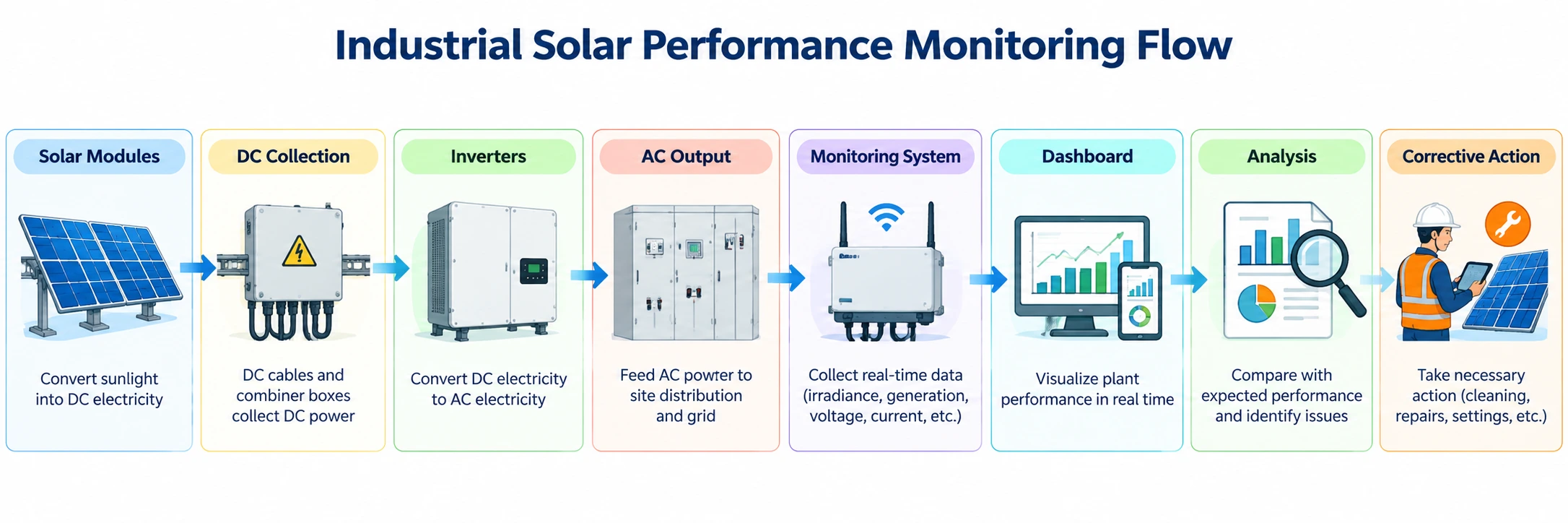
Modern industrial solar plants commonly use monitoring platforms or SCADA systems to collect and display plant data.
A monitoring dashboard may show:
- Solar Irradiation → PV Generation → Inverter Output → AC Generation → Grid/Factory Consumption
The system can also generate alarms when parameters move outside predefined limits.
Remote monitoring is especially useful because the O&M team can identify abnormal conditions without physically visiting the plant every time.
Compare Actual and Expected Generation
One of the most useful monitoring practices is comparing actual generation with expected generation.
Expected generation may be based on:
- Installed capacity
- Solar resource
- Historical performance
- Simulation results
- Seasonal conditions
- System losses
If actual generation remains consistently below the expected range, the plant should be investigated.
However, operators should avoid judging performance from a single day. Trends over weeks and months provide a much clearer picture.
Maintain a Performance Log
A proper monitoring system should be supported by a plant performance log.
Important records can include:
Parameter | What to Record |
Daily Generation | kWh/MWh |
Peak Power | Maximum output |
PR | Daily/monthly trend |
Availability | Operating percentage |
Inverter Output | Inverter-wise generation |
Irradiation | Available solar resource |
Temperature | Module/ambient temperature |
Faults | Alarms and shutdowns |
Maintenance | Work carried out |
Cleaning | Cleaning date and activity |
These records help identify long-term trends and provide useful evidence during audits, warranty claims and O&M reviews.
What to Do When Abnormal Performance Is Detected?
Monitoring is useful only when the information leads to action.
When an abnormal trend is identified, the O&M team should follow a systematic approach:
- Detect → Verify → Analyse → Locate → Repair → Re-test → Record
First, confirm that the monitoring data is reliable. Then check whether weather, grid conditions, or planned maintenance explain the deviation.
If the problem appears technical, compare inverter and string data and conduct appropriate site inspections and testing through qualified personnel.
After corrective action, generation should be monitored again to confirm that performance has improved.
Practical Solar Performance Monitoring Checklist
For regular industrial solar plant monitoring, check:
- Daily energy generation
- Peak power
- Performance Ratio
- Plant availability
- Inverter-wise generation
- String-wise output where available
- Solar irradiation
- Module and ambient temperature
- Inverter alarms
- Grid availability
- Cleaning and maintenance records
- Historical performance trends
- Actual vs expected generation
Conclusion
Monitoring an industrial solar plant is not simply about checking how many units of electricity were generated each day. It is about understanding why the plant generated that amount and whether its performance is consistent with the available solar resource and system design.
By tracking generation, Performance Ratio, availability, inverter output, string performance, irradiation, temperature, and alarms, an industrial facility can identify problems much earlier.
For businesses investing in solar energy, solar roof panels or a large solar plant, effective monitoring should be considered an essential part of the project rather than an optional activity. When monitoring is combined with planned O&M and timely corrective action, it can help protect the investment, reduce generation losses, and ensure that the plant continues delivering reliable solar electricity throughout its operating life.
Whether the project is a new installation or an existing industrial system, good performance monitoring ultimately helps answer one important question: Is the solar plant delivering the energy and value it was designed to deliver?
FAQs
Q1. What is industrial solar plant performance monitoring?
Ans: It is the regular or continuous collection and analysis of solar plant data to determine whether the plant is operating as expected.
Q2. What parameters should be monitored in a solar plant?
Ans: Important parameters include energy generation, power output, Performance Ratio, availability, inverter performance, irradiation, temperature, string output and equipment alarms.
Q3. Why is Performance Ratio important?
Ans: PR provides an indication of how effectively a solar PV plant is converting the available solar resource into electricity after accounting for system losses.
Q4. How often should an industrial solar plant be monitored?
Ans: Large industrial plants should ideally have continuous remote monitoring, supported by daily data review and periodic detailed performance analysis.
Q5. Can monitoring detect faulty solar panels?
Ans: Monitoring can help identify abnormal strings or sections, but specialised inspection and testing may be required to confirm an individual module fault.
Flat Roof Solar Installation Anchoring Techniques & Safety Guide
A practical guide to flat roof solar anchoring techniques and structural safety, covering secure installation methods for stable and reliable solar systems.
Battery Maintenance for Solar PV Systems Guide
A complete guide to battery maintenance for solar PV systems, including inspection, cleaning, testing, charging, and preventive maintenance to ensure long battery life and reliable performance.
Solar Cable Guide | Types, Sizing & Specifications for PV Systems
Solar cables play a critical role in ensuring efficient and safe power transmission in PV systems. This guide explains cable types, specifications, sizing methods, and best practices for selecting the right solar cables.
Workplace Safety Incident Reporting Guide for Solar PV
A complete guide to establishing and following safe work procedures in solar PV systems, ensuring worker safety during installation, testing, commissioning, operation, and maintenance.
Solar Financing for Businesses: Complete Guide to Funding Commercial & Industrial Solar Projects in India
Discover solar financing options for businesses in India, including CAPEX, OPEX, PPA models, solar loans, ROI, and funding strategies for commercial and industrial solar projects.
How to Check Equipment Location for Solar PV Systems
A complete guide to battery bank enclosure and rack installation, including site verification, setup procedures, and safety practices for solar PV systems.
Inverter-Wise Solar Generation for C&I Plants
Discover how inverter-wise solar generation monitoring helps commercial and industrial (C&I) solar plants identify underperforming inverters, detect faults early, compare performance, and improve overall energy generation.
How to Check Solar PV Module Performance
A complete guide to testing solar PV module performance, including voltage and current measurements, power output analysis, and performance verification techniques.