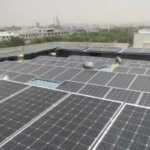
For large commercial establishments, industrial units, campuses, and institutional buildings in Uttar Pradesh, a 500 kW solar power plant has become a strong investment. With the right design, high output, and favourable policies, you can reduce your solar installation charges, optimise the solar energy installation cost, and move toward long-term savings. At Smart Roof Solar, we specialise in delivering turnkey systems that help you understand the 500 kW solar power plant cost in UP, estimate the total cost of solar installation, and design for efficiency.
What is a 500 kW Solar Power Plant?
A 500 kW system means the plant has a peak capacity of 500 kilowatts under standard conditions. In UP’s good sunlight conditions, this setup can generate roughly 6-7.5 lakh units (kWh) of solar electricity annually (site dependent).
Typically the required solar panel area per kW is about 80-100 sq ft, so for 500 kW you may need around 40,000-50,000 sq ft of roof or ground space. This puts you firmly in the large-scale category, beyond typical rooftop systems. Because of scale, your cost metrics like cost of solar per kWh installed get far better than smaller systems.
500 kW Solar Power Plant Cost in UP
Below is a cost table you can fill with your internal numbers to show the breakdown and compute your payback.
Capacity | Estimated Cost (excluding GST) |
500 kW in UP | Starting from ₹1,25,00,000* |
600 kW in UP | Starting from ₹1,44,00,000* |
700 kW in UP | Starting from ₹1,64,50,000* |
800 kW in UP | Starting from ₹1,88,00,000* |
*Prices quoted are indicative starting rates for the above mentioned solar installations may vary based on project-specific requirements, including ground mount or tin-shed structures, RC installation types, additional accessories like DG sync, safety rails, etc. Final pricing will be confirmed upon detailed site evaluation and project scope assessment.
As a benchmark, large installations of this size in UP could be in the ballpark of ₹35,000-₹45,000 per kW depending on design, site, and component quality. This means your solar energy installation cost for a 500 kW project might range between ₹1.75 crore to ₹2.25 crore in many cases.
Once operational, your effective solar roof installation cost per unit of electricity produced drops significantly, improving the return.
Power Generation & Payback Period
In UP, with good irradiation, your 500 kW plant could generate around 6-7.5 lakh kWh annually. If your electricity tariff is roughly ₹8-₹10 per unit, the annual savings would be around ₹48-₹75 lakh.
That translates to a payback period of about 3.5 to 5 years, depending on cost and generation. After that, your solar plant essentially produces low-cost electricity, making the cost of solar per kWh installed even more attractive.
Scale helps too: larger system size means your solar panel system cost per kW and per unit generation is better than for smaller systems.
Incentives & Subsidy Conditions in Uttar Pradesh
Central Subsidy – PM Surya Ghar: Muft Bijli Yojana
The central government, through the MNRE rooftop solar programme, offers Central Financial Assistance (CFA) largely for residential rooftop solar. In UP:
1-2 kW systems may get subsidy up to ₹30,000 per kW.
For systems above 3 kW (residential), a fixed subsidy of ₹78,000 is applicable (depending on slab).
However, this does not apply for large commercial installations like a 500 kW C&I plant. The CFA scheme is only for residential/household or eligible institutional setups.
State Incentives in UP
Under the Uttar Pradesh New & Renewable Energy Development Agency (UPNEDA) and the state solar energy policy:
- The state offers subsidy of ₹15,000 per kW, capped at ₹30,000 per consumer for residential rooftop systems.
Incentives for Commercial/Industrial sector:
- 100% exemption of electricity duty for up to 10 years.
- Exemption or waiver of stamp duty on land used for solar plants.
- Net-metering allowed up to 2 MW for rooftop solar.
Read our blog to know more about UPNEDA – UPNEDA Solar Subsidy 2025 | Solar Savings – Smart Roof Solar
What This Means for a 500 kW Plant
Since the direct residential subsidies don’t apply to a 500 kW plant in UP, your advantages come from:
- Much lower electricity bills thanks to scale.
- Net-metering/gross sale options under the policy.
- Faster payback and better economics thanks to size rather than subsidy.
Cost & Performance Drivers You Should Watch
- Choice of modules and smart solar panel price: high efficiency means less area and better savings.
- Roof or land conditions: flat roofs may cost more for structure; ground mount may require land cost.
- Wiring, earthing and protection: good BOS design reduces losses and lowers your solar installation cost per kWh.
- Monitoring and maintenance: a 500 kW system is a long-term asset, ensuring uptime improves your return.
- Tariff escalation and policy risk: favourable future tariffs and stable policy improve your long-term economics.
Use-Cases Ideal for a 500 kW Solar Plant in UP
- Large manufacturing or industrial units in UP’s industrial corridors.
- Educational & institutional campuses with large rooftops or open land.
- Hospitals, hotels, malls, cold storages requiring high daytime power.
- Ground-mounted systems for captive consumption or open-access resale.
Each of these use-cases benefits from the scale, reducing your home roof solar panels cost (in large scale equivalent), lowering your unit cost of power and supporting renewable energy and solar energy adoption.
Why Choose Smart Roof Solar
With our turnkey solutions, we focus on making solar energy economical, even at large scales. When you partner with us:
- We produce a clear quote with details of solar installation charges, solar module price per watt, solar roof installation cost, and expected generation.
- We handle approvals, interconnection, net-metering paperwork, and compliance.
- We use certified A-grade components to keep your total cost of solar installation realistic and avoid surprises.
- We provide O&M and monitoring to keep your system performing at peak for years.
Conclusion
A 500 kW solar power plant in Uttar Pradesh is a smart investment in 2025. While direct residential subsidies don’t apply at this size, the economics remain strong due to scale, generation, and policy incentives like duty exemptions and net-metering.
If you’re ready to explore how a 500 kW system can transform your power costs, reduce your reliance on the grid, and deliver clean renewable solar energy, contact Smart Roof Solar today. We’ll help you calculate your exact solar installation cost per kWh, evaluate the payback, and move you toward a sustainable future.
FAQs
Q1. Can a 500 kW solar plant operate during power outages?
Ans: Only if paired with batteries or a hybrid inverter system; standard grid-tied systems shut off for safety.
Q2. Can the power from a 500 kW system be sold to the grid?
Ans: Yes, under net-metering or gross-metering policies approved by UPNEDA and DISCOMs.
Q3. Is battery storage mandatory for a 500 kW solar setup?
Ans: No, it’s optional; most commercial systems are grid-tied for cost efficiency.
Q4. Can the system be expanded later?
Ans: Yes, modular design allows future expansion if the inverter and space permit.
Q5. What factors can increase the total cost of installation?
Ans: Roof type, distance from grid connection, custom structures, and premium equipment choices.