
Solar photovoltaic (PV) modules are the heart of every solar power system, converting sunlight into clean and renewable electricity. Whether installed on residential rooftops, commercial buildings, industrial facilities, or utility-scale solar farms, PV modules are expected to deliver reliable performance for 25 years or more. However, factors such as aging, environmental conditions, dirt accumulation, shading, electrical faults, manufacturing defects, and physical damage can gradually reduce their efficiency and energy output.
Regular performance testing of PV modules is a critical part of preventive maintenance and system commissioning. It helps verify whether individual modules and entire PV arrays are operating according to design specifications and manufacturer ratings. By identifying underperforming modules early, solar installers, commissioning engineers, EPC contractors, and operations and maintenance (O&M) professionals can take corrective action before energy losses become significant.
Performance evaluation involves measuring electrical parameters such as voltage, current, power output, insulation resistance, and temperature while considering environmental conditions like solar irradiance and ambient temperature. Accurate performance testing not only improves renewable solar system reliability but also supports warranty claims, troubleshooting, and long-term asset management.
Periodic performance checks of PV modules are essential for maintaining efficient solar electricity generation and ensuring the long-term reliability of solar PV systems.
This comprehensive guide explains the importance of PV module performance testing, required tools, testing methods, performance indicators, documentation procedures, safety precautions, and industry best practices.
Why is PV Module Performance Testing Important?
Although solar panels have no moving parts, their performance can decline over time due to environmental exposure, aging, and electrical or mechanical issues.
Routine performance testing helps:
- Verify energy production
- Detect underperforming modules
- Improve renewable solar system efficiency
- Prevent unexpected failures
- Support preventive maintenance
- Extend system lifespan
Regular performance evaluation ensures that the system continues to operate close to its expected capacity.
Factors Affecting PV Module Performance
Several factors influence the output of solar panels.
These include:
- Solar irradiance
- Module temperature
- Dust and dirt accumulation
- Partial shading
- Module degradation
- Loose electrical connections
- Damaged cells
- Cable losses
- Inverter efficiency
- Weather conditions
Understanding these factors helps technicians interpret test results correctly.
Key Performance Parameters to Check
Several electrical and environmental parameters should be measured during performance evaluation.
1. Open Circuit Voltage (Voc)
Open Circuit Voltage is the voltage measured across a PV module when no electrical load is connected.
A lower-than-expected Voc may indicate:
- Damaged cells
- Wiring faults
- Module degradation
2. Short Circuit Current (Isc)
Short Circuit Current is the maximum current produced when the module terminals are shorted under controlled testing conditions.
Reduced Isc may result from:
- Dirt
- Shading
- Cell damage
- Low irradiance
3. Operating Voltage
Operating voltage should match expected design values under load.
Unexpected deviations may indicate system faults.
4. Operating Current
Current measurements help identify:
- Module mismatch
- String faults
- Connector problems
5. Power Output
Actual power generation should be compared with expected performance after accounting for irradiance and temperature.
6. Module Temperature
High temperatures reduce module efficiency.
Temperature measurements help explain variations in electrical performance.
7. Solar Irradiance
Solar irradiance directly affects electricity generation.
Measurements should be taken during performance testing for accurate analysis.
Tools Required for PV Module Performance Testing
Proper testing requires suitable equipment.
Common tools include:
- Digital multimeter
- Clamp meter
- PV analyzer
- IV curve tracer
- Insulation resistance tester
- Infrared thermal camera
- Pyranometer
- Temperature sensor
- Data logger
- Personal protective equipment (PPE)
Calibrated instruments should always be used.
Personal Protective Equipment (PPE)
Technicians should wear:
- Safety helmet
- Electrical insulating gloves
- Safety glasses
- Safety shoes
- Fall protection harness (for rooftop systems)
Safety remains the highest priority during testing.
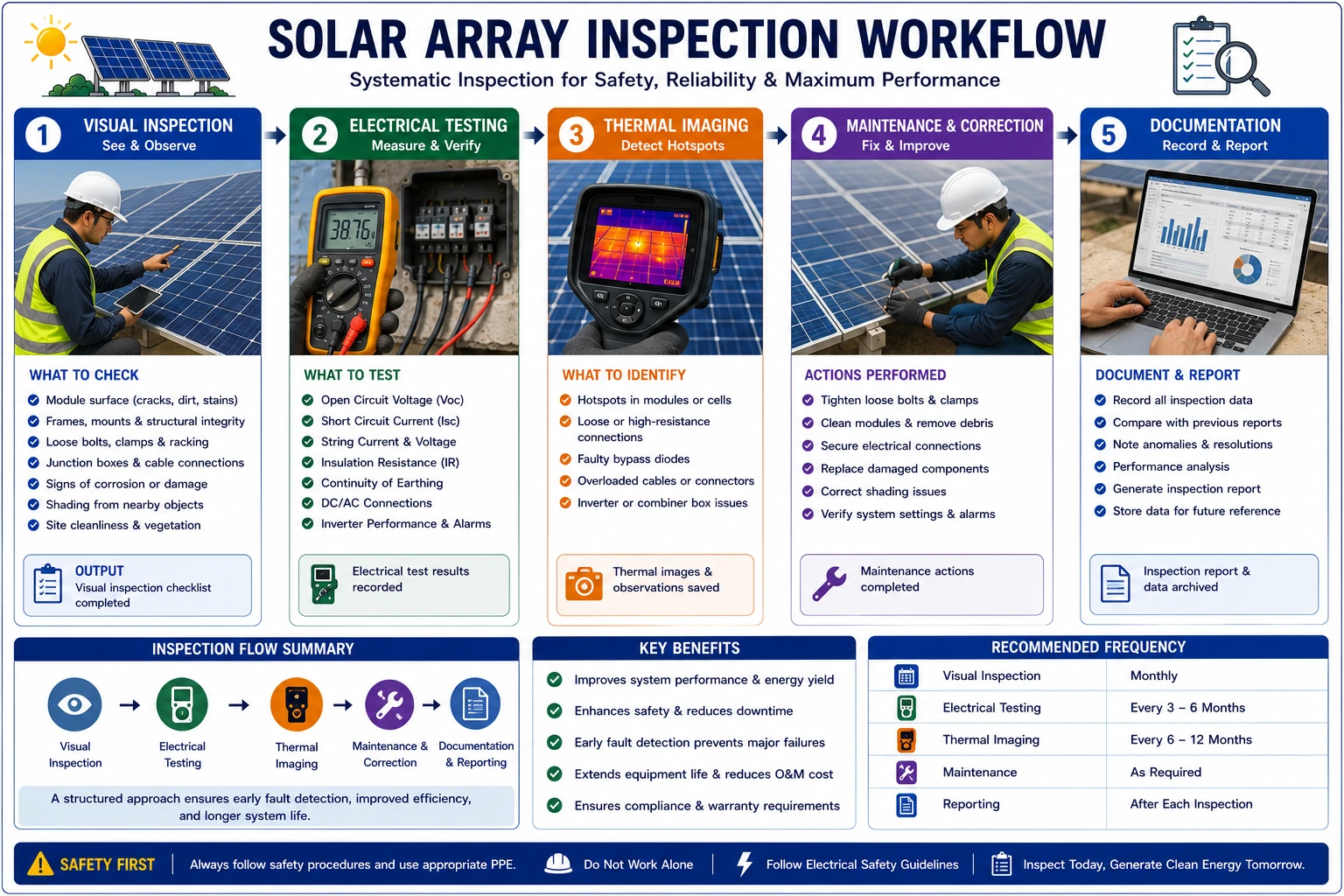
Step-by-Step Procedure to Check PV Module Performance
Step 1 – Review System Documentation
Before testing, review:
- Design drawings
- Previous maintenance records
- Manufacturer specifications
- Commissioning reports
This provides baseline performance values.
Step 2 – Verify Safe Working Conditions
Ensure:
- Suitable weather conditions
- Safe rooftop access
- Proper PPE
- Electrical safety procedures
Avoid testing during thunderstorms or unsafe weather.
Step 3 – Perform Visual Inspection
Inspect modules for:
- Dirt
- Cracks
- Loose connectors
- Damaged cables
- Corrosion
- Shading
Physical defects may influence performance measurements.
Step 4 – Measure Solar Irradiance
Using a pyranometer, measure the available sunlight. Record irradiance values before electrical testing.
Step 5 – Measure Module Temperature
Measure module surface temperature. Temperature corrections may be required when comparing results with standard test conditions.
Step 6 – Measure Open Circuit Voltage (Voc)
Disconnect the module or string according to approved procedures. Measure Voc using a digital multimeter. Compare measured values with manufacturer specifications.
Step 7 – Measure Short Circuit Current (Isc)
Measure Isc using appropriate test equipment and approved procedures. Avoid prolonged short-circuit testing.
Step 8 – Measure Operating Voltage and Current
With the system operating normally:
Record:
- Voltage
- Current
- Power output
Compare with expected operating values.
Step 9 – Perform Thermal Inspection
Use an infrared thermal camera to identify:
- Hotspots
- Overheated connectors
- Defective cells
- Loose electrical connections
Thermal imaging helps detect hidden problems.
Step 10 – Record Test Results
Document:
- Date
- Time
- Weather conditions
- Irradiance
- Module temperature
- Electrical measurements
- Observations
- Technician details
Update the maintenance logbook.
Comparing Measured Performance with Expected Values
Performance should be evaluated by considering:
- Manufacturer specifications
- Solar irradiance
- Temperature
- System age
- Site conditions
Minor variations are normal, but significant deviations require further investigation.
Common Causes of Poor PV Module Performance
Reduced output may result from:
- Dirt accumulation
- Shading
- Module degradation
- Loose connectors
- Damaged bypass diodes
- Corrosion
- Cable losses
- Hotspots
- Inverter faults
Proper diagnosis helps determine corrective actions.
Corrective Actions
Depending on inspection results:
- Clean dirty modules
- Remove shading sources where possible
- Tighten loose connections
- Repair damaged cables
- Replace faulty modules
- Replace damaged connectors
- Repair inverter faults
Always follow manufacturer recommendations.
Benefits of Routine Performance Testing
Improved Renewable Solar System Efficiency
Identifies performance losses early.
Higher Energy Production
Ensures modules operate close to their rated capacity.
Better Asset Management
Supports predictive maintenance and equipment planning.
Reduced Maintenance Costs
Early fault detection minimizes expensive repairs.
Improved Warranty Support
Performance records assist with warranty claims.
Conclusion
Routine performance testing of PV modules is a critical maintenance practice that ensures solar PV systems continue to operate safely, efficiently, and close to their designed performance throughout their operational life. By regularly measuring electrical output, evaluating environmental conditions, inspecting modules for defects, and comparing results with design specifications, technicians can detect performance degradation early, improve energy production, reduce operational costs, and extend equipment lifespan.
Systematic performance evaluation is an essential responsibility for solar installers, commissioning engineers, and operations and maintenance professionals. Furthermore, following technical recommendations and maintenance practices promoted by the Ministry of New and Renewable Energy, together with manufacturer guidelines, helps ensure safe, standards-compliant, and high-quality operation of renewable solar systems.
By implementing scheduled performance testing, using calibrated instruments, documenting measurements accurately, investigating abnormal results promptly, and carrying out timely corrective actions, solar professionals can optimize solar panel system cost, maximize renewable solar system reliability, improve solar electricity generation, and ensure the long-term success of residential, commercial, industrial, and utility-scale solar energy projects.
FAQs
Q1. Why is PV module performance testing important?
Ans: Performance testing verifies that solar panels are generating electricity according to their expected operating conditions, helping identify faults, degradation, and efficiency losses before they become major problems.
Q2. Which electrical parameters are commonly measured during PV module performance testing?
Ans: Common measurements include open circuit voltage (Voc), short circuit current (Isc), operating voltage, operating current, power output, insulation resistance, module temperature, and solar irradiance.
Q3. Why should irradiance and temperature be recorded during testing?
Ans: Solar panel performance depends heavily on sunlight intensity and module temperature. Recording these values allows technicians to interpret electrical measurements accurately and compare them with manufacturer specifications.
Q4. What can cause a PV module to produce lower-than-expected power?
Ans: Common causes include dirt accumulation, partial shading, module degradation, damaged cells, loose electrical connections, cable losses, faulty bypass diodes, inverter issues, and adverse environmental conditions.
Q5. How should performance testing results be documented?
Ans: Technicians should record the test date, module identification, weather conditions, irradiance, temperature, voltage, current, power output, observations, corrective actions, and technician details in the maintenance logbook.
Solar Power System Efficiency: How to Calculate for Residential, Industrial & Commercial Use
Understand and measure your solar system’s performance. Maximize energy output at home, industrial units, and commercial buildings
Utility Disconnect Installation in Solar PV Systems Guide
A step-by-step guide to utility disconnect installation in solar PV systems, including wiring, safety measures, and installation best practices.
Installation of DC Energy Meters in Solar PV Systems: Step-by-Step Guide
DC energy meters are used in solar PV systems to measure generated DC power and energy. This guide explains installation, wiring, testing, and safety procedures for solar installers.
From Solar Design to Site: Locating Footings for Solar Mounting Structures
A complete guide to translating solar design drawings into accurate footing locations on-site, including survey methods, marking techniques, and EPC best practices.
Solar Projects Challenges in India: Module Supply Shortages and Policy Delays Slow Growth
India’s utility-scale solar projects face delays due to module supply shortages and policy challenges, impacting the growth of renewable energy.

Net Metering and Its Advantages Explained: How Solar Users Save More on Energy Bills
Learn what Net Metering and its advantages mean for you—cut electricity costs, earn energy credits, and boost solar efficiency easily.
Solar for Pharma & Chemical Industries: Cost, Benefits, Installation & ROI in India
A complete guide on solar systems for the FMCG industry in India covering installation cost, benefits, ROI, system sizing, and the installation process.

Ground Mounted Solar Systems: Complete Guide for Commercial & Industrial Projects in India
Ground mounted solar systems are ideal for commercial and industrial projects with available land. This guide explains cost, land requirement, installation process, and ROI in India.