
Solar photovoltaic (PV) systems are complex electrical installations comprising interconnected components such as solar modules, inverters, batteries, charge controllers, combiner boxes, protection devices, energy meters, monitoring systems, communication equipment, and utility grid interfaces. While many operational issues can be identified and resolved through routine inspection, preventive maintenance, and standard troubleshooting procedures, certain faults may remain unresolved despite thorough testing and systematic diagnosis.
Some failures may involve intermittent electrical faults, hidden wiring defects, firmware issues, communication failures, internal inverter malfunctions, battery management system (BMS) errors, grid synchronization problems, or equipment requiring specialized diagnostic tools. In such situations, field technicians should never rely on guesswork, bypass safety features, or replace expensive components without evidence. Instead, the correct professional approach is to document all findings carefully and escalate the issue to supervisors, senior engineers, technical support teams, or authorized manufacturer service personnel for further investigation.
A structured escalation process ensures that unresolved faults receive expert attention, minimizes unnecessary equipment replacement, reduces system downtime, protects personnel safety, and maintains compliance with manufacturer guidelines and industry standards. It also improves communication between field technicians, project managers, EPC contractors, operations and maintenance (O&M) teams, and equipment manufacturers.
Snowing when and how to escalate unresolved faults is an essential professional competency for solar installers, commissioning engineers, EPC contractors, and operations and maintenance personnel.
This comprehensive guide explains when escalation is necessary, the standard escalation procedure, documentation requirements, communication practices, safety considerations, and industry best practices.
Why Is Fault Escalation Important?
Not every fault can be identified or repaired during field maintenance. Escalation helps to:
- Prevent incorrect repairs
- Improve troubleshooting accuracy
- Protect expensive equipment
- Reduce system downtime
- Improve renewable solar system reliability
- Increase solar electricity generation
- Maintain safety
- Protect manufacturer warranty
Professional escalation ensures faults are resolved efficiently and correctly.
Situations That Require Escalation
Technicians should escalate issues when:
- Faults remain unidentified after standard troubleshooting.
- Inverter displays persistent internal error codes.
- Battery Management System (BMS) reports unexplained alarms.
- Communication failures continue after inspection.
- Insulation resistance values remain abnormal.
- Repeated breaker trips occur without an identifiable cause.
- Ground faults cannot be located.
- Monitoring data is inconsistent despite normal field measurements.
- Specialized diagnostic tools are required.
- Manufacturer intervention is recommended.
Why Should Technicians Avoid Guesswork?
Replacing components without confirming the root cause may:
- Increase repair costs
- Damage healthy equipment
- Extend downtime
- Create additional electrical faults
- Void equipment warranties
- Reduce customer confidence
A structured escalation process prevents unnecessary repairs.
Personnel Involved in Fault Escalation
Depending on the project, faults may be escalated to:
- Site supervisor
- O&M manager
- Senior commissioning engineer
- Electrical design engineer
- EPC project manager
- Manufacturer technical support
- Authorized inverter service engineer
- Battery supplier technical team
- Utility representative (for grid-related issues)
Clear communication improves problem resolution.
Tools Used Before Escalation
Field technicians typically use:
- Digital multimeter
- Clamp meter
- Insulation resistance tester
- Earth resistance tester
- Infrared thermal camera
- Power quality analyzer
- Inverter monitoring software
- Data logger
- Personal Protective Equipment (PPE)
Only calibrated instruments should be used before escalating unresolved faults.
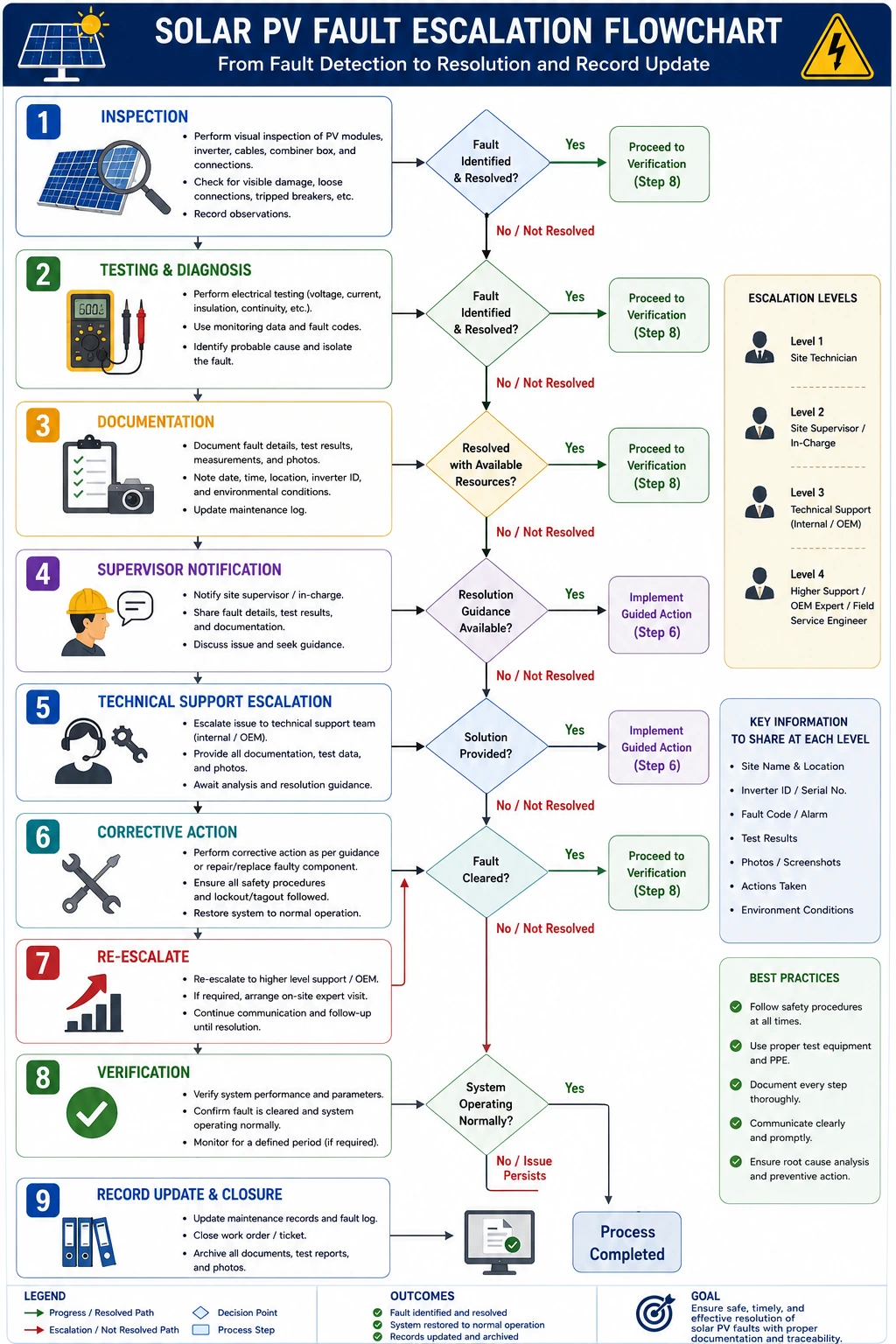
Step-by-Step Fault Escalation Procedure
Step 1 – Ensure Safety
Before continuing troubleshooting:
- Follow Lockout/Tagout (LOTO) procedures where applicable.
- Isolate equipment if required.
- Wear appropriate PPE.
- Ensure the work area is safe.
Safety should never be compromised during fault investigation.
Step 2 – Complete Standard Troubleshooting
Verify:
- DC voltages
- AC voltages
- Current measurements
- Protection devices
- Grounding
- Communication systems
- Inverter status
- Battery condition
- Cable continuity
Escalation should occur only after standard troubleshooting procedures have been completed.
Step 3 – Record All Test Results
Document:
- Voltage measurements
- Current measurements
- Insulation resistance
- Earth resistance
- Fault codes
- Environmental conditions
- Equipment status
Accurate measurements assist senior engineers.
Step 4 – Collect Supporting Evidence
Where permitted, gather:
- Photographs
- Thermal images
- Monitoring screenshots
- Event logs
- Alarm history
- Data logger reports
Supporting evidence speeds up diagnosis.
Step 5 – Prepare the Fault Report
The report should include:
- Site name
- Project identification
- Date and time
- Equipment details
- Serial numbers
- Fault description
- Test results
- Observations
- Actions already performed
- Remaining concerns
A complete report improves communication.
Step 6 – Inform the Appropriate Superior
Notify the designated authority according to company procedures.
Provide:
- Inspection report
- Test data
- Photographs
- Monitoring records
- Equipment identification
Timely reporting minimizes delays.
Step 7 – Follow Technical Guidance
After escalation:
- Follow instructions provided by senior engineers or manufacturer support.
- Do not perform unauthorized repairs.
- Carry out only approved corrective actions.
Step 8 – Verify Repairs
Once expert guidance has been implemented:
Verify:
- Stable inverter operation
- Normal voltage
- Correct current flow
- Alarm clearance
- Reliable energy generation
- Proper monitoring system operation
Ensure the fault has been fully resolved.
Step 9 – Update Maintenance Records
Record:
- Final diagnosis
- Corrective action
- Parts replaced
- Technical support received
- System status
- Technician details
Complete records support future troubleshooting.
Information to Include in the Escalation Report
Every report should include:
- Site location
- Customer details
- Equipment make and model
- Serial numbers
- Firmware version (where applicable)
- Date and time
- Fault description
- Electrical measurements
- Alarm codes
- Environmental conditions
- Photographs
- Corrective actions attempted
- Outstanding issues
Benefits of Proper Fault Escalation
Improved Renewable Solar System Reliability
Expert diagnosis improves long-term system performance.
Increased Solar Electricity Generation
Faster fault resolution minimizes energy production losses.
Enhanced Safety
Avoids unsafe repair practices and protects personnel.
Better Equipment Protection
Prevents unnecessary replacement of healthy components.
Reduced Maintenance Costs
Correct diagnosis reduces repeat service visits and unnecessary repairs.
Conclusion
Escalating unresolved faults is an important part of professional solar PV system maintenance. While field technicians are trained to perform inspections, testing, and standard troubleshooting, some electrical, electronic, communication, or software-related issues require advanced technical expertise and specialized diagnostic equipment. By completing systematic troubleshooting, accurately documenting all findings, collecting supporting evidence, and promptly informing supervisors or authorized technical support teams, technicians can ensure that complex faults are resolved safely, efficiently, and in accordance with manufacturer recommendations.
Recognizing the limits of field-level troubleshooting and following a structured escalation process is a key competency for solar installers, EPC contractors, commissioning engineers, and operations and maintenance professionals. Furthermore, adhering to technical recommendations and safety practices promoted by the Ministry of New and Renewable Energy, together with manufacturer guidelines and local electrical standards, ensures that unresolved faults are managed professionally and in compliance with industry requirements.
By maintaining detailed maintenance records, using calibrated testing instruments, avoiding unnecessary component replacement, communicating effectively with senior technical personnel, and escalating complex issues without delay, solar professionals can optimize solar panel system cost, improve renewable solar system reliability, maximize solar electricity generation, reduce the cost of solar per kWh installed, and ensure the long-term success of residential, commercial, industrial, and utility-scale solar energy projects.
FAQs
Q1. When should a technician escalate a fault in a solar PV system?
Ans: A fault should be escalated when standard troubleshooting has been completed but the root cause cannot be identified, when specialized diagnostic equipment is required, or when the manufacturer recommends expert intervention.
Q2. Why is it important not to guess the cause of a fault?
Ans: Guessing the cause may lead to unnecessary replacement of expensive components, increased downtime, additional equipment damage, and safety risks. A documented escalation process ensures that the issue is diagnosed correctly.
Q3. What information should be included in a fault escalation report?
Ans: The report should contain equipment details, fault description, electrical measurements, alarm codes, inspection observations, photographs (where permitted), maintenance history, and all corrective actions already performed.
Q4. Who should receive an escalated fault report?
Ans: Depending on the project, the report may be submitted to the site supervisor, senior engineer, O&M manager, EPC project manager, manufacturer technical support team, or authorized service technician.
Q5. How does timely escalation improve solar PV system performance?
Ans: Prompt escalation allows qualified experts to identify complex faults more quickly, reducing downtime, restoring solar electricity generation, preventing further equipment damage, and improving the long-term reliability of the renewable solar system.
Safety Hazard Identification & Mitigation in Solar PV
A complete guide to identifying and mitigating safety hazards in solar PV systems, including risk assessment, hazard control, preventive measures, and workplace safety practices.

Everything You Need to Know About Solar System Earthing
Power factor after solar installation often fluctuates due to system design and load patterns. Learn the key causes, challenges, and solutions for better efficiency.
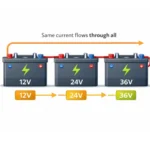
Series Connection of PV Modules – Effect on Voltage and Current
Connecting PV modules in series is a common practice in solar installations. This guide explains how series connections affect voltage and current and why they are used in solar PV systems.
Civil Structural General Arrangement (GA) Drawing in Solar Projects: Complete Design & Layout Guide
A Civil Structural General Arrangement (GA) drawing in solar projects is a detailed layout that defines the placement of solar modules, mounting structures, inverters, and civil foundations. It plays a crucial role in ensuring accurate design, optimal space utilization, and smooth execution of both rooftop and ground-mounted solar installations. This guide explains the key components, design considerations, and best practices for creating effective GA drawings in solar EPC projects.
Cable Continuity Testing in Solar Installations Guide
A complete guide to cable termination in solar installations, including tools, step-by-step methods, and best practices for safe connections.
PV System Maintenance Tools & Equipment Guide
A complete guide to performing the solar PV anti-islanding test, ensuring safe grid-connected operation, regulatory compliance, and reliable inverter performance.

Solar for Metal & Fabrication Units: Cost, Benefits and Installation in India
A practical guide on solar for metal and fabrication units in India covering installation cost, benefits, system options, and the installation process.

Grounding Conductor Sizing for Solar PV Systems
A complete guide to determining grounding conductor size for solar PV systems, ensuring safe, compliant, and reliable installations.