
When a business installs a solar plant, one of the biggest questions is not simply “How much electricity is the plant generating?” but “Is the plant generating as much as it should, considering the sunlight available?”
This is where Solar Plant Performance Ratio (PR) becomes important.
For commercial and industrial (C&I) solar plants, PR is a useful performance indicator because it relates the plant’s actual energy output to the solar resource available at the site. It helps businesses and O&M teams identify performance losses, track plant health, and understand whether the solar project is delivering the expected value.
PR is therefore much more than a number on a solar monitoring dashboard. It can provide an early indication that something in the plant needs attention.
What Is Solar Plant Performance Ratio?
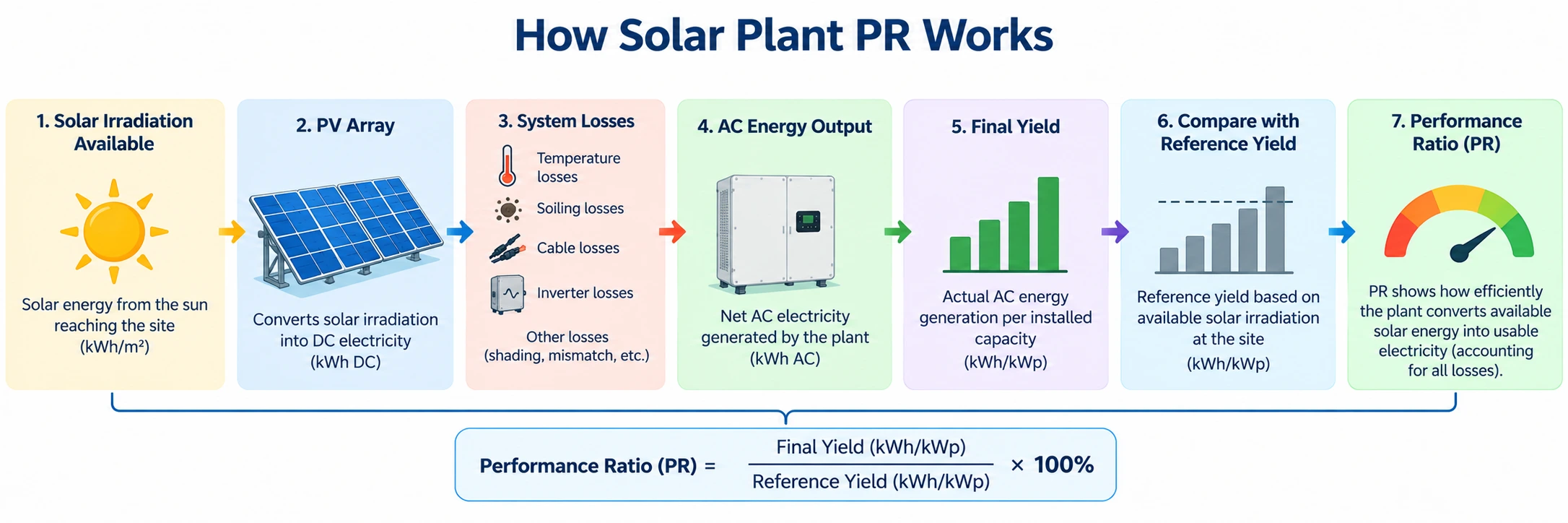
Performance Ratio is a measure of how effectively a PV plant converts the available solar resource into electrical energy.
In simple terms:
PR tells us how well the solar plant is performing after considering the solar irradiation available to it.
Under IEC 61724-1, PR is defined as the ratio of the system’s final yield to its reference yield. The reference yield is based on the measured solar irradiation and a defined reference irradiance.
A simplified representation is:
- PR = Final Yield ÷ Reference Yield × 100
The exact calculation and measurement boundary should always be clearly defined when PR is used for contracts, performance guarantees, or formal plant assessment.
Why Is PR Important for Businesses?
A C&I solar plant is a business investment. The company expects the system to reduce grid electricity consumption, lower energy costs, and provide long-term financial benefits.
If the plant continuously operates below its expected performance, the business may generate less solar electricity than planned.
PR can help businesses:
- Track overall plant performance
- Identify unusual performance changes
- Evaluate O&M effectiveness
- Compare performance across periods
- Investigate energy losses
- Support performance guarantees and reviews
- Understand long-term plant health
- Protect expected financial returns
Instead of simply seeing that generation has fallen, PR provides another layer of information about why the plant may not be performing as expected.
How Is PR Different from Solar Generation?
This distinction is very important.
Suppose a solar plant generates 100 MWh in one month and 120 MWh in another month. It would be incorrect to automatically conclude that the plant performed better during the second month.
The amount of sunlight may have been much higher during the second month.
PR considers the solar resource when evaluating plant performance. This makes it more useful for performance analysis than looking at electricity generation alone.
Therefore:
- Energy Generation = How much electricity was produced
PR = How effectively the plant performed relative to the available solar resource, under the defined calculation method
What Factors Affect Solar Plant PR?
Several technical and environmental factors can influence PR.
1. Solar Irradiation
Solar irradiation is the energy received from sunlight on the plane of the solar array.
Because PR uses irradiation as part of its reference, accurate irradiation measurement is important for reliable performance analysis.
2. Module Temperature
Solar modules generally lose electrical efficiency as their operating temperature increases.
This means that PR can vary with seasonal and weather conditions. Standard PR is not automatically temperature-corrected, so businesses should be careful when comparing PR across very different seasons.
3. Soiling
Dust, dirt, bird droppings, and other deposits on modules can reduce the sunlight reaching the cells.
For C&I facilities located in dusty industrial environments, roadsides or areas with construction activity, soiling can become an important performance-loss factor.
4. Shading
Shadows from buildings, trees, structures and nearby equipment can reduce the output of affected modules.
If shading changes over the day or season, its effect should be considered during detailed performance analysis.
5. Inverter Losses
The inverter converts DC electricity from the solar array into AC electricity.
Conversion losses, overheating, derating, faults and downtime can all affect the energy delivered by the plant.
6. Cable and Electrical Losses
Electrical energy is lost as it travels through cables, connectors, transformers and other components.
Poor connections or damaged equipment can create additional losses and may require investigation.
7. Module Degradation
Solar modules gradually lose some generating capability as they age.
Expected degradation should be considered when assessing long-term plant performance. An unexpected decline, however, may require a more detailed investigation.
8. Plant Availability
If an inverter or other important equipment is unavailable, the affected portion of the plant cannot generate electricity during that period.
Therefore, downtime can have a direct effect on plant energy performance.
Is There a “Good” PR for Every Solar Plant?
There is no single PR value that should be treated as universally good for every solar plant.
PR depends on factors such as:
- Plant design
- Location
- Climate
- Module technology
- Inverter configuration
- Temperature
- Soiling
- Shading
- System losses
- Plant age
- Measurement methodology
NREL specifically notes that different definitions of PR can produce different results, and the definition of the reference yield should be stated when interpreting or comparing PR values.
Therefore, businesses should compare their PR against project-specific expectations, historical trends and the agreed calculation method, rather than relying on a universal benchmark.
Why PR Trend Is More Useful Than One PR Reading
A single PR value does not always tell the complete story.
For example, a plant may have a lower PR during a particularly hot period. That does not automatically mean there is a fault.
Instead, businesses should look at:
- Daily → Weekly → Monthly → Seasonal → Annual PR Trends
A gradual or sudden decline that cannot be explained by normal operating conditions deserves further investigation.
This is particularly useful for identifying performance deterioration before it becomes a major energy loss.
How Should Businesses Monitor PR?
PR should be reviewed along with other plant parameters rather than in isolation.
A good C&I monitoring process can include:
- Energy generation
- Plane-of-array irradiation
- PR
- Plant availability
- Inverter-wise generation
- Specific yield
- Module temperature
- Equipment alarms
- Grid availability
- Cleaning records
- Maintenance activities
- Historical trends
Modern monitoring and SCADA systems can help collect and display much of this information.
The key is to convert the data into useful decisions.
What Happens When PR Falls?
A sustained fall in PR should trigger an investigation.
A basic process can be:
- PR Decline → Verify Data → Check Irradiation → Check Availability → Analyse Inverters → Check Soiling/Shading → Inspect Equipment → Identify Loss → Correct → Re-monitor
For example, if irradiation is normal but PR suddenly decreases, the O&M team may investigate inverter downtime, string-level issues, excessive soiling or other system losses.
Any electrical testing, repair or isolation should be carried out by appropriately qualified personnel according to site safety procedures and manufacturer instructions.
PR and the Financial Performance of a Solar Project
PR can also be connected to the financial side of a solar investment.
When a solar plant performs below expectations, the business may generate less electricity and therefore receive lower savings from avoided grid electricity purchases.
The relationship can be understood as:
- Lower Performance → Lower Generation → Higher Grid Dependence → Lower Energy Savings → Potentially Longer Payback
This is why PR monitoring should not be restricted to the engineering team. For large C&I projects, management, finance, and energy teams can also benefit from understanding the performance trend.
PR vs Other Solar Performance Parameters
PR is useful, but it should not be used alone.
Parameter | What if Helps Show |
Energy Generation | Total electricity produced |
Specific Yield | Energy produced per unit of installed capacity |
Plant Availability | How much time the plant is operational |
Inverter-wise Generation | Performance of individual inverter sections |
PR | Overall performance relative to the defined solar reference |
Performance Index | Comparison against a more detailed expected/modelled performance |
For some applications, a model-based performance index can provide a more detailed comparison because it can account for factors that a simple rating-based PR may not fully represent.
Practical PR Monitoring Checklist
Businesses and O&M teams can regularly review:
- Actual PR
- Expected/project PR
- PR calculation methodology
- Solar irradiation
- Energy generation
- Plant availability
- Inverter-wise generation
- Specific yield
- Module temperature
- Soiling condition
- Shading
- Equipment alarms
- Cleaning records
- Maintenance history
- Long-term PR trend
Conclusion
Solar Plant Performance Ratio (PR) is one of the most useful indicators for understanding how effectively a PV plant is operating relative to the solar resource available to it.
For C&I businesses, however, PR should never be treated as just a single percentage on a dashboard. The value becomes much more meaningful when it is analysed alongside irradiation, temperature, energy generation, plant availability, inverter-wise performance, maintenance records and historical trends.
Businesses should also remember that PR is methodology-dependent. Before comparing two plants or using PR for a performance guarantee, the reference yield, measurement boundary and calculation method should be clearly defined.
For companies investing in solar energy, solar roof panels or a large solar plant, proper PR monitoring can help identify performance losses, improve O&M decisions and protect the expected financial value of the project.
Ultimately, the purpose of PR is simple: to turn solar plant data into a clearer understanding of performance. When that information is monitored consistently and followed by timely corrective action, businesses can make better decisions and get greater long-term value from their renewable energy investment.
FAQs
Q1. What is Performance Ratio in a solar plant?
Ans: Performance Ratio is an indicator that compares the final yield of a PV system with its defined reference yield, helping evaluate the effect of system losses relative to the available solar resource.
Q2. Why is PR important for C&I businesses?
Ans: PR helps businesses understand whether their solar plant is performing as expected rather than relying only on total electricity generation.
Q3. What is the basic formula for solar plant PR?
Ans: A simplified relationship is:
PR (%) = Final Yield ÷ Reference Yield × 100
The exact calculation should be based on the defined methodology and measurement boundaries used for the project.
Q4. Is 80% PR always considered good?
Ans: Not necessarily. There is no universal PR value that applies to every project. Plant design, climate, technology, measurement method, and other conditions must be considered.
Q5. Does temperature affect PR?
Ans: Yes. Standard PR can vary with temperature because conventional PR does not automatically apply a temperature correction. This is one reason seasonal trends should be interpreted carefully.
What Is an Array Junction Box in Solar PV Modules? | Complete Guide
The Array Junction Box (AJB) is a critical component in solar PV systems, connecting multiple solar modules and ensuring safe flow of electricity to the inverter. This blog explains what an AJB is, its key features, types, and why it is essential for both residential and commercial solar installations. Understand how AJBs protect your system from overload, short circuits, and environmental factors while maintaining optimal performance.

How to Check Solar PV Modules for Physical Damage
A complete guide on how to clean solar PV modules, including safe cleaning techniques, recommended tools, maintenance schedules, and best practices to maximize energy output.

Optimizing Solar Layout for DC Combiner Box Placement
A complete guide to choosing the best location for DC combiner box placement to improve safety, cable routing, and solar system efficiency.

Solar PV Conduit & Cable Routing Plan Guide
A complete guide to preparing solar PV conduit and cable routing plans, including layout design, routing methods, and installation best practices.

What Is Solar Performance Ratio (PR)? Meaning, Formula & Importance
Solar Performance Ratio (PR) is a key indicator of how efficiently a solar power system converts available sunlight into usable electricity. This guide explains what PR is, how it is calculated, why it matters, and how it directly impacts your solar system’s actual energy output.

Sustainable Solar Panel Disposal: Recycling for a Greener Future
Sustainable solar panel disposal ensures old or damaged panels are recycled responsibly, reducing waste and environmental harm. By adopting eco-friendly recycling and reuse practices, we can recover valuable materials, lower carbon impact, and make solar energy truly sustainable from installation to end-of-life.
Solar PV Start-Up and Shutdown Procedures
A complete guide to demonstrating safe start-up and shutdown procedures for solar PV systems, covering pre-start checks, equipment sequencing, isolation, inverter operation, and system verification.
Group Net Metering for Solar Projects: A Smart Way to Maximize Solar Energy Generation
Discover how group net metering allows multiple participants to share solar energy from a single project, reduce electricity bills, and enhance solar efficiency.