
Installing a solar plant is not just about mounting panels and connecting an inverter. A successful renewable solar project begins with proper customer requirement assessment. Without understanding the client’s energy consumption, financial expectations, rooftop condition, and long-term goals, even a technically sound system may fail to deliver expected performance.
Before finalizing solar panel system cost, solar installation charges, and estimating the cost of solar per kWh installed, installers must conduct systematic evaluation procedures. Professional solar technicians must be trained in customer assessment techniques before designing a solar energy system.
This blog explains the different key assessment methods used to identify customer requirements prior to installing a solar plant.
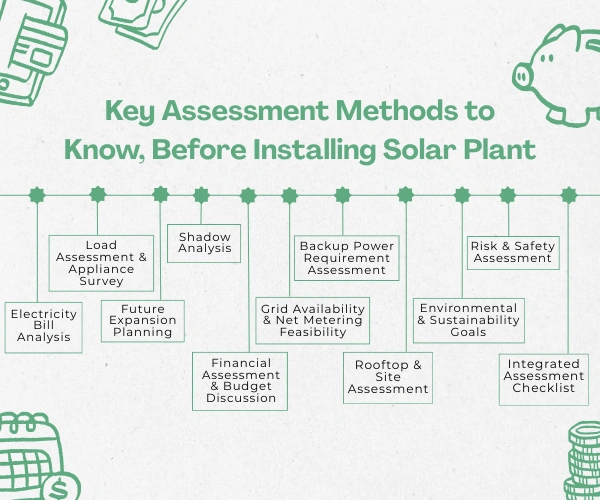
Electricity Bill Analysis
Purpose
Electricity bill analysis is the first and most important step in understanding customer requirements.
What to Assess
- Monthly energy consumption (kWh)
- Sanctioned load (kW)
- Tariff category (residential/commercial)
- Billing pattern (average, seasonal variation)
Why It Is Important
- Deciding optimal solar plant capacity
- Estimating solar electricity generation
- Calculating payback period
- Reducing the cost of solar per kWh installed
For example:
- If a home consumes 600 units per month, the system capacity must be designed accordingly for efficient solar energy for home use.
Load Assessment and Appliance Survey
What It Involves
Installers must evaluate:
- Type of appliances
- Rated power of each appliance
- Daily usage hours
- Peak load demand
Importance
- Load assessment ensures:
- Correct inverter sizing
- Battery selection (for hybrid/off-grid systems)
- Avoidance of system overloading
Incorrect load estimation increases solar installation charges due to redesign.
Rooftop and Site Assessment
For solar panels in rooftop installations, physical inspection is essential.
Key Parameters to Evaluate
- Available shadow-free area
- Roof orientation (South-facing preferred in India)
- Tilt angle suitability
- Structural strength
- Obstructions (water tanks, antennas, trees)
Importance
- Proper site assessment:
- Maximizes solar electricity output
- Reduces shading losses
- Improves renewable solar performance
- Optimizes solar panel system cost
Shadow Analysis
Shadow from:
- Adjacent buildings
- Trees
- Parapet walls can significantly reduce system output.
Installers may use:
- Shadow analysis tools
- Solar path diagrams
- Manual observation methods
Proper shading assessment ensures:
- Reduced energy loss
- Lower cost of solar per kWh installed
- Improved renewable energy technology efficiency
Financial Assessment and Budget Discussion
Understanding the customer’s financial capacity is critical.
What to Assess
- Budget range
- Interest in loan or EMI options
- Awareness of the government solar subsidy scheme
- Payback period expectations
Importance
- Financial assessment helps in:
- Recommending an appropriate system size
- Deciding between an on-grid, off-grid, or hybrid system
- Aligning the smart solar panel price with customer affordability
Grid Availability and Net Metering Feasibility
For grid-connected renewable solar systems:
- Check grid stability
- Confirm net metering eligibility
- Verify local DISCOM regulations
This ensures:
- Compliance under the government solar subsidy scheme
- Proper approval process
- Accurate solar energy installation cost estimation
Backup Power Requirement Assessment
Some customers prioritize backup during power cuts.
Installers must determine:
- Required backup load
- Backup duration
- Battery capacity requirement
This affects:
- Inverter type selection
- Solar panel system cost
- Solar installation charges
Future Expansion Planning
Customers may plan:
- Electric vehicle charging
- Additional appliances
- Commercial expansion
Considering future expansion:
- Prevents redesign
- Saves long-term cost
- Improves renewable solar scalability
Environmental and Sustainability Goals
Some customers aim to:
- Reduce carbon footprint
- Achieve energy independence
- Adopt renewable energy technology
Understanding motivation helps in designing an appropriate solar plant configuration.
Risk and Safety Assessment
Installers must evaluate:
- Earthing requirement
- Lightning protection need
- Roof waterproofing
- Fire safety compliance
Proper risk assessment reduces maintenance costs and improves solar electricity system reliability.
Integrated Assessment Checklist
Before finalizing a solar energy for home use system, ensure:
- Electricity bill analysis completed
- Load survey conducted
- Rooftop measured and inspected
- Shadow analysis done
- Budget discussed
- Grid feasibility checked
- Safety inspection performed
Impact on Solar Panel System Cost
Accurate assessment helps to:
- Avoid undersizing or oversizing
- Reduce unnecessary solar installation charges
- Improve system ROI
- Optimize the cost of solar per kWh installed
- Enhance performance under subsidised solar panels for home projects
Improper assessment leads to:
- Performance dissatisfaction
- Reduced solar electricity output
- Increased service cost
Conclusion
A solar plant installation begins long before panels are mounted. Comprehensive customer requirement assessment ensures technical accuracy, financial feasibility, and long-term satisfaction. From electricity bill analysis and load survey to rooftop inspection and financial discussion, each assessment method plays a critical role in determining solar panel system cost and overall project success.
Professional installers must master these evaluation techniques to deliver efficient renewable solar systems. Accurate assessment minimizes solar installation charges, optimizes the cost of solar per kWh installed, and ensures reliable solar energy for home use performance.
By conducting systematic and structured customer requirement analysis, installers can enhance renewable energy technology adoption and build trust in sustainable solar plant solutions across residential and commercial sectors.
FAQs
Q1. Why is electricity bill analysis important before installing a solar plant?
Ans: It helps determine the correct system capacity and estimate solar electricity generation accurately.
Q2. How does rooftop assessment affect solar panel system cost?
Ans: Proper site evaluation maximizes panel placement and reduces shading losses, improving cost efficiency.
Q3. What happens if the load assessment is incorrect?
Ans: Incorrect load calculation can cause inverter mismatch, increasing solar installation charges.
Q4. Is shadow analysis mandatory for rooftop solar systems?
Ans: Yes. Shading directly reduces renewable solar output and increases the cost of solar per kWh installed.
Q5. How does financial assessment help customers?
Ans: It aligns system design with budget, loan options, and government solar subsidy scheme benefits.

Solar Mounting Structure Installation: Complete Project Guide
A complete guide to solar mounting structures types in PV systems, covering fixed tilt, tracking, and rooftop installations for installers.
UP Discoms Propose 9.21% Electricity Tariff Hike for 2015-16
Uttar Pradesh Discoms propose a 9.21% increase in electricity tariffs for 2015-16, impacting residential, commercial, and industrial consumers across the state.
Latest Solar Mounting Structures: Smarter, Stronger, and More Efficient
Learn how the latest solar mounting structures in 2025 improve efficiency, reduce costs, and power the future of solar installations.
Monitoring Services for Solar Plants by Smart Roof Solar to Maximize Performance and Efficiency
Smart Roof Solar provides advanced monitoring services for solar plants to ensure maximum performance and efficiency. With real-time data tracking and intelligent analytics, our monitoring solutions help detect issues early, reduce downtime, and enhance the overall energy yield of your solar system.

Steps for Conducting a Load Assessment Before Solar Installation and Its Requirements
Load assessment is an essential step before installing a solar PV system. It helps determine electricity consumption and ensures accurate system sizing for optimal solar performance.
New IREDA Loan Scheme for Solar Rooftop Projects: Benefits, Eligibility & Interest Rates
India’s renewable energy push gets a major boost with the new IREDA loan scheme for solar rooftop projects. This scheme offers low-interest financing, simplified approvals, and better support for residential, commercial, and industrial consumers. Here’s a detailed look at its benefits, eligibility, interest rates, and how to apply for funding.
How to Calculate Savings from Rooftop Solar Solutions: A Complete Guide
Calculating savings from rooftop solar solutions is essential for planning your investment. This guide explains how to estimate cost reduction, return on investment, and long-term financial benefits for residential, commercial, and industrial solar projects.
How the RESCO Model Works in Solar: A Complete Guide for Industries
The RESCO model allows businesses to adopt solar with zero upfront investment. Under this model, a developer installs, owns, and operates the solar plant while you simply pay for the power you consume—making clean energy both affordable and hassle-free.