
Short Circuit Current (Isc) is one of the most important electrical parameters used to evaluate the performance, health, and efficiency of solar photovoltaic (PV) modules and arrays. It represents the maximum current generated by a solar PV module or string when the positive and negative terminals are directly connected with negligible resistance, creating a short-circuit condition. Measuring Isc is a standard practice during solar system installation, commissioning, preventive maintenance, troubleshooting, and performance verification.
For residential rooftop systems, commercial buildings, industrial facilities, and utility-scale solar power plants, routine measurement of short-circuit current helps verify that PV modules are operating as expected under prevailing environmental conditions. Significant deviations from the expected Isc value may indicate issues such as shading, dirt accumulation, damaged solar cells, degraded modules, loose electrical connections, faulty bypass diodes, or cable losses.
Unlike open-circuit voltage (Voc), which is measured without current flow, short-circuit current testing requires the module or string to be intentionally short-circuited using appropriate test equipment under controlled conditions. Because this test involves live DC electricity, it must only be performed by trained personnel using calibrated instruments, proper personal protective equipment (PPE), and approved electrical safety procedures.
Measuring short-circuit current is a fundamental electrical test that helps verify the electrical performance and operational health of solar PV modules and arrays.
This comprehensive guide explains the concept of short-circuit current, factors affecting Isc, testing methods, required tools, interpretation of results, safety precautions, documentation procedures, and industry best practices.
What is Short Circuit Current (Isc)?
Short Circuit Current (Isc) is the maximum current produced by a solar PV module or string when its positive and negative terminals are connected together with negligible resistance.
Under short-circuit conditions:
- Voltage becomes nearly zero.
- Current reaches its maximum value.
- The generated current depends mainly on available sunlight.
Manufacturers specify Isc under Standard Test Conditions (STC):
- Solar irradiance: 1000 W/m²
- Cell temperature: 25°C
- Air Mass (AM): 1.5
Actual field measurements may differ because environmental conditions vary.
Why is Measuring Short Circuit Current Important?
Routine Isc measurement helps verify the electrical health of a solar PV system.
It assists in:
- Performance verification
- Commissioning inspections
- Preventive maintenance
- Fault diagnosis
- Warranty evaluation
- Detecting degraded modules
- Identifying wiring issues
- Improving the renewable solar system reliability
Accurate Isc measurements support efficient solar electricity generation.
Factors Affecting Short Circuit Current
Several environmental and system-related factors influence Isc.
These include:
- Solar irradiance
- Module cleanliness
- Module temperature
- Partial shading
- Cell degradation
- Dust accumulation
- Cable resistance
- Manufacturing tolerances
- Module aging
Understanding these factors helps technicians evaluate results correctly.
Difference Between Voc and Isc
Parameter | Open Circuit Voltage (Voc) | Short Circuit Current (Isc) |
Circuit Condition | Open circuit | Short circuit |
Current Flow | Zero | Maximum |
Voltage | Maximum | Nearly zero |
Main Influence | Temperature | Solar irradiance |
Purpose | Voltage verification | Current generation verification |
Both tests are essential during commissioning and maintenance.
Typical Short Circuit Current Values
Isc varies depending on:
- Module wattage
- Cell technology
- Solar irradiance
- Manufacturer
Examples include:
Module Power Typical Isc
250 W | 8-9 A |
400 W | 10-13 A |
550 W | 13-15 A |
Always compare measured values with the manufacturer’s datasheet.
Tools Required for Measuring Isc
Accurate measurement requires appropriate equipment.
Common tools include:
PV analyzer
- Digital multimeter with current measurement capability
Clamp meter (for operating current verification)
- Short-circuit test adapter
Pyranometer
- Module temperature sensor
Inspection checklist
- Personal protective equipment (PPE)
All instruments should be calibrated before testing.
Personal Protective Equipment (PPE)
Technicians should wear:
- Safety helmet
- Electrical insulating gloves
- Safety glasses
- Safety shoes
- Arc-rated clothing where required
Appropriate PPE reduces electrical hazards during testing.
Step-by-Step Procedure for Measuring Short Circuit Current
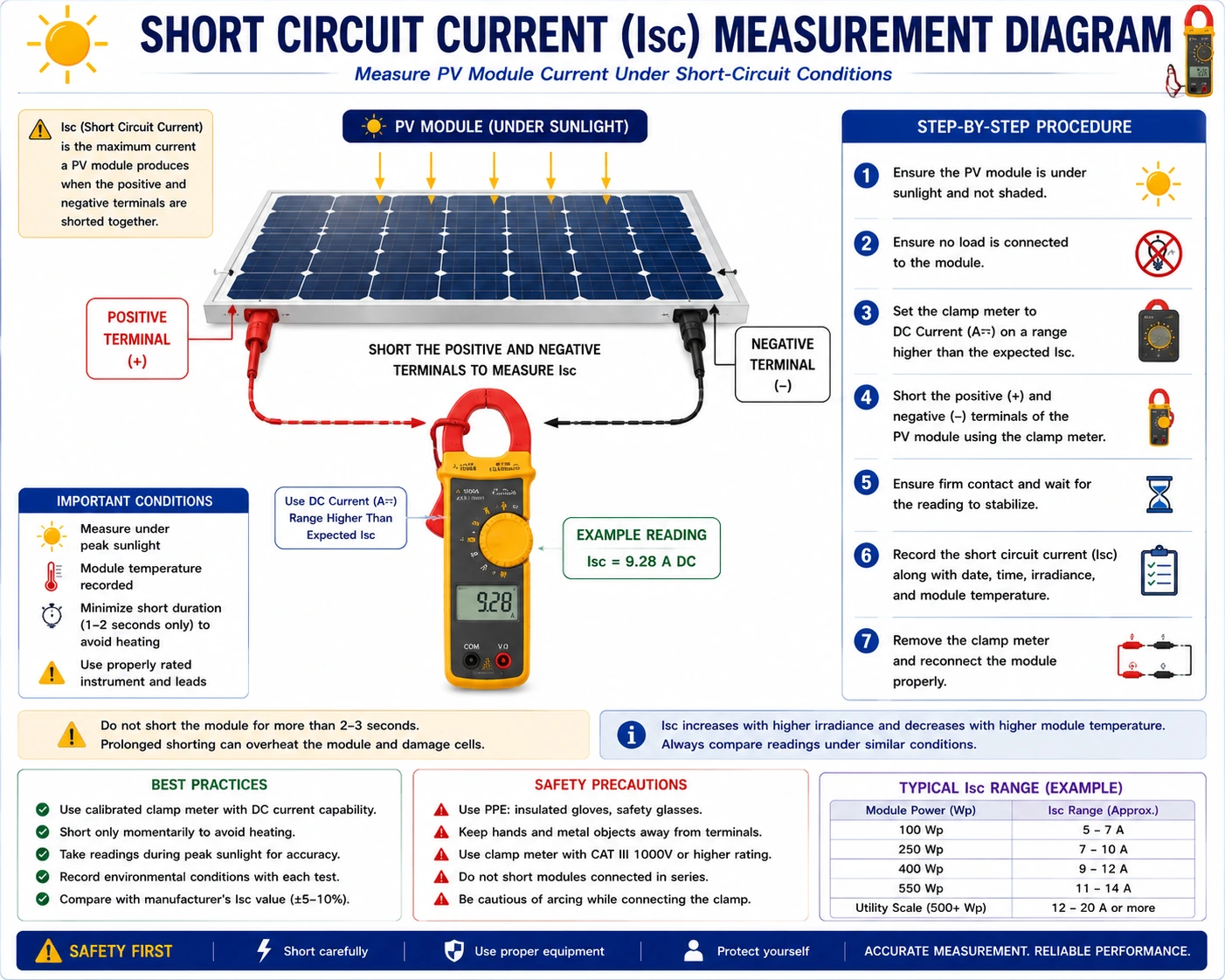
Step 1 – Review System Documentation
Before testing:
Review:
- Module datasheets
- Electrical drawings
- Previous maintenance records
- Commissioning reports
Determine the expected Isc value.
Step 2 – Verify Safe Working Conditions
Ensure:
- Safe rooftop access
- Stable work platform
- Proper weather conditions
- Electrical safety procedures
- Adequate lighting
Avoid testing during rain or thunderstorms.
Step 3 – Perform Visual Inspection
Inspect:
- PV modules
- Connectors
- Cables
- Junction boxes
- Combiner boxes
Look for:
- Cracks
- Dirt
- Corrosion
- Loose connectors
- Damaged insulation
Correct visible defects before electrical testing.
Step 4 – Measure Solar Irradiance
Using a pyranometer:
- Record the available solar irradiance.
Since Isc depends directly on sunlight intensity, irradiance measurements are essential for proper analysis.
Step 5 – Measure Module Temperature
Measure the module surface temperature. Temperature helps interpret test results accurately.
Step 6 – Prepare the Current Meter
Configure the multimeter or PV analyzer for:
- DC Current Measurement
Select the correct current range.
Step 7 – Connect the Test Instrument
Following manufacturer procedures:
- Connect the meter across the positive and negative terminals using approved testing methods that safely create a short-circuit condition.
- Avoid prolonged short-circuit testing.
Step 8 – Record the Current
Observe and record:
- Short Circuit Current (Isc)
- Module identification
- Date
- Time
- Weather conditions
- Irradiance
- Temperature
Accurate documentation is essential.
Step 9 – Compare Results
Compare measured values with:
- Manufacturer specifications
- Expected irradiance-adjusted values
- Previous maintenance records
Investigate significant deviations.
Step 10 – Complete Documentation
Update maintenance records with:
- Test results
- Environmental conditions
- Technician details
- Observations
- Corrective actions
Proper records support preventive maintenance.
Common Causes of Low Short Circuit Current
Reduced Isc may result from:
- Dust accumulation
- Partial shading
- Damaged cells
- Cracked modules
- Loose electrical connections
- Corroded connectors
- Faulty bypass diodes
- Cable losses
- Module degradation
Prompt corrective action improves system performance.
Importance of Environmental Conditions
Isc depends strongly on:
- Solar irradiance
- Module cleanliness
- Weather conditions
Unlike Voc, Isc increases significantly with increasing sunlight.
Environmental measurements should always accompany Isc testing.
Conclusion
Measuring short-circuit current is a critical electrical test that plays an essential role in the installation, commissioning, inspection, troubleshooting, and preventive maintenance of solar PV systems. Regular Isc testing helps verify the current-generating capability of PV modules, identify performance losses, detect electrical faults, and ensure that solar arrays continue to operate efficiently under varying environmental conditions. When combined with visual inspections, irradiance measurements, and other electrical tests, Isc measurements provide valuable insight into the overall health and reliability of a renewable solar system.
Routine measurement of short-circuit current is a standard practice for solar installers, commissioning engineers, EPC contractors, and operations and maintenance professionals. Furthermore, following technical recommendations and testing procedures promoted by the Ministry of New and Renewable Energy, together with manufacturer guidelines, ensures safe, accurate, and standards-compliant evaluation of solar PV system performance.
By using calibrated testing instruments, considering environmental conditions during analysis, maintaining detailed maintenance records, performing regular inspections, and responding promptly to abnormal test results, solar professionals can optimize solar panel system cost, maximize renewable solar system reliability, improve long-term solar electricity generation, and ensure the continued success of residential, commercial, industrial, and utility-scale solar energy projects.
FAQs
Q1. What is the short-circuit current (Isc) in a solar PV module?
Ans: Short circuit current (Isc) is the maximum current generated by a solar PV module when its positive and negative terminals are directly connected under controlled testing conditions, resulting in nearly zero output voltage.
Q2. Why is measuring Isc important?
Ans: Measuring Isc helps verify module performance, detect faulty or degraded panels, identify wiring issues, assess the effects of shading or dirt, and support commissioning and preventive maintenance activities.
Q3. Which instrument is commonly used to measure short-circuit current?
Ans: A calibrated digital multimeter with current measurement capability, a PV analyzer, or a dedicated short-circuit testing device is commonly used, following approved safety procedures.
Q4. Why does the short-circuit current change during the day?
Ans: Short-circuit current depends primarily on solar irradiance. As sunlight intensity changes due to weather, cloud cover, or the position of the sun, the measured Isc value also changes.
Q5. What information should be recorded during an Isc test?
Ans: Technicians should record the measured Isc, module or string identification, date, time, weather conditions, solar irradiance, module temperature, technician details, observations, and any corrective actions taken.
Solar Module Support & Racking Frame Installation
A practical guide to solar racking frame installation, covering module support structures, alignment, and best practices for reliable PV systems.
Solar Cable Guide | Types, Sizing & Specifications for PV Systems
Solar cables play a critical role in ensuring efficient and safe power transmission in PV systems. This guide explains cable types, specifications, sizing methods, and best practices for selecting the right solar cables.
Solar System for FMCG Industry: Cost, Benefits, Installation & ROI in India
A complete guide on solar systems for the FMCG industry in India covering installation cost, benefits, ROI, system sizing, and the installation process.
Installation of DC Energy Meters in Solar PV Systems: Step-by-Step Guide
DC energy meters are used in solar PV systems to measure generated DC power and energy. This guide explains installation, wiring, testing, and safety procedures for solar installers.
Optimum Solar Plant Capacity for Industries
A complete guide to sizing a solar plant for an industrial facility, covering electricity consumption, peak demand, rooftop space, load patterns, grid export limits, and financial feasibility.
Solar String Sizing Check: Did Your Installer Get It Right?
Worried your rooftop solar strings might be sized incorrectly? Check these tips to ensure your Solar PV system is installed for maximum efficiency and safety
Rooftop Solar Installation Cost in India: Complete 2026 Guide for Homes and Businesses
This 2026 guide explains the rooftop solar installation cost in India for homes and businesses. Learn price per kW, subsidies, ROI, payback period, and factors affecting system cost.

Solar ROI vs Payback Period Explained for Commercial & Industrial Projects
Compare payback period and ROI for solar systems. Discover how businesses should evaluate solar investments effectively.