
In solar power systems, how components are connected plays a crucial role in overall performance, efficiency, and safety. For every solar installer, understanding series and parallel connections is not optional; it is a fundamental requirement. The way solar panels, batteries, and loads are connected determines system voltage, current, inverter compatibility, and energy output.
This guide provides a complete explanation of connections in series and parallel, how each works, the differences between them, and why this knowledge is critical for solar PV installers.
What Is an Electrical Connection?
An electrical connection refers to the method of linking components like solar panels, batteries, or resistive loads so that electricity can flow through a complete circuit. In renewable energy systems, proper wiring ensures maximum power generation and safe operation.
There are two primary types of connections:
- Series Connection
- Parallel Connection
Series Connection – Full Explanation
What Is a Series Connection?
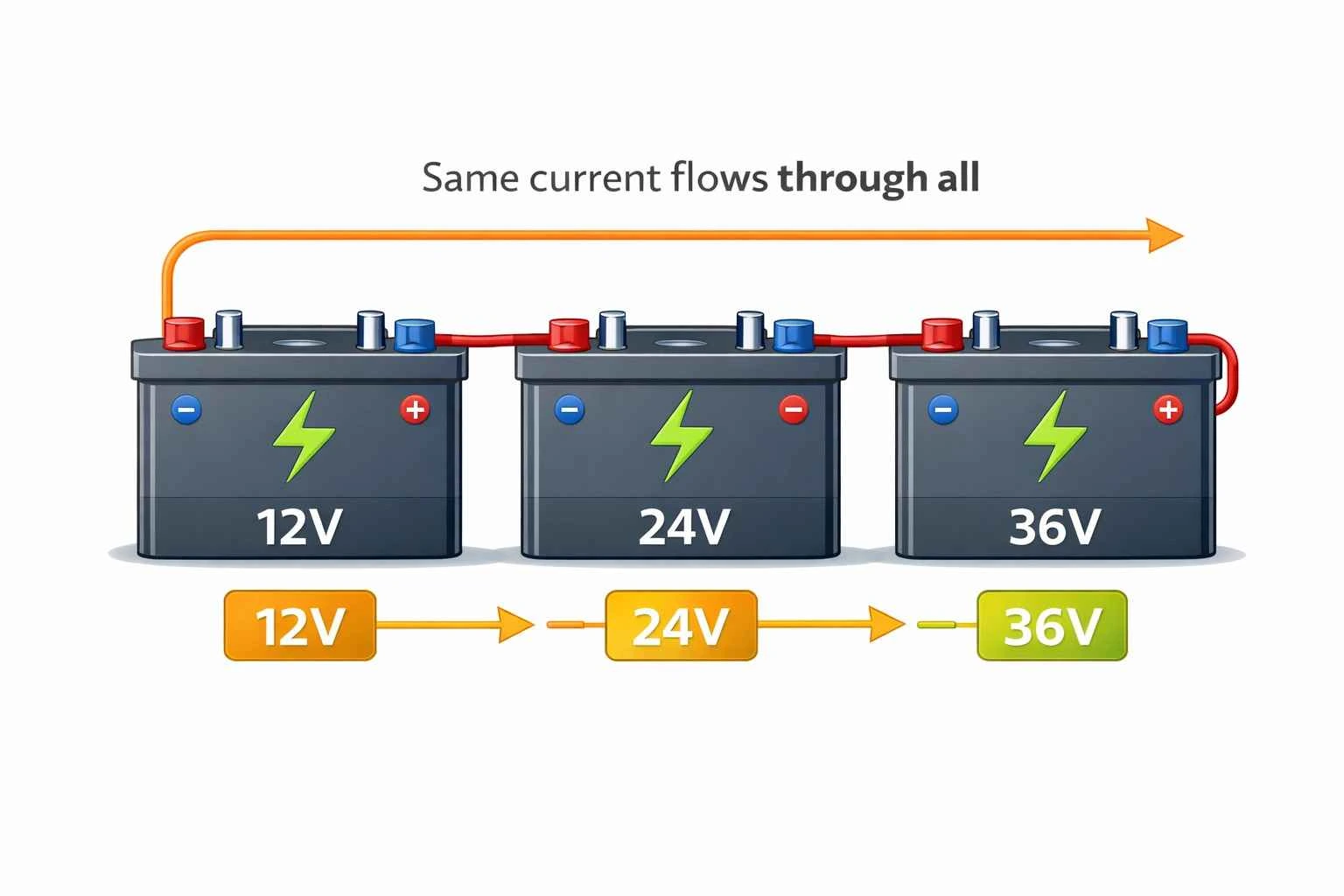
In a series connection, components are connected end-to-end, meaning the positive terminal of one panel connects to the negative terminal of the next panel.
Electricity flows through each component in a single path.
Key Characteristics of Series Connection:
- Voltage increases
- Current remains the same
- Single current path
If one component fails, the entire circuit is affected
Formula for Series Connection
Voltage in Series:
Total Voltage = V₁ + V₂ + V₃ + …
Current in Series:
- Current remains constant
Example: If three solar panels each have:
V = 40V; I = 10A
In series:
Total Voltage = 40 + 40 + 40 = 120V
Current = 10A
Series Connection in Solar Panels
Use Cases:
- When you need a higher voltage to match the inverter requirements
- To reduce current (and thus use thinner wires)
- When you have an MPPT charge controller that accepts high voltage
Example: Four 40V, 330W Panels in Series
- Each panel: 40V, 8.25A
- Connected in series: 160V, 8.25A
- Total power: 1320W
Advantages of Series:
- Higher voltage = Lower current
- Lower current = Thinner wires possible
- Less voltage drops over long distances
- Lower cost of cables
Important Points:
- All panels in series should be identical (same brand, wattage, age)
- Never exceed the charge controller’s maximum voltage rating
- Shade on one panel affects the entire string
Series Connection in Batteries
Example 1: Creating a 24V Battery Bank
- Two 12V, 100Ah batteries in series
- Result: 24V, 100Ah bank
- Voltage doubles, capacity (Ah) stays the same
Example 2: Creating a 48V Battery Bank
- Four 12V, 150Ah batteries in series
- Result: 48V, 150Ah bank
- Higher voltage system
Use Cases:
- When inverter requires 24V, 48V or higher
- For larger systems (higher voltage is more efficient)
- To reduce the current in the wiring
Advantages of Series Connection in Solar Systems
- Achieves the required inverter voltage range
- Reduces current flow, lowering cable losses
- Suitable for grid-tied solar systems
- Efficient for long-distance transmission
Disadvantages of Series Connection
- Shading on one panel reduces the total output
- One faulty panel affects the entire string
- Voltage mismatch can reduce efficiency
Parallel Connection – Full Explanation
What Is a Parallel Connection?
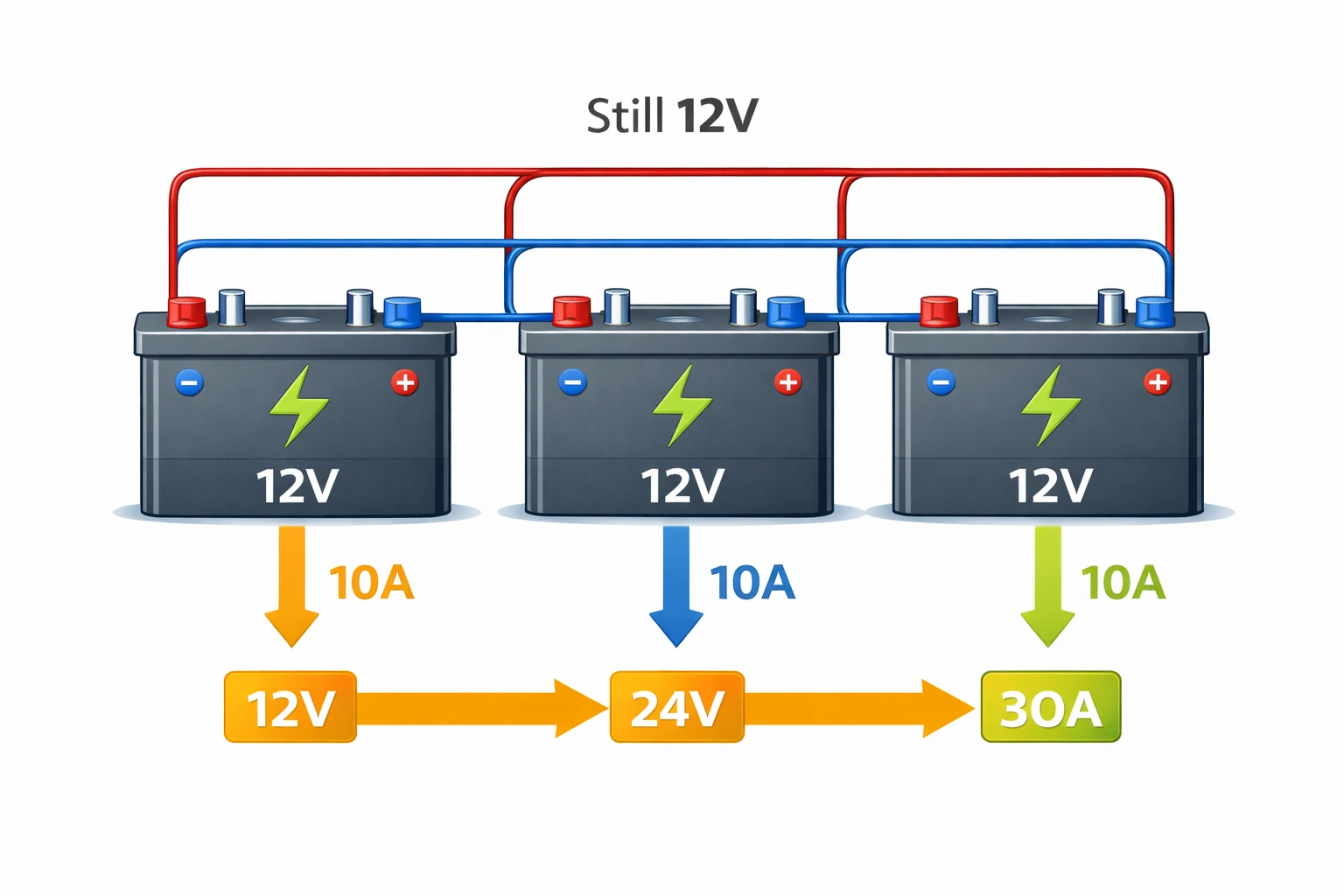
In a parallel connection, all positive terminals are connected together, and all negative terminals are connected together. Electricity flows through multiple paths.
Key Characteristics of Parallel Connection:
- Current increases
- Voltage remains the same
- Multiple current paths
- The system continues working even if one panel fails
Formula for Parallel Connection
Current in Parallel:
Total Current = I₁ + I₂ + I₃ + …
Voltage in Parallel:
- Voltage remains constant
Example: If three solar panels each have:
V = 40V; I = 10A
In parallel:
Voltage = 40V
Total Current = 10 + 10 + 10 = 30A
Parallel Connection in Solar Panels
Use Cases:
- When the system voltage is already correct (12V system with 12V panels)
- When you need more current
- To increase total power while keeping the voltage the same
Example: Four 12V, 100W Panels in Parallel
- Each panel: 12V, 8.3A
- Connected in parallel: 12V, 33.2A
- Total power: 400W
Important Points:
- All panels should be identical (same voltage rating, especially)
- Use proper junction boxes or combiner boxes
- Each panel string should have its own fuse
- Easier to add more panels later
Parallel Connection in Batteries
Example 1: Increasing Capacity
- Two 12V, 100Ah batteries in parallel
- Result: 12V, 200Ah bank
- Voltage same, capacity doubles
Example 2: Large Battery Bank
- Four 12V, 150Ah batteries in parallel
- Result: 12V, 600Ah bank
- More backup time
Use Cases:
- When you need more backup time (capacity)
- When you need to supply higher current loads
- For 12V systems with high energy consumption
Advantages of Parallel Connection in Solar Systems
- Better performance under partial shading
- Increased total current output
- Greater reliability
- Flexible expansion
Disadvantages of Parallel Connection
- Higher current requires thicker cables
- Increased wiring complexity
- Higher copper losses if not sized properly
Difference Between Series and Parallel Connection
Parameter | Series Connection | Parallel Connection |
Voltage | Increases | Remains Same |
Current | Remains Same | Increases |
Current Path | Single | Multiple |
Shading Impact | High | Lower |
Cable Thickness | Thinner | Thicker |
Best Use | High Voltage Systems | High Current Systems |
Importance of Series and Parallel Connection for Solar Installers
For solar PV installers, understanding connection types is essential for:
1. Inverter Compatibility
Inverters require specific voltage ranges. Series connections help achieve the required input voltage.
2. Load Matching
Proper wiring ensures optimal power delivery to loads.
3. Reducing Energy Loss
Correct configuration minimizes transmission losses.
4. System Expansion
Parallel connections allow easy addition of panels.
5. Safety Compliance
Improper wiring can cause overheating, short circuits, or inverter damage.
6. Maximum Power Output
Balanced configuration ensures peak system efficiency.
Combination of Series and Parallel (Series-Parallel Connection)
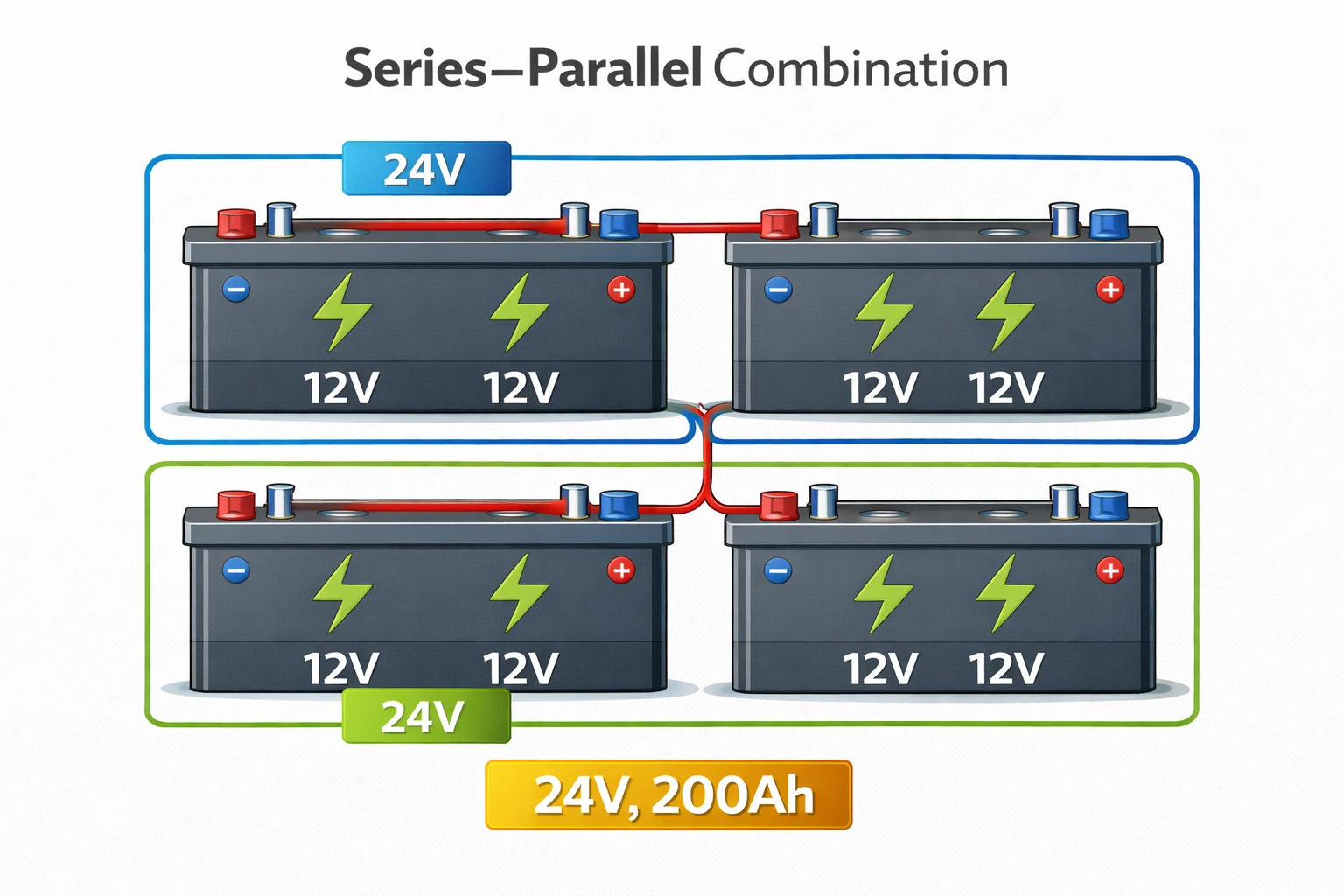
Most real-world solar installations use a combination of series and parallel connections.
Example:
- Panels connected in series to form a string (increase voltage)
- Multiple strings connected in parallel (increase current)
Example: 4 Batteries in Series-Parallel
- Four 12V, 100Ah bsatteries
- Configuration: 2 series strings of 2 batteries each, then parallel
- Result: 24V, 200Ah bank
This method balances voltage and current to match the inverter requirements.
Common Mistakes Solar Installers Must Avoid
- Mixing panels with different ratings
- Ignoring shading conditions
- Incorrect cable sizing
- Overloading the inverter input
- Not checking voltage limits
Proper calculation and design prevent long-term issues.
Conclusion
Understanding connections in series and parallel is fundamental for every solar installer. These connection methods directly influence system voltage, current, inverter compatibility, energy efficiency, and overall safety.
Series connections increase voltage, making them ideal for matching inverter input requirements. Parallel connections increase current, improving system reliability and performance under partial shading. Most modern solar power systems use a combination of both to achieve optimal output.
For solar PV installers, mastering series and parallel configurations ensures proper system design, reduced energy losses, and long-term performance stability. Accurate planning and correct wiring are the foundation of a successful renewable energy installation.
FAQs
Q1. What is the main difference between series and parallel connections?
Ans: Series increases voltage; parallel increases current.
Q2. Which connection is better for solar panels?
Ans: It depends on the inverter requirements and system design.
Q3. Does shading affect series connection?
Ans: Yes, shading on one panel reduces total output.
Q4. Why are thicker cables required in parallel connection?
Ans: Because the current increases.
Q5. Can I mix panels of different wattages?
Ans: It is not recommended.
Solar PV Mounting Techniques: Rooftop & Ground Systems
A complete guide to solar PV module mounting techniques for rooftop and ground systems, including methods, structures, and best practices.

Solar Panel Efficiency and Temperature: What You Need to Know
The stronger the sun, the higher the temperature and more energy your solar panels produce, right? No.
Should You Switch to Solar in India? Complete Guide
India has become a hot-selling solar market and people are interested in installing solar systems in their homes as well as in industries and factories.
Electrical Equipment Bonding in Solar PV Systems
A complete guide to electrical equipment bonding in solar PV systems, including anti-oxidant application, compliance requirements, and safety best practices.

Go Off-Grid with Solar Energy: A Complete Guide
Living off-grid, more commonly defined as not having a dependence on public utilities such as electricity, sounds appealing for a lot of reasons. The idea of being self-sufficient, powering your own home with solar energy, and maybe even building that home with your own two hands can sound like a dream and a challenge for people who wish to live life on their terms.
Battery Bank Installation in Solar Projects: Site Selection & Best Practices
Battery banks are essential for energy storage in solar projects. This guide explains site selection, installation procedures, safety measures, and best practices for solar battery systems.
How to Check Battery Location for Solar PV Systems
A complete guide to solar PV battery location assessment, helping installers select safe and efficient locations for battery storage systems.

Agrovoltaics Innovation: Boosting Solar Energy While Supporting Farming
Explore agrovoltaics innovation: how combining solar energy with farming boosts efficiency, supports agriculture, and maximizes land use.