
In solar photovoltaic (PV) systems, especially off-grid and hybrid setups, charge controllers play a vital role in managing the flow of electricity between solar panels and batteries. They ensure that batteries are charged efficiently while protecting them from overcharging and deep discharge.
Two main types of charge controllers are widely used: PWM (Pulse Width Modulation) and MPPT (Maximum Power Point Tracking). Understanding their specifications, working principles, and differences is essential for solar installers to design efficient and cost-effective systems.
Selecting the right charge controller significantly impacts system efficiency, battery life, and overall solar panel system cost.
This blog provides a complete comparison of PWM and MPPT charge controllers, including specifications, working principles, and how to choose the right one.
What is a Charge Controller?
A charge controller is a device that regulates the voltage and current coming from solar panels to the battery.
Its main functions include:
- Preventing battery overcharging
- Protecting against deep discharge
- Improving battery life
- Ensuring safe system operation
Charge controllers are essential in battery-based renewable solar systems.
Types of Charge Controllers
1. PWM (Pulse Width Modulation) Charge Controller
PWM is the traditional and simpler type of charge controller.
Working Principle
PWM controllers connect the solar panel directly to the battery and gradually reduce charging current as the battery reaches full charge.
Key Features
- Simple design
- Lower cost
- Reliable operation
Applications
- Small solar systems
- Low-budget installations
2. MPPT (Maximum Power Point Tracking) Charge Controller
MPPT controllers are more advanced and efficient.
Working Principle
MPPT controllers track the maximum power point of solar panels and convert excess voltage into additional current, increasing overall efficiency.
Key Features
- Higher efficiency (up to 30% more than PWM)
- Advanced technology
- Better performance in varying weather conditions
Applications
- Medium to large solar systems
- High-efficiency installations
Key Specifications of PWM and MPPT Controllers
1. Voltage Rating
Defines the system voltage:
- 12V, 24V, 48V systems
MPPT controllers support a wider voltage range compared to PWM.
2. Current Rating
Indicates the maximum current the controller can handle.
Example:
- 20A, 40A, 60A
Proper sizing ensures safe operation.
3. Efficiency
- PWM: 70–80%
- MPPT: 95–99%
Higher efficiency improves solar electricity generation.
4. Input Voltage Range
MPPT controllers can handle higher input voltages from panels, allowing flexible system design.
5. Temperature Compensation
Both controllers may include temperature sensors to adjust charging based on battery temperature.
6. Protection Features
Common protections include:
- Overcharge protection
- Short circuit protection
- Reverse polarity protection
These features ensure the safe operation of renewable energy technology systems.
PWM vs MPPT: Key Differences
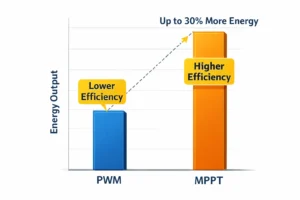
Feature | PWM Controller | MPPT Controller |
Technology | Simple | Advanced |
Efficiency | Lower | Higher |
Cost | Low | High |
Voltage Handling | Limited | Wide Range |
Energy Output | Lower | Higher |
Best Use | Small systems | Large systems |
Advantages of PWM Controllers
- Affordable
- Simple to install
- Suitable for small systems
Disadvantages of PWM Controllers
- Lower efficiency
- Limited flexibility
- Not suitable for large systems
Advantages of MPPT Controllers
- High efficiency
- Better performance in low sunlight
- Flexible panel configurations
- Maximizes solar electricity generation
Disadvantages of MPPT Controllers
- Higher cost
- More complex design
How to Choose Between PWM and MPPT
1. Based on System Size
- Small systems → PWM
- Large systems → MPPT
2. Based on the Budget
- Limited budget → PWM
- Long-term efficiency → MPPT
3. Based on Climate Conditions
- Cloudy or variable conditions → MPPT performs better
4. Based on Energy Requirement
- Higher energy demand systems benefit from MPPT controllers.
5. Based on Installation Type
- Battery-based systems require careful selection of charge controllers.
Impact on Solar Panel System Cost
Charge controller selection affects:
- Initial solar installation charges
- System efficiency
- Battery lifespan
- Cost of solar per kWh installed
MPPT controllers have a higher upfront cost but a lower long-term cost due to better efficiency.
Conclusion
Charge controllers are a crucial part of solar PV systems with battery storage, ensuring efficient and safe charging of batteries. The choice between PWM and MPPT controllers depends on system size, budget, and performance requirements. While PWM controllers are suitable for small and cost-sensitive installations, MPPT controllers provide higher efficiency and better long-term performance.
Selecting the right charge controller is essential for optimizing system efficiency and battery life. Additionally, adherence to guidelines from the Ministry of New and Renewable Energy ensures safe and reliable solar system implementation.
By choosing the appropriate charge controller, solar professionals can optimize solar panel system cost, improve solar electricity generation, and support sustainable solar energy for home use and advanced renewable solar applications.
FAQs
Q1. What is the main difference between PWM and MPPT controllers?
Ans: PWM controllers are simpler and less efficient, while MPPT controllers are advanced and provide higher efficiency.
Q2. Which controller is better for large solar systems?
Ans: MPPT controllers are better for large systems due to higher efficiency.
Q3. Are PWM controllers cheaper than MPPT?
Ans: Yes, PWM controllers are more affordable but less efficient.
Q4. Can MPPT improve solar electricity generation?
Ans: Yes, MPPT can increase energy output by up to 30% compared to PWM.
Q5. Is a charge controller required in all solar systems?
Ans: It is required in systems with battery storage, such as off-grid and hybrid systems.

Perovskite: Future of Solar Cells
Discover how solar batteries store excess energy, maximize your solar system’s efficiency, and provide reliable power during outages. Learn about the types, benefits, lifespan, and maintenance tips to make the most of your solar investment.

Solar Rooftop Projects: Benefits of Intentional Islanding for Power Backup
Discover the role of intentional islanding in solar rooftop projects. Ensure continuous power supply, system safety, and reliable energy even during grid failures.
What to Expect from a Solar PV System
A complete guide to preparing solar PV system handover documentation, covering technical records, commissioning reports, equipment warranties, operating instructions, and maintenance documents for customers.

Solar Site Safety Plan and Work Area Management Guide
A step-by-step guide to solar inverter stand installation as per drawings and manuals, ensuring proper alignment, stability, and safety.

Solar for Cold Storage Units: Cost, Benefits, Installation & ROI in India
A complete guide on solar systems for the FMCG industry in India covering installation cost, benefits, ROI, system sizing, and the installation process.

Environmental Hazards in Solar PV Installations Guide
A complete guide to identifying and mitigating safety hazards in solar PV systems, including risk assessment, hazard control, preventive measures, and workplace safety practices.

Complete Guide to Solar Panel Subsidy Scheme in Haryana
Solar power is not only less expensive, but it is also the most abundant source of clean energy.

Solar PV AC or DC: How Solar Electricity Is Generated
Total solar PV power represents the combined power output of a solar photovoltaic system. This guide explains its meaning, calculation, and how it directly impacts solar performance, efficiency, and long-term energy generation.