
Setting up a solar power plant, whether 1 MW, 500 kW, or a smaller commercial system, always begins with one crucial question: “Kitni land chahiye?”
The land requirement for Solar Plant directly affects the solar installation cost, structure design, wiring distance, and even the solar energy installation cost for the entire project.
With India pushing toward faster adoption of renewable energy and solar energy, thousands of industries, institutions, and landowners are exploring solar plant development in 2025. This blog explains exactly how much land is required, what factors affect space, and how to plan it correctly, along with important considerations on cost, wiring length, shading, and more.
Minimum Land Requirement for Solar Plants
The general thumb rule for ground-mounted solar installations in India is:
- 1 MW Solar Plant = 4-5 acres of land
This can go up to 6 acres depending on:
- Type of solar modules
- Row spacing
- Soil conditions
- Shadow-free area
- Cable routing
- Structure height
Smaller Capacities:
- 500 kW → 2-2.5 acres
- 250 kW → 1-1.2 acres
- 100 kW → 0.4-0.5 acres
These numbers change slightly depending on the solar panel area per kW, tilt angle, and module efficiency.
Why so much land?
Because solar farms need:
- Sunlight exposure from morning to evening
- Proper row spacing to avoid shading
- Room for inverter stations, pathways, and O&M access
Higher-efficiency modules reduce land usage because the solar module price per watt and output per panel increases, meaning more energy from fewer panels.
Factors To Decide Land Requirement for Solar Plant
Land for a solar plant is not just an empty plot. Many technical parameters affect the final requirement.
Solar Panel Efficiency & Technology
Higher-efficiency modules (Mono PERC, TOPCon, Bifacial) reduce the solar panel area per kW.
Technology | Area Required | Notes |
Polycrystalline | Highest | Old technology, larger panel count |
Mono PERC | Medium | Most commonly used |
TOPCon / Bifacial | Lowest | Best for reducing land requirement |
Better efficiency = less space + lower solar installation cost per kWh over 25 years.
Tilt Angle & Shadow Distance
Plants in North India need tilt angles between 20-28°, depending on the region.
More tilt = more spacing between rows = more land
Soil & Terrain Conditions
Soft, uneven, agricultural, or loose soil requires:
- Stronger structures
- Extra pathways
- Re-alignment
- Earthwork
This increases the total cost of solar installation too.
Inverter Placement & Cable Distance
Wiring distance is a major hidden cost in solar farms.
Long DC cable runs increase:
- Voltage drop
- Heat loss
- Material cost
- Conduit/trenching cost
This directly affects the solar energy installation cost and cost of solar per kWh installed.
Shadow-Free Area
Even a small shadow can reduce power generation by 30-40%.
Therefore:
- Trees, poles, towers must be avoided
- Nearby buildings must be considered
- Land must be open and obstruction-free
Thus, even if land is 5 acres, usable area may be less, leading to additional land requirement.
Land Requirement for Rooftop Solar Plant (If Not Using Land)
If the purpose is to install a 50 kW or 100 kW system, many consumers prefer rooftops instead of land.
Rooftop Space Requirement
- 1 kW = 80-100 sq. ft.
- 10 kW = 800-1000 sq. ft.
- 100 kW = 8,000-10,000 sq. ft.
This is why many factories, industries, and warehouses use their roofs instead of buying land.
This also reduces the solar roof installation cost, mainly because no foundation or land acquisition is needed.
Cost of Land + Solar Installation
Land itself is a major cost component, especially in cities like NCR, Rajasthan, UP, and MP.
The solar installation charges depend on:
- Plant capacity
- Structure type
- Cabling length
- Soil condition
- Module brand
- Cleaning and access pathways
- Land Cost Components
- Land acquisition/lease
- Mutation & approvals
- Fencing
- Path creation
- Earthing pit area
With these included, the total cost of solar installation for a 1 MW plant can vary widely across states.
How Land Requirement for Solar Plant Impacts the Plant Cost
Land has a direct impact on many financial components:
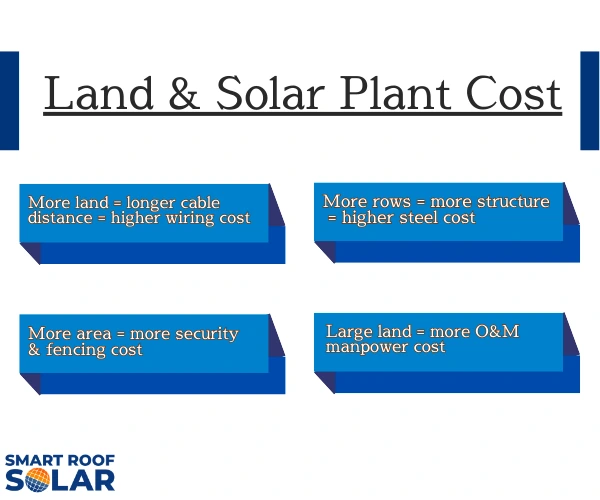
This indirectly influences the:
- solar panel system cost
- solar installation cost per kWh
- cost of solar per kWh installed
- overall financial viability
High land availability helps industries keep smart solar panel price and installation cost low.
Land Required for Commercial vs Industrial Solar Plants
- Commercial Users (Hotels, Offices, Malls)
- Usually prefer rooftop solar unless the capacity is above 200-300 kW.
- Industrial Users (Factories, Warehouses, Plants)
- Often choose ground-mounted solar outside the premises if rooftop space is small.
- Industries also benefit more because their solar electricity usage is high during the day.
Even though subsidised solar panels for homes exist, industries do not get subsidies, but they still enjoy the best ROI.
Government Regulations for Solar Land in India
Government allows use of land for solar plants under:
- Agricultural land (with approval)
- Industrial land
- Non-agricultural land
- Panchayat land
- Waste land
Solar also supports renewable solar and reduces dependence on fossil fuels. Many states like Rajasthan, Gujarat, Karnataka, and MP have easy approvals.
How to Choose Land for a Solar Power Plant
When selecting land, keep these points in mind:
- Completely shadow-free area
- Good road access for trucks
- Soil strong enough for structures
- Close to load centre to reduce wiring
- Level land to reduce civil work
- Water availability for cleaning
- Single-owner land for easy paperwork
Choosing the right land saves lakhs in solar energy installation cost later.
Conclusion
The minimum land requirement for solar plant in India is generally:
- 1 MW = 4-5 acres
- 500 kW = 2-2.5 acres
- 100 kW = 0.4-0.5 acres
But the exact requirement depends on many technical factors like shading, panel type, tilt angle, cable routing, land shape, and topography.
Choosing the right land is the foundation of a high-performing solar plant, and Smart Roof Solar ensures you get the most efficient design at the lowest solar energy installation cost, making solar a long-term, reliable investment for your business.
FAQs
Q1. Do I need grid connectivity approval before buying land?
Ans: Yes, check grid availability and substation capacity prevents costly delays later.
Q2. What type of soil is ideal for solar installations?
Ans: Hard or semi-hard soil is preferred, as soft soil requires deeper foundations and increases structure cost.
Q3. How long does it take to prepare land before installation begins?
Ans: Basic land clearing, fencing, and leveling typically take 2-4 weeks depending on terrain.
Q4. How much land is needed for battery storage if added later?
Ans: Battery storage typically requires an additional 5-10% area depending on containerized system size.
Q5. Can one solar plant supply power to multiple facilities?
Ans: Yes, through open access or group captive models, but regulatory approvals are required.

Solar for Manufacturing Units: Cost, Benefits, ROI & Installation in India
A detailed guide on 1 MW solar plant for industry covering installation cost, area requirement, power generation, ROI, and long-term savings in India.
Why Is Investing In Grade A Panels Important?
Investing in Grade A solar panels guarantees superior performance, safety, and maximum return on your solar investment.
How Solar Energy Generation Is Calculated: A Simple Step-by-Step Guide
Understanding how solar energy generation is calculated helps estimate system output, savings, and ROI. This step-by-step guide explains the formula, key factors, and real-world examples to make solar energy calculation simple and practical.
Single Line Diagram (SLD) in Solar PV Systems: Complete Guide to Design, Symbols & Reading
Learn how to fetch a Bill of Material (BOM) for a solar PV system directly from design documents like SLD, layout, and GA drawings. This step-by-step guide helps installers and EPCs ensure accurate material estimation and efficient project execution.
How to Prepare a Bill of Material (BOM) for Solar PV Systems: Step-by-Step Installer Guide
Learn how to prepare a detailed Bill of Material (BOM) for solar PV systems using design documents like SLDs and layouts. This step-by-step guide helps installers ensure accurate material planning, reduce errors, and improve project execution.

Complete Guide to Net Metering and Electricity Bill Savings
Learn how net metering lets you sell excess solar energy back to the grid, reducing your electricity bills and maximizing your solar investment.
What Is Global Tilted Irradiation (GTI) in Solar Energy? Explained Simply
Solar panel wattage and ratings decide how much electricity you generate. This guide explains panel output, efficiency, and how to choose the right solar panel for your needs.

Perovskite: Future of Solar Cells
Discover how solar batteries store excess energy, maximize your solar system’s efficiency, and provide reliable power during outages. Learn about the types, benefits, lifespan, and maintenance tips to make the most of your solar investment.