Rooftop Solar for Factories: Maximum kW You Can Install
Industrial Rooftop Solar installer can plan to install solar panels (KW) as per their solar requirements. Let us say solar requirements of factories, cold storages, warehouses, commercial buildings, Malls etc.
Understanding sizing of industrial rooftop solar plant
To understand industrial rooftop solar plant sizing, let us assume a hypothetical case of industry located in Kundali, Sonipat (Haryana). Following is known about the plant.
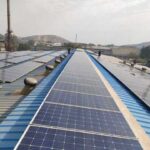
- Roof made of metal shed and has an area of 3000sqmeters,
- Contract load of 1,500 KW,
- An average monthly electricity consumption of 70,000 units or kWh
- Connected to a distribution transformer of 2,000KVA.
Factors of consideration to design industrial rooftop solar plant design
Following factors should be taken into consideration while designing the solar system for your roof.
- Roof Size determines the maximum capacity of the solar plant that can be installed.
- Each panel has an area of roughly 2 sq meter (1 meter X 2 meter) with a capacity of around 325 watts. So broadly, 3 panels can make 1 KW of solar installation. Which implies 1 KW can be installed in 6 sq meter of roof area in ideal conditions.
- However, space is required to be left between the panel rows to avoid shadow on the panels. As the panel structures are raised to provide inclination and better exposure to sunlight, the shadow free area further decreases.
- Typically, on concrete roofs, 10 sq meter would be a good estimate for 1 KW of solar panels. For inclined metal sheds and asbestos roofs, the area required to install 1 KW of solar panels would decrease based on the direction of the shed. A South facing shed can accommodate more solar panels than the one facing north.
- For the roof in the above example, a solar plant of 300-350 KW (=3000 /10) can be installed based on the size and inclination of roof.
2. Industrial rooftop Solar Plant size in KWs cannot be more than the Contract Load. In Haryana, Delhi, Uttar Pradesh, Rajasthan and other states, the size of solar plant is constraint by the Contract Load of the Building as per the Discom’s regulations. So, in this case, the maximum size of the solar plant that can be installed on the roof is 1500 KW.
3. Electricity bill is an important factor to determine the industrial rooftop solar plant size. As the Net Metering facility is available in all the states of India. Thus, the annual electricity consumption of the industrial unit, factory, warehouse or the building should be considered while sizing the industrial rooftop solar plant.
- In Haryana, UP and Delhi, consumers should consider a solar generation of 1400 kWh per KW of solar panels with 5 percent variation in the first year of the plant’s installation.
- In the above example, the factory has average monthly consumption of 70,000 units or annual consumption of 8,40,000 units (=70,000 X 12).
- To reduce the variable part of the electricity bill to zero, the industrial unit should install 600 KW (=8,40,000 / 1,400) of solar panels on the roof or within the campus.
4. Availability of Distribution Transformer capacity is important for the solar plant.
All the state regulators and Discoms have specified the maximum capacity of solar plants that can be connected to a Distribution transformer. For example, Haryana allows only 15% of the distribution transformer capacity that can be used by the solar plant. While Delhi allows 20% of the transformer capacity and Uttar Pradesh allows 25% of transformer capacity.
In the example above, the transformer has a capacity of 2000 KVA. So, a maximum of 300 KW (=15% of 2000) of solar panels can be connected to this transformer.
Discoms may consider the distribution transformer located in the premises of the industry also. As the distribution transformer in spite of the transformer being owned by the consumer. Therefore, it is important to check with the Discom for the maximum solar capacity that can be installed and Net Metered with the Distribution Transformer.
So, going by the above 4 factors, the Kundali consumer in this example can plan for a solar plant of only 300 KW. The factors are (1) Roof Size (2) Contract Load (3) Electricity Bill (4) Distribution Transformer capacity. In this case, the size of distribution transformer and the roof size are constraining factors.
Suggested Articles

Difference Between Solar Power and Photovoltaic: Explained Simply
Total solar PV power represents the combined power output of a solar photovoltaic system. This guide explains its meaning, calculation, and how it directly impacts solar performance, efficiency, and long-term energy generation.

Selecting Solar Panels: Best Guide for Homes and Factories
Solar panels are a hot topic these days, as the cost of solar is finally approaching what the average family can afford.

Complete Guide to Net Metering and Electricity Bill Savings
Learn how net metering lets you sell excess solar energy back to the grid, reducing your electricity bills and maximizing your solar investment.

Identification of Solar PV Installation Tools and Their Applications
Solar PV installation requires various tools and equipment for safe and efficient system setup. This guide explains the essential tools used by solar installers and their functions.

Difference Between Single-Phase and Three-Phase Voltage and Its Use for Solar PV Installer – Complete Guide
Understanding the difference between single-phase and three-phase voltage is essential for solar PV installers. While single-phase supply is common in residential systems, three-phase power is widely used in commercial and industrial solar projects. This complete guide explains electrical phase differences, applications in solar installations, and how choosing the right phase connection impacts system efficiency, safety, and performance.

Are Colleges and Schools ready to take up Solar challenge?
Adopting solar energy can help schools and colleges reduce electricity costs and promote sustainability. This guide explores how educational institutions can implement rooftop solar projects, the benefits, and what steps are needed to take on the solar challenge effectively.

GHI vs DNI Explained: Understanding Solar Radiation for Better Solar System Design
GHI and DNI are two critical solar radiation parameters used in designing efficient solar power systems. This guide explains the difference between GHI vs DNI, how each is measured, and why understanding them is essential for accurate solar system design and performance estimation.

Agrovoltaics Innovation: Boosting Solar Energy While Supporting Farming
Explore agrovoltaics innovation: how combining solar energy with farming boosts efficiency, supports agriculture, and maximizes land use.