
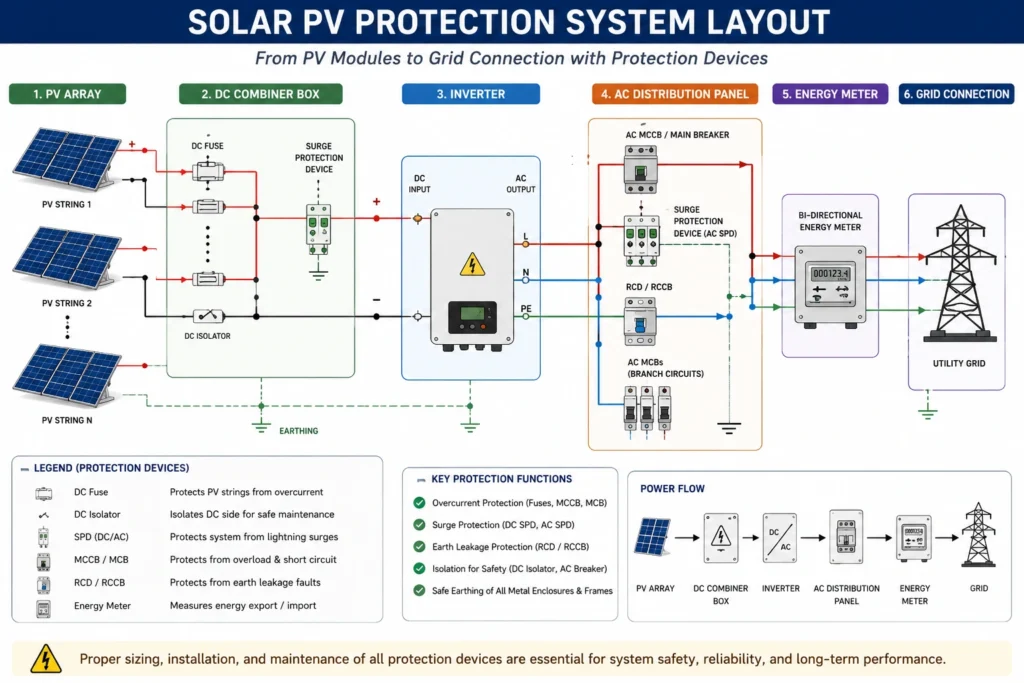
Solar photovoltaic (PV) systems rely on several protective devices to ensure the safe, reliable, and efficient operation of electrical equipment. Among the most important of these devices are fuses and circuit breakers, which protect the PV array, cables, inverters, batteries, and electrical distribution systems from overcurrent, short circuits, overloads, and equipment faults. These protective devices act as the first line of defense, preventing damage to expensive solar components while reducing the risk of electrical fires and ensuring personnel safety.
Over time, fuses and circuit breakers may deteriorate due to aging, repeated fault operations, excessive heat, moisture, corrosion, improper installation, loose electrical connections, or environmental conditions. A blown fuse, faulty breaker, poor contact, or improperly rated protection device can interrupt power generation, reduce system efficiency, or expose the solar PV system to serious electrical hazards. Therefore, routine inspection and testing of fuses and circuit breakers are essential parts of preventive maintenance.
During commissioning and maintenance, technicians must verify that all protective devices are correctly rated, mechanically sound, electrically functional, and capable of operating under fault conditions. Regular inspections help identify defective protection devices before they lead to unexpected outages or equipment failures.
Checking the working condition of fuses and circuit breakers is a fundamental maintenance activity for solar installers, commissioning engineers, EPC contractors, and operations and maintenance (O&M) professionals.
This comprehensive guide explains the purpose of fuses and circuit breakers, common faults, inspection procedures, testing methods, required tools, documentation practices, safety precautions, and industry best practices.
Why Are Fuses and Circuit Breakers Important?
Protective devices help to:
- Prevent equipment damage
- Protect against overloads
- Interrupt short-circuit currents
- Prevent cable overheating
- Improve personnel safety
- Reduce fire risks
- Improve the renewable solar system’s reliability
- Ensure uninterrupted solar electricity generation
Without properly functioning protection devices, even a minor electrical fault can cause extensive damage.
What Is a Fuse?
A fuse is a sacrificial overcurrent protection device containing a metallic element that melts when the current exceeds its rated capacity.
Once a fuse operates, it must be replaced with a correctly rated replacement.
Fuses are commonly installed in:
- DC combiner boxes
- Battery circuits
- String protection circuits
- AC distribution panels
What Is a Circuit Breaker?
A circuit breaker is a reusable protective device that automatically disconnects the electrical circuit when abnormal current conditions occur.
Unlike fuses, circuit breakers can usually be reset after the fault has been corrected.
Circuit breakers are commonly installed in:
- AC distribution boards
- Inverter output circuits
- Utility interconnection panels
- Battery protection circuits
Why Perform Routine Inspection?
Routine inspection helps detect:
- Blown fuses
- Weak fuse contacts
- Tripped breakers
- Worn breaker mechanisms
- Overheating
- Corrosion
- Loose terminals
- Improper ratings
Early detection improves system reliability and reduces maintenance costs.
Common Causes of Fuse and Circuit Breaker Failure
Protective devices may fail due to:
- Short circuits
- Overloads
- Loose electrical connections
- Moisture ingress
- Corrosion
- High ambient temperatures
- Aging
- Mechanical wear
- Improper installation
- Incorrect fuse or breaker ratings
Proper maintenance minimizes these risks.
Signs of Faulty Fuses or Circuit Breakers
Technicians should look for:
- Burn marks
- Melted fuse bodies
- Broken fuse elements
- Tripped breaker handles
- Discoloration
- Overheating
- Corrosion
- Loose terminals
- Cracked housings
- Unusual odors
Any abnormality should be investigated immediately.
Tools Required
Technicians commonly use:
- Digital multimeter
- Continuity tester
- Clamp meter
- Insulation resistance tester
- Infrared thermal camera
- Screwdriver set
- Torque wrench
- Inspection flashlight
- Personal Protective Equipment (PPE)
Only calibrated instruments should be used.
Step-by-Step Inspection Procedure
Step 1 – Ensure Safety
Before inspection:
- Follow Lockout/Tagout (LOTO) procedures where applicable.
- Isolate electrical circuits if required.
- Wear appropriate PPE.
- Verify the work area is safe.
Safety is always the first priority.
Step 2 – Review Maintenance Records
Review previous:
- Inspection reports
- Fault history
- Replacement records
- Protection settings
Historical data helps identify recurring issues.
Step 3 – Perform Visual Inspection
Inspect all fuses and circuit breakers for:
- Burn marks
- Corrosion
- Physical damage
- Loose mounting
- Cracks
- Moisture ingress
- Labeling
Replace damaged components immediately.
Step 4 – Verify Correct Ratings
Check:
- Current rating
- Voltage rating
- Breaking capacity
- Manufacturer specifications
Never replace a fuse or breaker with one of a different rating unless specified by the manufacturer.
Step 5 – Check Mechanical Condition
Operate the breaker manually.
Verify:
- Smooth operation
- Positive switching action
- Proper locking
- Secure mounting
Mechanical defects require replacement.
Step 6 – Perform Continuity Test (Fuse)
Using a multimeter:
- Check fuse continuity.
- A blown fuse will show an open circuit.
- Only test isolated circuits.
Step 7 – Measure Voltage
Measure voltage across:
- Fuse terminals
- Breaker terminals
Abnormal readings may indicate poor electrical contacts or faulty devices.
Step 8 – Perform Thermal Inspection
Use an infrared thermal camera to detect:
- Hot connections
- Overheated terminals
- Excessive resistance
- Loose electrical joints
Abnormal heating requires corrective action.
Step 9 – Tighten Electrical Connections
Inspect and tighten terminals according to the manufacturer’s torque specifications. Loose connections increase resistance and overheating.
Step 10 – Replace Faulty Components
Replace:
- Blown fuses
- Damaged circuit breakers
- Corroded terminals
- Defective accessories
Always use approved replacement parts.
Step 11 – Perform Functional Verification
After maintenance:
Verify:
- Proper breaker operation
- Correct voltage
- Stable inverter operation
- Normal system startup
- Proper energy generation
Ensure the protection devices function correctly under normal operating conditions.
Step 12 – Record Inspection Results
Document:
- Device identification
- Test results
- Fuse ratings
- Breaker ratings
- Observed defects
- Replacements performed
- Technician details
Accurate documentation supports preventive maintenance.
Common Faults and Corrective Actions
Fault | Corrective Action |
Blown fuse | Identify the fault and replace it with the correct rated fuse |
Tripped circuit breaker | Investigate the cause before resetting |
Loose terminal | Tighten to the specified torque |
Corroded contacts | Clean or replace affected components |
Overheated breaker | Inspect the load and replace it if damaged |
Incorrect rating | Install a correctly rated protective device |
Conclusion
Routine inspection and testing of fuses and circuit breakers are essential for maintaining the safety, reliability, and long-term performance of solar PV systems. These protective devices play a critical role in safeguarding solar modules, inverters, cables, batteries, and other electrical equipment against overloads, short circuits, and fault currents. By performing systematic visual inspections, verifying ratings, conducting continuity and voltage tests, checking mechanical operation, carrying out thermal inspections, and replacing defective components promptly, technicians can prevent unexpected failures, reduce downtime, and ensure uninterrupted solar electricity generation.
Inspecting the working condition of fuses and circuit breakers is a core preventive maintenance activity for solar installers, EPC contractors, commissioning engineers, and operations and maintenance professionals. Furthermore, following technical recommendations and safety practices promoted by the Ministry of New and Renewable Energy, together with manufacturer guidelines and local electrical standards, helps ensure that protective devices operate safely, accurately, and in compliance with industry requirements.
By implementing scheduled inspections, using calibrated testing instruments, maintaining detailed maintenance records, replacing damaged protective devices with correctly rated components, and addressing faults promptly, solar professionals can optimize solar panel system cost, improve renewable solar system reliability, maximize solar electricity generation, reduce the cost of solar per kWh installed, and ensure the long-term success of residential, commercial, industrial, and utility-scale solar energy projects.
FAQs
Q1. Why are fuses and circuit breakers important in solar PV systems?
Ans: Fuses and circuit breakers protect solar PV systems from overloads, short circuits, and electrical faults. They help prevent equipment damage, reduce fire risks, and ensure the safe operation of the entire installation.
Q2. How can a technician determine if a fuse is faulty?
Ans: A technician can inspect the fuse visually for damage and perform a continuity test using a digital multimeter. A blown fuse will typically show an open circuit and should be replaced with a fuse of the correct rating after the root cause has been identified.
Q3. Why should a circuit breaker not be reset repeatedly after tripping?
Ans: Repeated tripping usually indicates an underlying electrical problem such as an overload, short circuit, or equipment fault. The cause should be investigated and corrected before the breaker is reset to avoid further damage or safety hazards.
Q4. What causes overheating in fuses and circuit breakers?
Ans: Common causes include loose electrical connections, excessive current, corrosion, improper ratings, aging, and poor contact surfaces. Thermal inspections can help identify overheating before it leads to failure.
Q5. How often should fuses and circuit breakers be inspected?
Ans: Protective devices should be inspected during routine preventive maintenance, commissioning, annual inspections, after major electrical faults, or whenever abnormal system behavior is observed, following manufacturer recommendations and maintenance schedules.
पीएम सूर्य घर योजना 2025 – मुफ्त बिजली पाने के लिए ऐसे करें आवेदन
पीएम सूर्य घर योजना ऑनलाइन आवेदन 2025: मुफ्त बिजली पाने की आसान स्टेप-बाय-स्टेप प्रक्रिया यहाँ पढ़ें।
Solar Inverter Inspection & Maintenance Guide
A complete guide to battery maintenance for solar PV systems, including inspection, cleaning, testing, charging, and preventive maintenance to ensure long battery life and reliable performance.
Measure and Record ESS Voltage in Solar PV Systems
A complete guide to measuring and recording energy storage system voltage for battery performance monitoring, troubleshooting, and maintenance.

Solar for Metal & Fabrication Units: Cost, Benefits and Installation in India
A practical guide on solar for metal and fabrication units in India covering installation cost, benefits, system options, and the installation process.
Introducing the ESS-2000-24V Hybrid Solar Inverter: Smart Power for Modern Homes & Businesses
The ESS-2000-24V Hybrid Solar Inverter delivers intelligent power management for homes and businesses. With advanced solar charging, lithium battery support, and seamless backup, it ensures uninterrupted, efficient, and clean energy for modern users.

Solar Sector Growth in India Slows as Investments Decline in Q1 2023
India’s solar sector experiences an investment slowdown in Q1 2023, reflecting challenges in funding and growth for renewable energy projects.
Solar for Commercial Buildings in India: Costs, Benefits & ROI Explained
Solar for commercial buildings in India is becoming the smartest way to cut electricity bills and increase energy independence. This guide explains system costs, benefits, ROI, and how solar power helps offices, malls, hotels, and commercial complexes become more sustainable and profitable.

Why Is Investing In Grade A Panels Important?
Investing in Grade A solar panels guarantees superior performance, safety, and maximum return on your solar investment.