
In solar photovoltaic (PV) projects, structural planning plays a crucial role in ensuring the safety, durability, and efficiency of the installation. One of the most important documents used during this stage is the General Arrangement (GA) Drawing. It provides a comprehensive layout of how solar panels and supporting structures will be installed on a site.
A Civil Structural GA Drawing helps installers, engineers, and EPC professionals visualize the exact placement, alignment, and structural configuration of a solar PV system. Understanding structural drawings is essential for ensuring safe and efficient solar installations.
This blog offers a complete guide to Civil Structural GA Drawings in solar projects, covering design principles, components, and how to interpret them effectively.
What is a Civil Structural GA Drawing?
A General Arrangement (GA) Drawing is a detailed layout that shows the positioning and arrangement of solar panels, mounting structures, and other structural components at the installation site.
It includes:
- Panel layout and alignment
- Mounting structure design
- Spacing between rows
- Structural supports and foundations
GA drawings are essential for planning solar panel in rooftop installations as well as ground-mounted solar plants.
Importance of GA Drawings in Solar Projects
GA drawings play a key role in solar project execution.
Key benefits include:
- Ensures proper panel placement and alignment
- Optimizes space utilization
- Improves solar electricity generation
- Reduces installation errors
- Enhances structural safety
They also help in optimizing the solar panel system cost by ensuring efficient material usage.
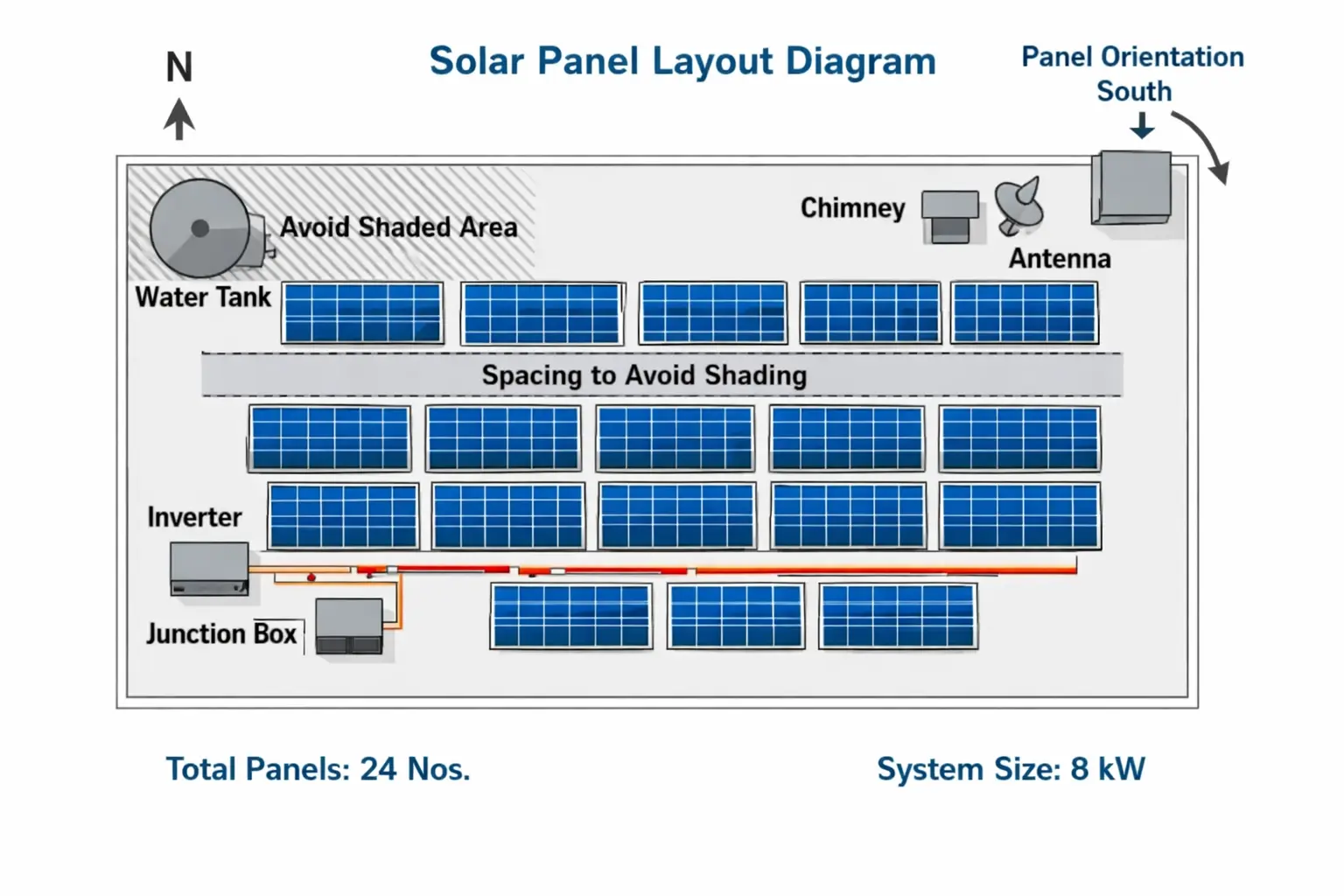
Key Elements of a Solar GA Drawing
1. Solar Panel Layout
This section shows:
- Number of panels
- Panel arrangement (rows and columns)
- Orientation (south-facing in India)
Proper layout ensures maximum sunlight exposure and improves solar electricity generation.
2. Mounting Structure Design
The GA drawing specifies:
- Type of mounting structure (fixed tilt, adjustable)
- Material used (GI, aluminum)
- Structural support design
This ensures durability and stability of the solar plant.
3. Tilt Angle and Orientation
The tilt angle is crucial for maximizing energy generation.
GA drawings include:
- Panel tilt angle
- Direction of installation
Proper orientation improves renewable solar system efficiency.
4. Row Spacing and Clearance
Spacing between panel rows is important to avoid shading.
GA drawings specify:
- Distance between rows
- Clearance from roof edges
- Maintenance pathways
This helps reduce shading losses and improves system performance.
5. Structural Support and Foundation
For ground-mounted systems, GA drawings include:
- Foundation type (concrete, pile)
- Support structure details
- Load distribution
This ensures structural integrity and safety.
6. Cable Routing and Equipment Placement
Although mainly structural, GA drawings may also indicate:
- Cable routes
- Inverter location
- Junction box placement
This helps in planning efficient installation.
7. Safety and Accessibility Features
GA drawings include:
- Walkways for maintenance
- Safety clearances
- Access points
These features ensure safe operation and maintenance of the system.
Steps to Design a GA Drawing for Solar PV Systems
Step 1 – Analyze Site Survey Data
Start with site assessment information:
- Rooftop dimensions
- Structural strength
- Shading analysis
This data forms the basis of the GA drawing.
Step 2 – Determine System Capacity
Based on load assessment and energy requirements:
- Decide total system capacity
- Calculate number of panels
This influences layout design and solar energy installation cost.
Step 3 – Plan Panel Layout
Arrange panels in rows and columns.
Consider:
- Available space
- Orientation and tilt
- Shadow-free zones
This step ensures efficient solar electricity generation.
Step 4 – Design Mounting Structure
Select appropriate mounting structure based on:
- Roof type
- Wind load conditions
- Installation angle
Proper design ensures system durability.
Step 5 – Define Spacing and Clearance
Ensure adequate spacing between rows to prevent shading.
Include:
- Maintenance pathways
- Edge clearance
This improves system efficiency and safety.
Step 6 – Add Structural Details
Include:
- Support structures
- Foundation design
- Load distribution
This ensures safe installation of renewable energy technology systems.
Step 7 – Finalize and Label Drawing
Clearly label:
- Panel positions
- Dimensions
- Structural elements
A well-labeled GA drawing improves communication among project teams.
How to Read a GA Drawing
Step 1 – Identify Layout Dimensions
Check overall dimensions of the installation area.
Step 2 – Observe Panel Arrangement
Understand how panels are arranged on the site.
Step 3 – Check Orientation and Tilt
Verify panel direction and tilt angle.
Step 4 – Analyze Structural Details
Review mounting structures and support systems.
Step 5 – Look for Clearances and Safety Features
Ensure proper spacing and access pathways are provided.
Impact of GA Drawing on Solar Panel System Cost
GA drawings help optimize project costs by:
- Efficient use of available space
- Reducing material wastage
- Preventing design errors
- Minimizing solar installation charges
This improves the cost of solar per kWh installed.
Best Practices for GA Drawing Preparation
- Use accurate site measurements
- Ensure proper orientation and tilt
- Maintain adequate spacing between panels
- Include safety and maintenance access
- Verify structural strength and load capacity
These practices ensure efficient renewable solar installations.
Conclusion
Civil Structural General Arrangement (GA) drawings are a vital part of solar PV system design. They provide a clear and detailed layout of how solar panels and supporting structures will be installed, ensuring efficient use of space and safe system operation. By carefully designing and interpreting GA drawings, solar installers can improve system performance, reduce solar energy installation cost, and ensure long-term reliability.
Understanding structural drawings is essential for successful solar project execution. Proper planning and adherence to guidelines also align with standards set by the Ministry of New and Renewable Energy.
With accurate GA drawings, solar professionals can optimize solar panel system cost, enhance renewable solar efficiency, and deliver sustainable solar energy for home use and commercial solar solutions.
FAQs
Q1. What is a GA drawing in solar projects?
Ans: A GA drawing is a layout that shows the arrangement of solar panels and structural components at the installation site.
Q2. Why is GA drawing important for solar installation?
Ans: It helps ensure proper panel placement, structural safety, and efficient system performance.
Q3. What details are included in a GA drawing?
Ans: It includes panel layout, mounting structure design, spacing, orientation, and structural supports.
Q4. How does GA drawing affect solar panel system cost?
Ans: It optimizes material usage and reduces installation errors, lowering overall costs.
Q5. Is GA drawing required for rooftop solar systems?
Ans: Yes, GA drawings are important for both rooftop and ground-mounted solar installations.
Higher Electricity Bills in Haryana as Fuel Surcharge Rises
Haryana consumers are facing higher electricity bills after the Haryana Electricity Regulatory Commission (HERC) approved a fuel surcharge hike for DHBVN and UHBVN areas. The increase reflects rising fuel and power purchase costs, directly impacting domestic, commercial, and industrial users across the state.

Connection in Series and Parallel: Meaning, Differences, Formula & Applications
Understanding the difference between single-phase and three-phase voltage is essential for solar PV installers. While single-phase supply is common in residential systems, three-phase power is widely used in commercial and industrial solar projects. This complete guide explains electrical phase differences, applications in solar installations, and how choosing the right phase connection impacts system efficiency, safety, and performance.

COP27: Harnessing Solar Energy for a Sustainable Future
COP27 is the latest in a long line of global climate conferences, which have been held regularly since 1994. The United Nations Framework Convention on Climate Change (UNFCCC) was created at the 1992 Rio Earth Summit.
What Is an Array Junction Box in Solar PV Modules? | Complete Guide
The Array Junction Box (AJB) is a critical component in solar PV systems, connecting multiple solar modules and ensuring safe flow of electricity to the inverter. This blog explains what an AJB is, its key features, types, and why it is essential for both residential and commercial solar installations. Understand how AJBs protect your system from overload, short circuits, and environmental factors while maintaining optimal performance.
Solar Radiation on a Tilted Surface: Importance & Impact on Solar Output
Solar radiation on a tilted surface directly affects how much energy a solar panel produces. Learn why tilt angle matters and how it impacts solar output.

Solar Energy for Industries Explained: Everything You Need to Know
Solar energy can greatly benefit industrial and factory owners as they require a constant and substantial source of electricity 24/7.
What Is Renewable Energy? What Is the Best Source of Renewable Energy and Why? – Complete Guide
Renewable energy comes from natural sources like sunlight, wind, water, and biomass that are constantly replenished. As India accelerates its transition toward clean energy, understanding different renewable energy sources and identifying the most efficient and cost-effective option is crucial. This complete guide explains renewable energy types, their advantages, and compares them to determine the best source based on sustainability, scalability, and long-term benefits.
Why Solar Energy Makes Sense for the Healthcare Industry
Explore how the healthcare industry can leverage solar energy to reduce electricity bills, enhance reliability, and support green initiatives.