
Batteries are one of the most critical components of off-grid and hybrid solar photovoltaic (PV) systems. They store excess energy generated by solar panels during periods of sunlight and supply power when solar generation is unavailable, such as at night, during cloudy weather, or during grid outages. A properly functioning battery bank ensures continuous power supply, improves energy independence, and enhances the reliability of renewable solar systems.
Modern solar installations use different battery technologies, including flooded lead-acid (FLA), sealed lead-acid (SLA), Absorbent Glass Mat (AGM), Gel, and lithium-ion batteries. While these technologies differ in design, charging characteristics, and maintenance requirements, all batteries are susceptible to faults caused by aging, improper charging, excessive discharge, poor maintenance, environmental conditions, loose electrical connections, or Battery Management System (BMS) failures.
Battery-related issues can significantly reduce system performance by lowering storage capacity, decreasing solar electricity availability, causing inverter shutdowns, shortening battery life, or even creating electrical and fire hazards. Therefore, systematic battery troubleshooting is an essential skill for solar installers, commissioning engineers, EPC contractors, and Operations & Maintenance (O&M) professionals.
Effective troubleshooting involves a structured process of inspecting the battery bank, checking electrical parameters, reviewing charging performance, testing battery health, verifying safety systems, documenting observations, and implementing corrective actions. Rather than replacing batteries immediately, technicians should identify the root cause of the problem using appropriate testing equipment and manufacturer-recommended procedures.
Systematic troubleshooting of batteries is a fundamental competency for professionals responsible for installing, commissioning, testing, and maintaining solar PV systems.
This comprehensive guide explains common battery faults, troubleshooting methods, testing procedures, required tools, documentation practices, safety precautions, and industry best practices.
Why Are Batteries Important in Solar PV Systems?
Batteries perform several important functions:
- Store excess solar energy
- Supply backup power
- Stabilize hybrid systems
- Improve energy availability
- Support critical electrical loads
- Enhance system reliability
Healthy batteries ensure uninterrupted solar electricity generation and storage.
Why Is Battery Troubleshooting Necessary?
Routine troubleshooting helps to:
- Detect battery degradation
- Improve charging efficiency
- Prevent unexpected failures
- Extend battery lifespan
- Improve system safety
- Reduce maintenance costs
- Increase overall system reliability
Early fault detection prevents major failures.
Common Battery Problems
Technicians frequently encounter:
- Low battery voltage
- Overcharging
- Undercharging
- Sulfation (lead-acid batteries)
- Cell imbalance
- Electrolyte loss
- Corroded terminals
- Loose cable connections
- Swollen battery casing
- Battery overheating
- BMS communication errors
- Internal short circuits
- Reduced battery capacity
- Battery aging
Each fault requires systematic diagnosis.
Common Causes of Battery Failures
Battery faults may result from:
- Improper charging settings
- Excessive discharge cycles
- High operating temperatures
- Poor ventilation
- Incorrect installation
- Loose electrical connections
- Corrosion
- Moisture ingress
- Manufacturing defects
- Aging
- Faulty charge controller
- Inverter charging problems
Understanding the root cause is essential before replacing the battery.
Tools Required
Technicians commonly use:
- Digital multimeter
- Clamp meter
- Battery analyzer
- Hydrometer (for flooded lead-acid batteries)
- Infrared thermal camera
- Insulation resistance tester
- Torque wrench
- Battery monitoring software
- Personal Protective Equipment (PPE)
All instruments should be calibrated.
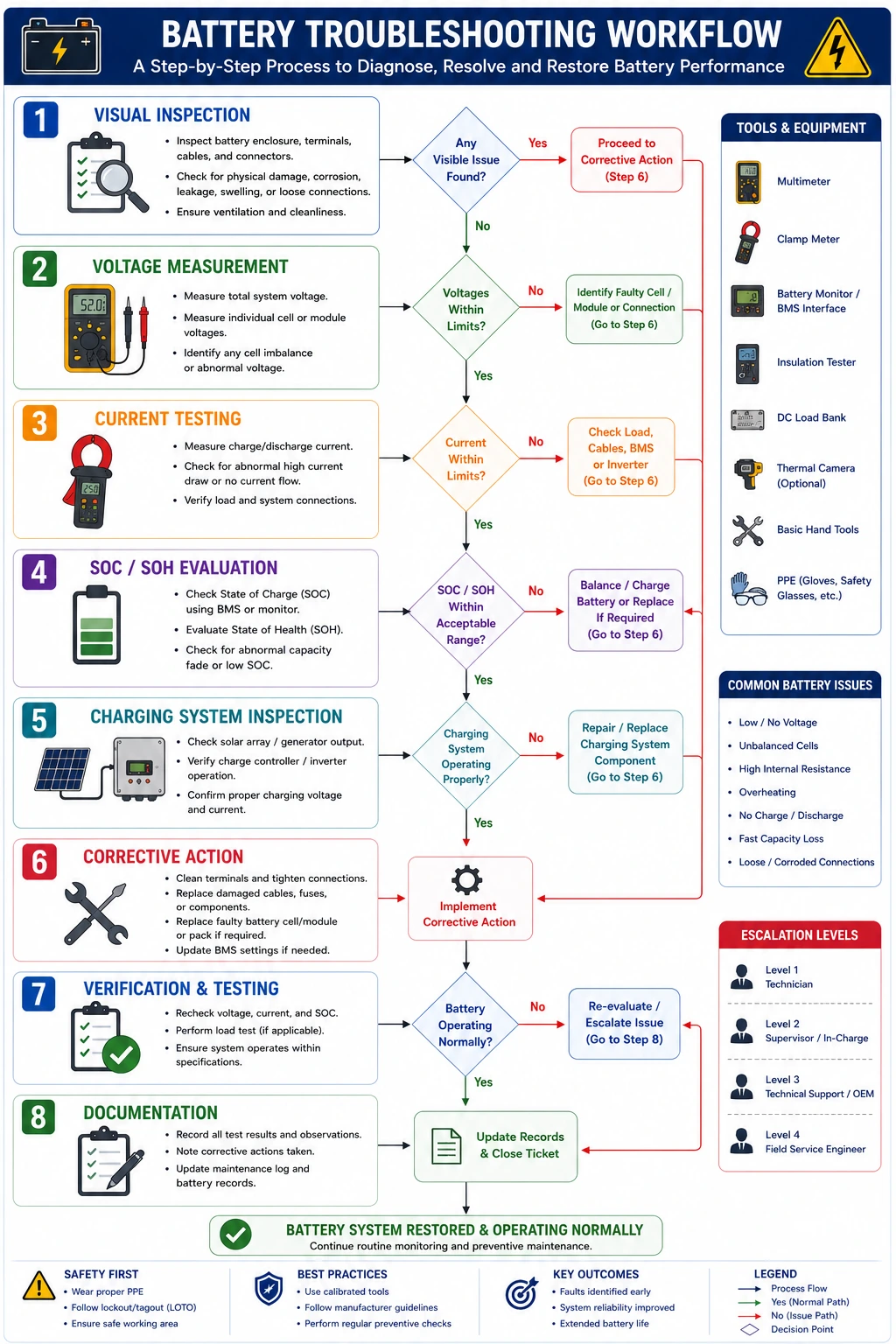
Step-by-Step Battery Troubleshooting Procedure
Step 1 – Ensure Safety
Before starting:
- Follow Lockout/Tagout (LOTO) procedures where applicable.
- Disconnect charging sources if required.
- Wear appropriate PPE.
- Ensure adequate ventilation around the battery bank.
Safety should always be the first priority.
Step 2 – Review System Information
Check:
- Battery specifications
- Installation records
- Maintenance history
- Manufacturer recommendations
- Battery monitoring data
Understanding battery history helps identify recurring problems.
Step 3 – Perform a Visual Inspection
Inspect for:
- Cracked battery casing
- Swelling
- Electrolyte leakage
- Corroded terminals
- Loose connections
- Burn marks
- Damaged cables
- Dust accumulation
- Water ingress
Visible defects should be corrected immediately.
Step 4 – Measure Battery Voltage
Using a digital multimeter:
Measure:
- Individual battery voltage
- Battery bank voltage
- Charging voltage
- Resting voltage
Compare readings with manufacturer specifications. Abnormal voltage indicates potential charging or battery health issues.
Step 5 – Check Battery Current
Measure:
- Charging current
- Discharging current
Compare values with the system design and operating conditions. Unexpected current levels may indicate wiring faults, excessive load, or charging system problems.
Step 6 – Inspect Battery Terminals and Connections
Verify:
- Tight terminal connections
- Clean terminals
- No corrosion
- Proper cable routing
- Correct polarity
Loose or corroded terminals increase resistance and reduce efficiency.
Step 7 – Test State of Charge (SOC)
Determine the battery’s State of Charge using:
- Battery monitor
- Hydrometer (for flooded lead-acid batteries)
- Manufacturer-approved diagnostic tools
Low SOC may indicate charging issues or battery degradation.
Step 8 – Check State of Health (SOH)
Evaluate:
- Remaining capacity
- Internal resistance
- Charge acceptance
- Battery age
Reduced SOH indicates battery wear or deterioration.
Step 9 – Inspect the Charging System
Verify operation of:
- Solar charge controller
- MPPT controller
- PWM controller
- Inverter charger
- Battery Management System (BMS)
Incorrect charging settings can significantly reduce battery life.
Step 10 – Perform Thermal Inspection
Using an infrared thermal camera:
Inspect for:
- Hot terminals
- Uneven battery temperatures
- Overheated cables
- Overheated connectors
Thermal anomalies require immediate investigation.
Step 11 – Verify Battery Management System (BMS)
For lithium-ion batteries:
Check:
- Cell balancing
- Communication status
- Temperature sensors
- Protection alarms
- Fault logs
BMS faults can affect charging and battery safety.
Step 12 – Implement Corrective Actions
Depending on the diagnosis:
- Tighten loose terminals
- Clean corrosion
- Replace damaged cables
- Correct charging settings
- Balance battery cells (where applicable)
- Replace defective batteries
- Update firmware (if recommended)
Only manufacturer-approved corrective actions should be performed.
Step 13 – Verify Normal Operation
After repairs:
Verify:
- Stable charging
- Stable discharging
- Correct battery voltage
- Normal inverter operation
- Reliable backup performance
Ensure the battery system operates normally.
Step 14 – Document All Findings
Record:
- Battery voltage
- Charging current
- State of Charge
- State of Health
- Thermal inspection results
- Corrective actions
- Technician details
Proper documentation supports preventive maintenance.
Common Battery Faults and Corrective Actions
Fault | Corrective Action |
Low battery voltage | Inspect charging system and recharge battery |
Corroded terminals | Clean terminals and apply anti-corrosion compound |
Loose connections | Tighten terminals to recommended torque |
Swollen battery | Replace battery immediately |
Electrolyte loss | Refill with distilled water (flooded lead-acid only) as per manufacturer instructions |
BMS communication fault | Diagnose communication wiring and BMS settings |
Uneven battery temperatures | Inspect ventilation and charging system |
Benefits of Proper Battery Troubleshooting
Improved Renewable Solar System Reliability
- Healthy batteries improve overall system stability.
Increased Solar Electricity Availability
- Efficient energy storage ensures continuous power supply.
Extended Battery Lifespan
- Early detection of faults prevents premature battery failure.
Improved Safety
- Routine inspections reduce risks associated with overheating, electrical faults, and battery damage.
Lower Maintenance Costs
- Preventive maintenance minimizes emergency replacements and downtime.
Conclusion
Troubleshooting batteries is a critical aspect of maintaining reliable and efficient solar PV systems. Since batteries serve as the primary energy storage component in off-grid and hybrid installations, their performance directly influences system availability, backup capability, and overall solar electricity generation. By following a structured troubleshooting process that includes visual inspections, voltage and current measurements, State of Charge and State of Health evaluations, charging system verification, thermal inspections, and careful documentation, technicians can accurately identify battery-related faults and implement appropriate corrective actions before they escalate into major failures.
Systematic battery troubleshooting is an essential competency for solar installers, EPC contractors, commissioning engineers, and operations and maintenance professionals. Furthermore, following technical recommendations and safety practices promoted by the Ministry of New and Renewable Energy, together with manufacturer guidelines and local electrical standards, ensures that battery inspections and repairs are carried out safely, accurately, and in compliance with industry requirements.
By conducting routine inspections, maintaining clean and secure electrical connections, monitoring charging performance, using calibrated testing instruments, replacing defective batteries when necessary, and maintaining comprehensive maintenance records, solar professionals can optimize solar panel system cost, improve renewable solar system reliability, maximize solar electricity availability, reduce the cost of solar per kWh installed, and ensure the long-term success of residential, commercial, industrial, and utility-scale solar energy projects.
FAQs
Q1. What are the most common battery problems in solar PV systems?
Ans: Common issues include low battery voltage, overcharging, undercharging, sulfation in lead-acid batteries, cell imbalance, corroded terminals, loose connections, overheating, electrolyte loss, and reduced battery capacity.
Q2. Why is measuring the State of Charge (SOC) important?
Ans: The State of Charge indicates the amount of energy currently stored in the battery. Monitoring SOC helps technicians determine whether the battery is charging and discharging correctly and prevents excessive deep discharge.
Q3. How can technicians identify battery overheating?
Ans: Battery overheating can be detected through visual inspection, temperature sensors, battery monitoring systems, or by using an infrared thermal camera to identify abnormal temperature differences between batteries or connections.
Q4. What should be done if battery terminals are corroded?
Ans: Corroded terminals should be disconnected safely, cleaned using appropriate methods recommended by the manufacturer, inspected for damage, reconnected securely, and protected with a suitable anti-corrosion compound where applicable.
Q5. Why should battery faults be addressed immediately?
Ans: Ignoring battery faults can reduce storage capacity, interrupt solar electricity supply, damage connected equipment, shorten battery life, create safety hazards, and increase maintenance costs. Early diagnosis and corrective action improve the reliability and lifespan of the renewable solar system.

Solar for Metal & Fabrication Units: Cost, Benefits and Installation in India
A practical guide on solar for metal and fabrication units in India covering installation cost, benefits, system options, and the installation process.

Agrivoltaics: Merging Solar Power with Farming
Discover how solar batteries store excess energy, maximize your solar system’s efficiency, and provide reliable power during outages. Learn about the types, benefits, lifespan, and maintenance tips to make the most of your solar investment.
Net Metering and its Advantages
Net Metering allows solar panel owners to feed excess electricity back to the grid and earn credits, reducing energy bills. Learn the key advantages of net metering for homes and businesses.
Role of PV Solar Installer in India – Responsibilities, Skills, and Industry Importance
PV solar installers play a critical role in India’s rapidly expanding solar energy sector. From rooftop systems to large-scale industrial projects, skilled installers ensure safe, efficient, and compliant solar plant deployment. This guide explains the responsibilities, technical skills, certifications, and career opportunities for PV solar installers in India, along with their growing importance in supporting the nation’s renewable energy transition.

1MW Solar Power Plant Construction Cost & Profit in India
Choosing the right industrial solar EPC is critical for plant performance and ROI. This guide explains how Indian industries can select the best solar EPC partner.
How to Prepare a Bill of Material (BOM) for Solar PV Systems: Step-by-Step Installer Guide
Learn how to prepare a detailed Bill of Material (BOM) for solar PV systems using design documents like SLDs and layouts. This step-by-step guide helps installers ensure accurate material planning, reduce errors, and improve project execution.

Researchers Propose New Way to Make Nuclear Power Plants Safer
Researchers propose innovative methods to enhance the safety of nuclear power plants, aiming to reduce risks and improve operational security.

Corporate Safety Policies for Solar PV Workplaces
A complete guide to establishing and following safe work procedures in solar PV systems, ensuring worker safety during installation, testing, commissioning, operation, and maintenance.