
Battery energy storage has become an important component of many solar photovoltaic (PV) systems. Batteries allow excess to be stored and used when solar generation is unavailable or insufficient. They are used in standalone systems, hybrid systems, backup applications, and increasingly in commercial and utility-scale renewable energy projects.
However, batteries introduce additional safety risks that must be carefully managed. Unlike PV modules, which primarily generate electricity when exposed to sunlight, batteries can store electrical energy and release it even when the solar array is not generating power. Depending on the battery chemistry and system configuration, workers may also be exposed to corrosive electrolytes, flammable gases, thermal hazards, high short-circuit currents, fire, and toxic substances.
Battery hazards can occur during transportation, installation, commissioning, operation, inspection, maintenance, testing, troubleshooting, and disposal. Improper handling or inadequate protection can result in electric shock, burns, chemical injuries, fire, explosion, equipment damage, or serious injury.
Therefore, battery safety must be treated as an integral part of solar PV system design and maintenance rather than as a separate activity.
This guide explains the major battery hazards associated with solar PV systems, their causes, preventive measures, inspection requirements, safe working practices, and emergency considerations.
What Are Battery Hazards?
Battery hazards are conditions associated with battery systems that can cause injury, illness, fire, equipment damage, or environmental harm.
In a solar PV installation, battery hazards can arise from:
- Stored electrical energy
- High fault currents
- Short circuits
- Incorrect polarity
- Electrolyte leakage
- Corrosion
- Hydrogen or other gas generation
- Thermal runaway
- Excessive temperature
- Overcharging
- Deep discharge
- Physical damage
- Improper ventilation
- Poor connections
- Inadequate protection
- Incorrect battery installation
- Improper maintenance
The specific hazards depend heavily on the battery chemistry and system design.
Why Is Battery Safety Important in Solar PV Systems?
Battery systems can store substantial amounts of energy.
Even when:
- The PV array is disconnected,
- The inverter is switched off, or
- The grid supply is unavailable,
the battery may still contain significant stored energy.
This makes batteries different from many other components of a PV installation. A battery system can potentially provide enough current during a short circuit to cause severe burns, equipment damage, or fire.
For this reason, battery systems require appropriate:
- Design
- Installation
- Protection
- Ventilation
- Monitoring
- Maintenance
- Emergency procedures
Types of Batteries Used in Solar PV Systems
Different battery technologies have different characteristics and hazards.
Common technologies include:
- Lead-acid batteries
- Flooded lead-acid batteries
- Sealed lead-acid batteries
- AGM batteries
- Gel batteries
- Lithium-ion batteries
- Lithium iron phosphate (LiFePO₄) batteries
- Other advanced energy-storage technologies
The safety procedures should always follow the specific battery manufacturer’s instructions and the applicable installation requirements.
Major Battery Hazards
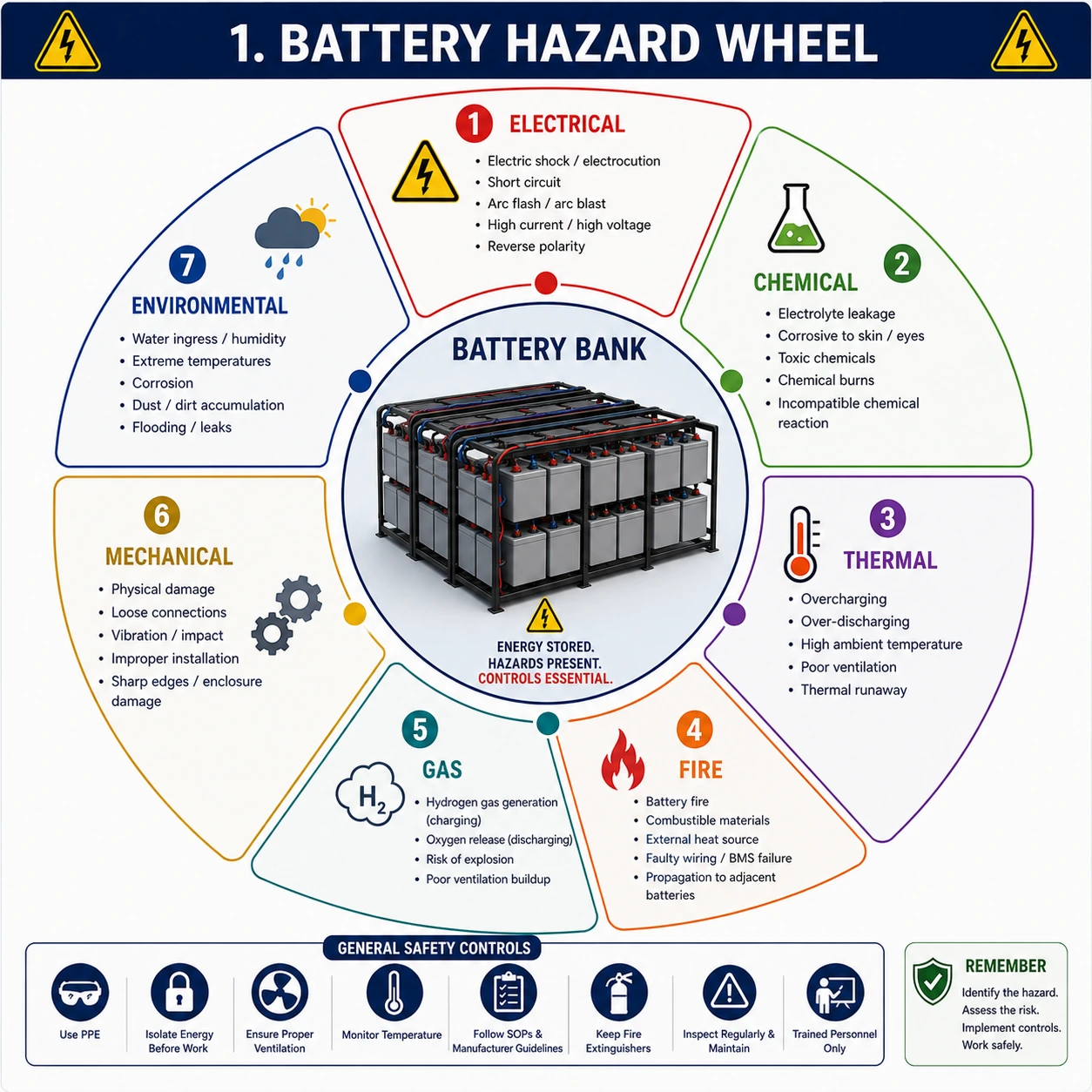
The main battery hazards in solar PV systems include:
1. Electric Shock
Battery terminals may remain electrically energized even when the PV system is shut down.
Workers can receive an electric shock by:
- Touching exposed terminals
- Contacting damaged cables
- Using conductive tools incorrectly
- Making incorrect connections
- Working on energized battery circuits
- Accidentally bridging terminals
The risk increases with higher battery-system voltages.
Preventive Measures
Workers should:
- Identify the battery system’s voltage and energy rating.
- Follow approved isolation procedures.
- Use suitable PPE.
- Use insulated tools where appropriate.
- Avoid touching exposed terminals.
- Remove metallic jewelry before working on batteries.
- Prevent accidental contact between terminals.
2. High Short-Circuit Current
One of the most significant battery hazards is the large amount of current that a battery can deliver during a short circuit.
A short circuit can occur if a conductive object connects the positive and negative terminals.
Consequences may include:
- Rapid heating
- Burns
- Sparks
- Melting metal
- Fire
- Battery damage
- Explosion in certain battery environments
Preventive Measures
- Keep conductive tools away from terminals.
- Use insulated tools where appropriate.
- Cover exposed terminals where required.
- Follow correct connection procedures.
- Install appropriate overcurrent protection.
- Do not place metal objects on batteries.
3. Arc and Spark Hazards
Connecting or disconnecting battery circuits incorrectly can produce sparks or electrical arcs.
These sparks may become particularly dangerous in areas where flammable gases are present.
Potential causes include:
- Loose terminals
- Incorrect connection
- Short circuits
- Switching under inappropriate conditions
- Damaged cables
Prevention
Battery connections should be made according to the manufacturer’s procedure and the approved electrical design.
Workers should avoid creating sparks near batteries that may release flammable gases.
4. Chemical Hazards
Some batteries contain hazardous chemicals. Traditional lead-acid batteries, for example, contain sulfuric acid electrolyte.
Contact with electrolyte can cause:
- Skin burns
- Eye injuries
- Irritation
- Damage to clothing and materials
Safe Practices
- Wear suitable chemical-resistant gloves where required.
- Use appropriate eye and face protection.
- Handle batteries carefully.
- Inspect for leaks.
- Follow the manufacturer’s safety instructions.
- Maintain suitable spill-response arrangements.
5. Electrolyte Leakage
Flooded lead-acid batteries contain liquid electrolyte.
Leakage can occur because of:
- Physical damage
- Cracked battery cases
- Overfilling
- Improper handling
- Battery deterioration
- Incorrect installation
Electrolyte leakage can damage equipment and create chemical exposure hazards.
What Should Be Done?
If leakage is detected:
- Keep unauthorized personnel away.
- Avoid direct contact.
- Use appropriate PPE.
- Follow the site’s chemical spill procedure.
- Inform the responsible supervisor.
- Follow manufacturer and emergency instructions.
6. Hydrogen Gas Hazard
Flooded lead-acid batteries can release hydrogen gas during charging. Hydrogen is highly flammable.
If hydrogen accumulates in an enclosed area, a spark or ignition source can potentially cause a fire or explosion.
Preventive Measures
Battery rooms should have appropriate ventilation where required.
Workers should:
- Avoid smoking near batteries.
- Avoid open flames.
- Prevent unnecessary sparks.
- Maintain ventilation systems.
- Keep ignition sources away from battery areas.
Battery-room ventilation should be designed according to the battery type, charging characteristics, applicable requirements, and manufacturer recommendations.
7. Fire Hazards
Battery fires can originate from:
- Short circuits
- Overheating
- Faulty connections
- Overcharging
- Internal faults
- Damaged batteries
- Thermal runaway
- Incorrect installation
Battery fires may be difficult to manage because the battery itself can continue to contain stored energy.
Prevention
- Maintain correct charging parameters.
- Monitor battery temperature.
- Inspect battery connections.
- Maintain appropriate protection systems.
- Prevent physical damage.
- Follow manufacturer requirements.
- Maintain suitable emergency procedures.
8. Thermal Runaway
Thermal runaway is a condition in which increasing temperature can cause reactions that generate additional heat, potentially causing further temperature rise.
This is particularly important for certain rechargeable battery chemistries, including some lithium-ion systems.
Thermal runaway can potentially lead to:
- Fire
- Smoke
- Gas release
- Battery failure
- Propagation to nearby battery units
Warning Signs
Possible warning signs can include:
- Unusual heating
- Swelling
- Smoke
- Unusual odor
- Unexpected temperature increase
- Abnormal charging behavior
- Repeated battery alarms
Any such condition should be treated seriously and handled according to the manufacturer’s and site’s emergency procedures.
9. Overcharging
Overcharging occurs when a battery receives charging beyond its permissible operating conditions.
Depending on battery chemistry, overcharging can cause:
- Excessive heating
- Reduced battery life
- Electrolyte loss
- Gas generation
- Battery damage
- Fire risk
Prevention
Charging systems should be configured according to the battery manufacturer’s specifications.
The charge controller, inverter, battery management system, and associated protection should be correctly configured.
10. Overheating
Battery temperature affects both safety and performance.
Excessive temperature can accelerate degradation and, depending on battery chemistry, increase safety risks.
Sources of excessive heating may include:
- High ambient temperature
- Excessive charging or discharging
- Poor ventilation
- High-resistance connections
- Internal battery faults
Preventive Measures
- Maintain appropriate operating temperatures.
- Ensure adequate ventilation or thermal management.
- Monitor battery temperature where required.
- Inspect connections.
- Avoid operating batteries outside specified limits.
11. Deep Discharge
Deep discharge occurs when a battery is discharged beyond its recommended limit.
Repeated deep discharge can:
- Reduce battery life
- Reduce capacity
- Affect system performance
- Cause battery failure
Some battery technologies can be particularly sensitive to excessive discharge. Battery management and charge-control systems should therefore be configured appropriately.
12. Incorrect Polarity
Connecting a battery with reversed polarity can damage:
- Inverters
- Charge controllers
- Battery management systems
- Cables
- Protection devices
It can also create unsafe conditions.
Prevention
Before making a battery connection:
- Identify positive and negative terminals.
- Verify the polarity.
- Confirm cable identification.
- Check the system documentation.
- Make the connection according to the approved procedure.
13. Battery Swelling
Battery swelling can indicate an internal problem.
Depending on the battery chemistry, swelling may be associated with:
- Gas generation
- Overcharging
- Excessive heat
- Internal failure
- Cell degradation
A swollen battery should not be treated as normal.
Workers should avoid attempting to puncture, compress, dismantle, or otherwise manipulate it. The issue should be isolated and escalated according to the manufacturer’s safety procedure.
14. Physical Damage
Battery damage can occur during:
- Transportation
- Installation
- Maintenance
- Mechanical impact
- Incorrect handling
Damage may include:
- Cracked casing
- Deformation
- Broken terminals
- Leakage
- Swelling
Damaged batteries should be assessed by competent personnel before being returned to service.
15. Corrosion
Corrosion can develop around battery terminals and connections, particularly in certain battery technologies and environmental conditions.
Corrosion can increase electrical resistance and contribute to:
- Heating
- Poor connections
- Reduced performance
- Terminal damage
Regular inspection can help identify corrosion at an early stage.
16. Improper Ventilation
Ventilation requirements vary according to battery chemistry and system design. Poor ventilation can allow heat or gases to accumulate.
For battery rooms using technologies that may release gases, ventilation can be an important safety control. Battery enclosures should therefore be designed and maintained according to applicable requirements and manufacturer instructions.
17. Manual-Handling Hazards
Some battery units can be heavy.
Improper lifting can cause:
- Back injuries
- Muscle strains
- Dropped batteries
- Crush injuries
- Equipment damage
Safe Handling
- Determine the battery weight before moving it.
- Use mechanical assistance where appropriate.
- Use team lifting when required.
- Maintain stable footing.
- Avoid lifting beyond individual capability.
- Secure batteries during transportation.
18. Battery Disposal Hazards
Batteries should not simply be discarded with general waste.
Improper disposal can result in:
- Chemical exposure
- Fire
- Environmental contamination
- Resource loss
Used batteries should be handled through appropriate collection, recycling, or disposal channels according to local requirements and the battery manufacturer’s recommendations.
Battery Hazards During Installation
Battery installation should begin only after reviewing:
- Battery specifications
- System voltage
- Capacity
- Polarity
- Location
- Ventilation requirements
- Temperature conditions
- Mounting requirements
- Protection requirements
- Manufacturer instructions
The battery bank should be installed on a suitable surface or enclosure capable of supporting its weight.
Connections should be properly secured and protected against accidental short circuits.
Battery Hazards During Commissioning
During commissioning, technicians may need to verify:
- Battery voltage
- Polarity
- Connections
- Charging behavior
- Battery management system operation
- Temperature
- Protective devices
- Charge-controller settings
- Inverter settings
Measurements should be made using correctly rated instruments and according to approved procedures.
Battery Hazards During Maintenance
Battery maintenance can expose workers to both stored electrical energy and chemical or thermal hazards.
Before maintenance:
- Review the maintenance procedure.
- Identify battery type.
- Identify stored-energy hazards.
- Isolate equipment where required.
- Use appropriate PPE.
- Inspect the battery condition.
- Perform the required maintenance.
- Verify the system before returning it to service.
Battery Inspection Checklist
A regular battery inspection can include:
Inspection Area | What to Check |
Battery Casing | Cracks, swelling or deformation |
Terminals | Corrosion & secure connections |
Cables | Damage, overheating or loose connections |
Electrolyte | Leakage or abnormal level where applicable |
Temperature | Excessive heating |
Ventilation | Adequate airflow where required |
Enclosure | Structural condition |
Polarity | Correct identification |
Protection | Fuses and circuit breakers |
BMS | Alarms and operating status |
Charging | Correct charging behavior |
Environment | Moisture, dust and contamination |
Warning Signs of Battery Problems
Workers should pay attention to:
- Unusual smell
- Smoke
- Excessive heat
- Swelling
- Leakage
- Corrosion
- Discoloration
- Repeated alarms
- Unexpected voltage changes
- Rapid loss of charge
- Reduced battery capacity
- Unusual sounds
- Damaged cables
Any abnormal condition should be documented and investigated.
Battery Management System and Safety
Lithium-based battery systems commonly incorporate a Battery Management System (BMS).
A BMS may monitor parameters such as:
- Cell voltage
- Pack voltage
- Temperature
- State of charge
- Charging and discharging conditions
Depending on the system, the BMS may also provide protective functions against abnormal operating conditions.
However, workers should not assume that a BMS eliminates all battery hazards. Physical inspection, appropriate installation, protection, and maintenance remain essential.
Conclusion
Battery systems provide an important energy-storage function in modern photovoltaic installations, allowing excess solar generation to be stored and used when required. They can improve energy availability, support backup power, and increase the usefulness of renewable energy and solar energy. However, the presence of stored electrical energy and, depending on the technology, chemical and thermal hazards means that batteries require careful safety management.
The major battery hazards include electric shock, high short-circuit currents, sparks and electrical arcs, corrosive electrolyte, gas generation, fire, thermal runaway, overheating, overcharging, deep discharge, incorrect polarity, physical damage, corrosion, poor ventilation, and manual-handling risks. These hazards can affect workers during installation, commissioning, operation, maintenance, troubleshooting, and disposal.
Battery safety begins with selecting the appropriate battery technology and designing a suitable installation environment. Battery location, racks, enclosures, ventilation, thermal management, electrical protection, monitoring systems, and emergency arrangements should all be considered before commissioning the system.
Once installed, regular inspection and maintenance become essential. Workers should check battery casings, terminals, cables, connections, temperature, leakage, corrosion, swelling, alarms, and charging behavior. Any abnormal condition should be recorded and investigated rather than ignored.
Safe working procedures are equally important. Personnel should identify the battery’s stored energy, follow appropriate isolation procedures, use correctly rated tools and instruments, avoid conductive objects near terminals, verify polarity, and wear PPE appropriate to the hazard. Complex faults should be escalated to qualified personnel instead of attempting unsafe repairs.
FAQs
Q1. What are the major battery hazards in solar PV systems?
Ans: Major hazards include electric shock, high short-circuit current, chemical exposure, electrolyte leakage, hydrogen gas, fire, thermal runaway, overheating, overcharging, incorrect polarity, physical damage, and poor ventilation.
Q2. Can a battery be dangerous even when the solar panels are not producing electricity?
Ans: Yes. Batteries store electrical energy and can remain energized even when the PV array is disconnected or sunlight is unavailable.
Q3. Why should metal jewelry be removed before working on batteries?
Ans: Metal jewelry can accidentally bridge battery terminals and create a high-current short circuit. This can cause severe burns or other injuries.
Q4. What happens if a battery is short-circuited?
Ans: A battery can deliver a very high current during a short circuit. This can rapidly generate heat, sparks, molten metal, burns, equipment damage, or fire.
Q5. Why are flooded lead-acid batteries associated with hydrogen hazards?
Ans: During charging, flooded lead-acid batteries can generate hydrogen gas. If it accumulates in an inadequately ventilated area, an ignition source can create a fire or explosion hazard.

How DISCOMs Implement Net Metering for Solar Power Plants
Discover the process of net metering implementation by DISCOMs for solar power plants. Understand the benefits, billing mechanism, and how it maximizes solar energy utilization.

Delhi Jal Board Solar Project: A Step Towards Sustainable Energy
Delhi Jal Board has embraced solar power, becoming a leader in renewable energy adoption. This initiative highlights the benefits of solar energy, including cost savings, sustainability, and promoting clean energy practices in institutional operations.
Electrical Hazards in Solar PV Systems: Identification, Prevention & Safety
A complete guide to identifying electrical hazards in solar PV systems and implementing effective prevention and safety measures for installation, testing, operation, and maintenance.

Solar Inverter Inspection & Maintenance Guide
A complete guide to battery maintenance for solar PV systems, including inspection, cleaning, testing, charging, and preventive maintenance to ensure long battery life and reliable performance.

Solar for Industrial Use in India: Costs, Benefits & Energy Savings Explained
Solar for industrial use in India is rapidly transforming how factories manage energy costs and efficiency. This guide covers system sizes, costs, benefits, ROI, and how solar energy helps manufacturing units, warehouses, and industrial plants reduce power bills and ensure long-term sustainability.

Solar ROI for Commercial & Industrial Projects in India: Cost, Payback & Profits
Learn how commercial and industrial solar projects deliver strong ROI for businesses in India through lower energy costs, faster payback, and long-term profit generation.
Solar Inverter Troubleshooting Guide for Solar PV Systems
A complete guide to troubleshooting charge controllers in solar PV systems, including fault diagnosis, electrical testing, error identification, and corrective maintenance for reliable system performance.

How Solar Energy Is Converted into Electricity Using Solar Panels – Complete Guide
Solar panels convert sunlight into usable electricity through the photovoltaic effect. From photon absorption to inverter conversion and grid connection, each component plays a critical role in solar power generation. This complete guide explains the step-by-step process of how solar energy becomes electricity for homes, businesses, and industries, helping you understand the technology behind India’s growing renewable energy movement.