
Battery energy storage systems are becoming an integral part of modern solar photovoltaic (PV) installations. Whether used in off-grid solar systems, hybrid solar systems, or large-scale energy storage applications, batteries help store excess solar electricity for use during nighttime, grid outages, or peak demand periods. However, the performance, safety, and lifespan of a battery bank depend not only on the batteries themselves but also on the proper installation of battery enclosures and racks.
Battery bank enclosures and racks provide structural support, protection from environmental conditions, ventilation, safety from accidental contact, and organized battery placement. Improperly installed battery racks can lead to mechanical instability, overheating, corrosion, maintenance difficulties, and increased solar installation charges.
Proper battery installation practices are essential for safe solar electricity generation, renewable solar system reliability, and long-term energy storage performance.
This blog provides a complete guide to confirming and installing battery bank enclosures and racks, including site preparation, installation procedures, safety considerations, inspection methods, and best practices for solar installers and EPC professionals.
Importance of Battery Bank Enclosures and Racks
Battery enclosures and racks serve several critical functions:
- Provide structural support
- Organize battery placement
- Improve ventilation
- Protect batteries from physical damage
- Simplify maintenance and inspection
- Improve safety
- Extend battery life
Proper installation helps improve renewable energy technology performance and reduce maintenance costs.
What is a Battery Bank Enclosure?
A battery bank enclosure is a protective housing designed to accommodate and protect battery systems.
The enclosure helps:
- Prevent unauthorized access
- Protect against environmental exposure
- Improve safety
- Support ventilation and temperature management
Battery enclosures are commonly used in:
- Residential solar energy for home use
- Commercial solar systems
- Telecom power systems
- Utility-scale battery energy storage projects
What is a Battery Rack?
A battery rack is a structural framework designed to support and organize battery units safely.
Battery racks:
- Maintain proper spacing
- Improve accessibility
- Distribute weight evenly
- Support cable management
They are widely used in renewable solar projects and energy storage installations.
Why Proper Battery Rack Installation is Important
Proper installation helps:
- Improve battery safety
- Prevent structural failure
- Enhance ventilation
- Simplify maintenance
- Reduce fire risks
- Optimize solar panel system cost
Improper installation can result in:
- Battery damage
- Reduced lifespan
- Electrical hazards
- Increased solar installation cost per kWh
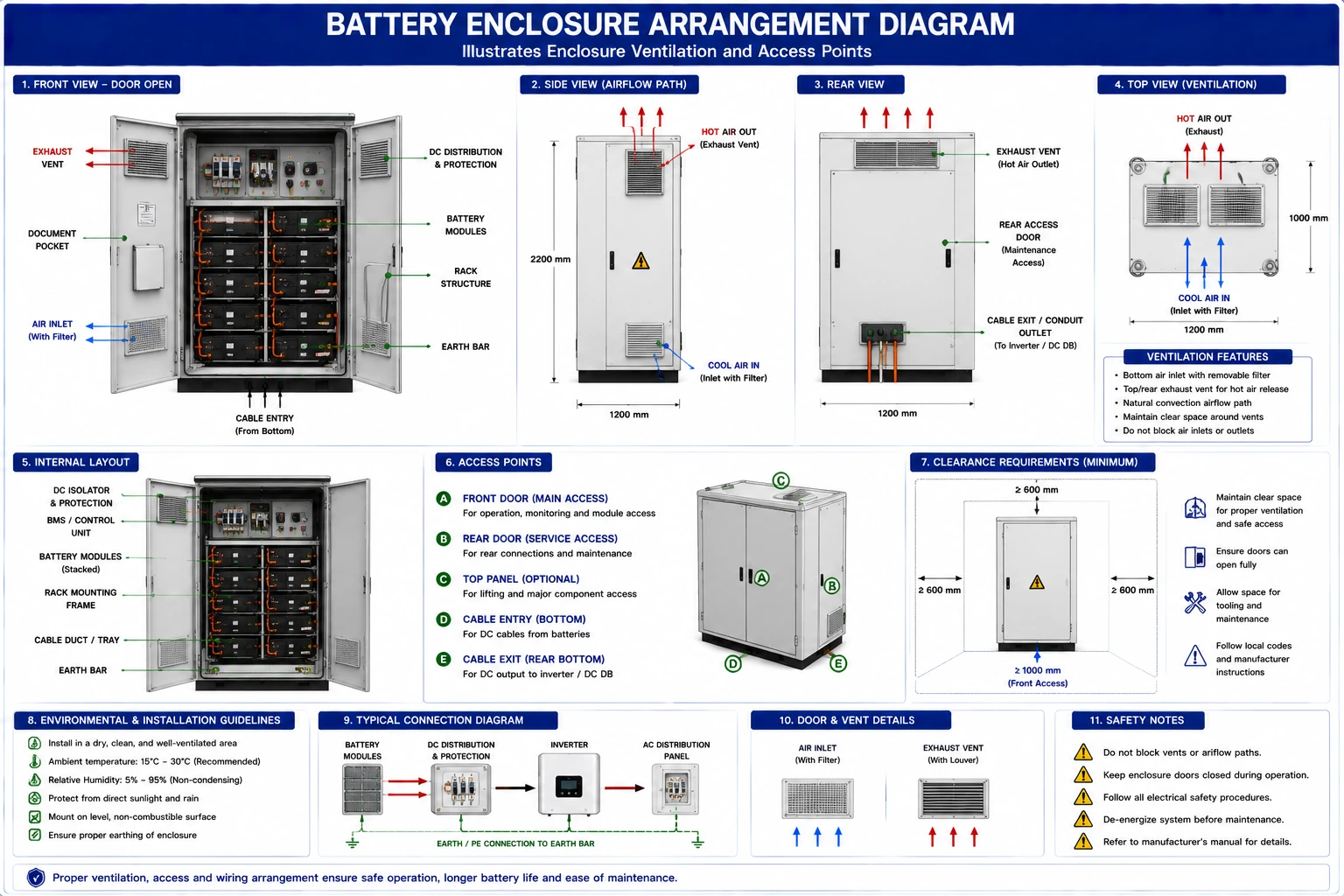
Types of Battery Enclosures Used in Solar PV Systems
1. Indoor Battery Enclosures
Installed inside dedicated electrical rooms.
Benefits:
- Better environmental control
- Enhanced security
Applications:
- Residential systems
- Commercial buildings
2. Outdoor Battery Enclosures
Designed to withstand:
- Rain
- Dust
- UV exposure
- Temperature variations
Applications:
- Solar farms
- Industrial facilities
3. Ventilated Battery Enclosures
Designed for batteries that may release gases during operation.
Benefits:
- Improved safety
- Better temperature control
4. Weatherproof Battery Cabinets
- Provide protection in harsh outdoor environments.
Types of Battery Racks
1. Single-Tier Battery Racks
Used for smaller battery banks.
Advantages:
- Easy access
- Simple installation
2. Multi-Tier Battery Racks
Used where space optimization is required.
Advantages:
- Higher storage capacity
- Efficient use of floor space
3. Seismic Battery Racks
- Designed for earthquake-prone regions.
Benefits:
- Enhanced structural stability
4. Heavy-Duty Industrial Racks
- Used for large-scale battery energy storage systems.
Factors to Consider Before Installation
1. Battery Type
Different battery technologies require different enclosure considerations.
Examples:
- Lead-acid batteries
- Lithium-ion batteries
- Gel batteries
- AGM batteries
2. Battery Weight
- Battery racks must safely support the total battery bank weight.
3. Ventilation Requirements
Proper airflow prevents:
- Overheating
- Gas accumulation
4. Accessibility
Allow sufficient space for:
- Inspection
- Maintenance
- Battery replacement
5. Environmental Conditions
Consider:
- Temperature
- Humidity
- Dust levels
- Corrosion exposure
Step-by-Step Procedure to Confirm and Install Battery Bank Enclosure/Racks
Step 1 – Review Project Drawings
Study:
- General Arrangement (GA) drawings
- Battery room layout
- Equipment specifications
Verify:
- Rack dimensions
- Enclosure requirements
- Battery configuration
Step 2 – Inspect Installation Area
Confirm:
- Floor strength
- Space availability
- Ventilation provisions
- Accessibility
Ensure the area is clean and free from obstructions.
Step 3 – Verify Rack and Enclosure Components
Inspect delivered materials for:
- Damage
- Missing components
- Manufacturing defects
Confirm compliance with project specifications.
Step 4 – Mark Installation Locations
Using approved drawings:
- Mark rack positions
- Identify anchor locations
- Confirm clearances
Accurate layout helps avoid future installation issues.
Step 5 – Install Anchor Bolts
Secure anchor bolts according to design requirements.
Ensure:
- Proper alignment
- Correct spacing
- Structural integrity
Step 6 – Assemble Battery Rack Structure
Install:
- Base frames
- Vertical supports
- Cross members
Verify:
- Proper alignment
- Mechanical stability
Step 7 – Check Level and Alignment
Use:
- Spirit level
- Laser level
Ensure racks are:
- Level
- Plumb
- Properly aligned
Misalignment may affect battery placement and safety.
Step 8 – Secure Rack Structure
Tighten all bolts according to specified torque values.
Inspect for:
- Stability
- Structural integrity
Step 9 – Install Battery Enclosure
Position enclosure according to approved drawings.
Verify:
- Ventilation openings
- Access doors
- Clearance requirements
Step 10 – Install Ventilation System
- Ensure proper airflow around batteries.
- This is particularly important for lead-acid battery systems.
Step 11 – Install Safety Signage
Display warning signs such as:
- Electrical hazard
- Battery hazard
- No smoking
- Authorized personnel only
Step 12 – Verify Cable Entry and Routing
Confirm:
- Cable gland locations
- Cable tray access
- Future maintenance accessibility
Step 13 – Final Inspection
Inspect:
- Rack stability
- Enclosure integrity
- Fastener tightness
- Clearance requirements
Document findings before battery installation.
Conclusion
Confirming and installing battery bank enclosures and racks correctly is a critical step in developing safe, efficient, and reliable solar energy storage systems. Properly installed racks provide structural stability, improve battery organization, support ventilation, and simplify maintenance while protecting valuable energy storage assets.
Proper battery installation practices are essential for renewable solar systems and solar energy for home use. Additionally, adherence to recommendations issued by the Ministry of New and Renewable Energy helps ensure compliance with industry safety and quality standards.
By implementing best practices for battery rack and enclosure installation, conducting thorough inspections, and maintaining proper ventilation and accessibility, solar professionals can optimize solar panel system cost, improve solar electricity generation reliability, and support the long-term success of renewable energy technology projects across residential, commercial, industrial, and utility-scale applications.
FAQs
Q1. Why are battery racks important in solar PV systems?
Ans: Battery racks provide structural support, improve organization, maintain spacing, and simplify maintenance activities.
Q2. Why is ventilation important in battery enclosures?
Ans: Ventilation helps control temperature and prevents the accumulation of gases generated during battery operation.
Q3. What should be checked before installing battery racks?
Ans: Installers should verify floor strength, available space, ventilation, accessibility, and compliance with project drawings.
Q4. Does proper battery rack installation affect solar panel system cost?
Ans: Yes. Proper installation reduces maintenance costs, improves battery lifespan, and enhances system reliability.
Q5. What safety precautions should be followed during installation?
Ans: Use PPE, verify structural integrity, follow lifting procedures, maintain clear work areas, and comply with applicable safety standards.

Everything you Need to Know about Bifacial Solar Panels technology
Learn how bifacial solar panels capture sunlight on both sides, boosting energy efficiency and maximizing solar power generation for homes and businesses.

1MW Solar Power Plant Construction Cost & Profit in India
Choosing the right industrial solar EPC is critical for plant performance and ROI. This guide explains how Indian industries can select the best solar EPC partner.

How to Choose Solar Panel Mounting Structures for Home, Industry & Commercial Installations
Choosing the right mounting structure is crucial for solar panel efficiency and durability. This blog explains various types of mounting structures for residential, industrial, and commercial solar installations, including rooftop, ground-mounted, and hybrid systems, to help you make an informed decision.
Solar Inverter Wire Connection Inspection Guide
A complete guide to inspecting solar inverter wire connections, identifying damaged cables, loose terminals, and ensuring safe, efficient, and reliable solar PV system operation.
Hazard Mitigation Measures for Solar PV Systems
A complete guide to mitigation measures after hazards occur in solar PV systems, covering emergency response, hazard control, incident reporting, corrective actions, and follow-up inspections.

Faulty Solar PV Module Detection Using Shading Test
A complete guide to detecting faulty solar PV modules using the shading test and ammeter readings, helping installers quickly identify underperforming modules and restore system performance.
Battery Troubleshooting in Solar PV Systems Guide
A complete guide to battery troubleshooting in solar PV systems, including fault diagnosis, performance testing, common battery issues, and effective corrective measures.

Solar Mounting Structure Installation: Complete Project Guide
A complete guide to solar mounting structures types in PV systems, covering fixed tilt, tracking, and rooftop installations for installers.