
When planning a rooftop solar project, one of the first questions is: “How much solar capacity can this roof support?” The answer depends strongly on the available roof area.
A larger roof generally provides more space for solar roof panels, but the entire roof cannot always be covered with modules. Access pathways, equipment, parapet walls, water tanks, HVAC units, shading, safety clearances, and structural limitations can reduce the actual usable area.
Therefore, calculating solar capacity is not simply a matter of measuring the roof. The available area must be assessed carefully before deciding the final system size.
Why Roof Area Matters in Solar Installation
Solar panels convert sunlight into electricity. The amount of electricity that can be generated from a roof depends partly on how many panels can physically fit on it.
For example, a roof with enough usable space for 100 panels can support a much larger solar plant than a roof that can accommodate only 30 panels.
However, two roofs of the same size may support different solar capacities because of:
- Roof shape and dimensions
- Module size and efficiency
- Shading from nearby objects
- Roof orientation and tilt
- Space required between module rows
- Walkways and maintenance access
- Water tanks, HVAC equipment and other structures
- Fire and safety clearances
- Structural limitations
PV system design guidance similarly distinguishes between total module area and the actual system design, while noting that higher-efficiency modules can provide the same capacity using less roof space.
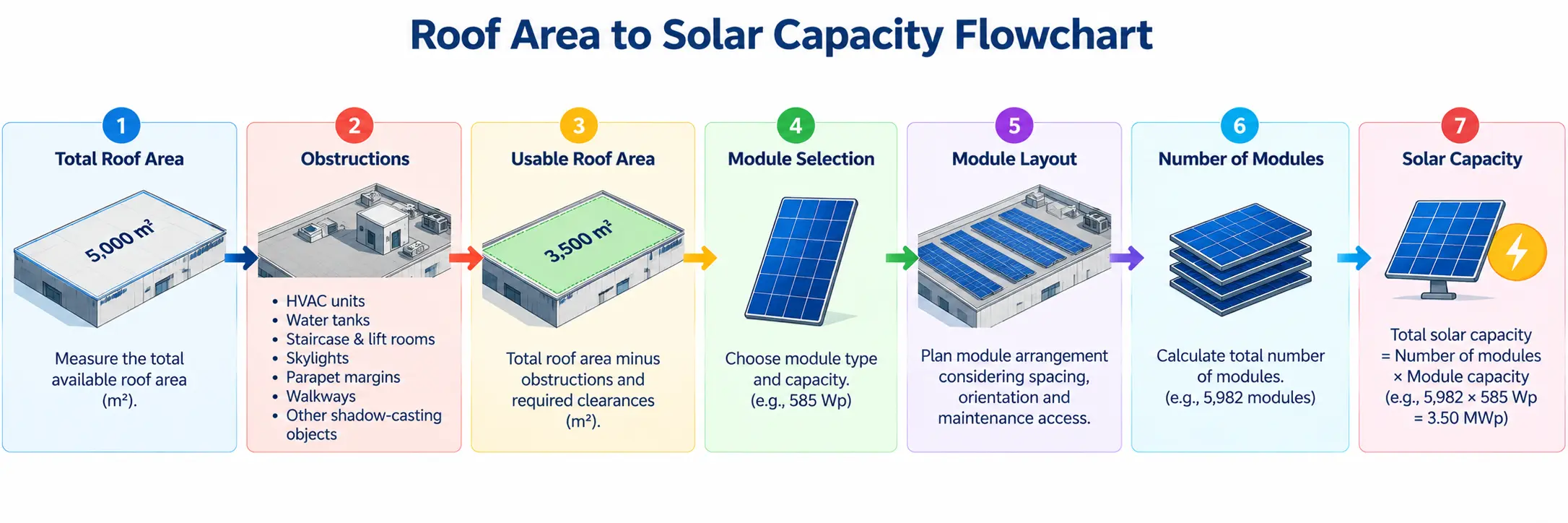
Gross Roof Area vs Usable Roof Area
The gross roof area is the total physical area of the roof. But solar designers are more interested in the usable roof area.
For example:
Total roof area = 1,000 m²
Suppose 250 m² is occupied by water tanks, HVAC equipment, staircases, skylights and other structures. Additional space is also needed for walkways and safe maintenance access.
The usable solar area may therefore be considerably lower than 1,000 m².
Simple concept:
- Gross Roof Area → Deduct Obstructions → Deduct Access/Safety Space → Usable Solar Area
This usable area is the starting point for estimating solar capacity.
How to Estimate Solar Capacity from Roof Area
A basic preliminary relationship is:
- Solar Capacity ≈ Usable Area × Module Efficiency × 1,000 W/m²
This is based on the standard test condition assumption of approximately 1,000 W/m² solar irradiance.
Example
Suppose:
- Usable roof area = 500 m²
- Module efficiency = 20%
Then:
Capacity ≈ 500 × 0.20 × 1,000 = 100,000 W = 100 kW
This is a theoretical preliminary estimate. The actual installed capacity may be lower because the calculation does not by itself account for module arrangement, walkways, shading, equipment clearances, and other rooftop constraints.
Module Size Also Affects Capacity
The number of modules that can fit on a roof depends on the physical dimensions of the selected module.
For example, if a module occupies approximately 2.5 m² and the usable roof area allows 200 modules:
- 200 × 2.5 m² = 500 m² of module area
If each module has a rated capacity of 550 W:
- 200 × 550 W = 110,000 W
So the array capacity would be approximately:
- 110 kW DC
This is why the final solar installation design should normally be based on the actual module dimensions and layout rather than relying only on a simple watts-per-square-metre assumption.
Module Efficiency Can Increase Capacity from Limited Roof Space
Module efficiency becomes particularly important when roof space is limited.
Suppose two modules produce the same electrical output but one has higher efficiency. The higher-efficiency module can generally provide the required capacity using less surface area.
NREL notes that a system with the same nameplate capacity can require less area when higher-efficiency modules are used.
This is especially useful for:
- Commercial buildings
- Factories
- Warehouses
- Hospitals
- Schools
- Offices
- Buildings with small rooftops
For a space-constrained project, selecting suitable high-efficiency solar roof panels can help maximise the available capacity.
Why the Entire Roof Cannot Be Covered with Panels
A common mistake is to assume:
“My roof is 1,000 m², so I can install panels over all 1,000 m².”
In practice, this is rarely possible.
Space may be required for:
- Maintenance walkways
- Fire and safety access
- Inverter locations
- Cable routes
- Drainage
- Roof edges
- Parapet walls
- Existing rooftop equipment
- Cleaning and inspection
- Shading avoidance
On flat roofs, module row spacing may also be required to reduce self-shading between rows.
Roof Shape and Orientation Matter
Two roofs with identical areas may not have identical solar potential.
A rectangular roof with a large uninterrupted surface may be easier to design than a roof divided into several small sections.
Similarly, different roof orientations can affect the arrangement and expected generation.
During a site survey, the solar installation team should therefore record:
- Roof length and width
- Roof height
- Roof orientation
- Tilt or slope
- Available roof sections
- Obstructions
- Shading sources
- Access points
- Structural information
- Existing electrical infrastructure
A proper layout should then be prepared before finalising the system capacity.
Roof Area and Industrial Solar Capacity
For industrial and commercial projects, roof area is one of the first inputs used during feasibility assessment.
For example, a factory may have a large 10,000 m² roof, but the final solar plant capacity will depend on how much of that area is actually suitable for PV.
The process can be viewed as:
- Roof Area → Usable Area → Module Selection → Module Layout → Number of Modules → DC Capacity → Inverter Selection
The electrical load of the facility should also be considered. A very large roof does not automatically mean that the largest possible solar plant should be installed. Depending on the project’s electricity consumption, tariff structure, grid rules, and applicable regulations, the economically suitable capacity may be smaller than the physical rooftop potential.
Roof Area and Solar Installation Cost
Roof area also indirectly affects solar installation cost.
A larger solar plant generally requires more:
- Solar modules
- Mounting structures
- DC cables
- AC cables
- Inverters
- Protection equipment
- Earthing materials
- Installation labour
- Monitoring equipment
However, larger systems can sometimes achieve better economies of scale.
Therefore, solar energy installation cost should not be estimated from roof size alone. The final cost depends on system capacity, equipment selection, roof structure, installation conditions, electrical requirements and project-specific design.
Practical Roof Capacity Assessment Checklist
Before finalising a rooftop solar plant, check:
- Total roof area measured
- Usable roof area calculated
- Roof condition inspected
- Structural suitability assessed
- Shading checked at different times
- Rooftop obstructions identified
- Module dimensions confirmed
- Module efficiency checked
- Row spacing considered
- Maintenance pathways provided
- Electrical load reviewed
- Module layout prepared
- DC capacity calculated
- Inverter capacity selected
- Final generation estimate prepared
Conclusion
Roof area is one of the most important starting points for determining rooftop solar capacity, but total roof area is not the same as usable solar area.
A reliable capacity assessment considers the roof’s dimensions, obstructions, shading, orientation, access requirements, module efficiency, module dimensions, and electrical requirements. The designer then converts the usable area into an actual module layout and determines the DC capacity of the solar plant.
For residential, commercial, and industrial projects, this approach helps avoid overestimating the available capacity and creates a more practical solar design.
Ultimately, the goal is not simply to fit as many solar panels as possible. The goal is to use the available roof intelligently and design a solar plant that provides strong generation, safe access, reliable operation, and good long-term value.
FAQs
Q1. Does a bigger roof always mean a bigger solar plant?
Ans: No. Usable area, shading, roof structure, module efficiency, access requirements and electrical requirements also affect the final capacity.
Q2. How much solar capacity can a 100 m² roof support?
Ans: A rough theoretical estimate depends on module efficiency. With 20% efficiency, 100 m² could correspond to around 20 kW under the simplified STC calculation, before accounting for layout and other practical constraints.
Q3. Can the entire roof be covered with solar panels?
Ans: Usually not. Space is required for access, maintenance, safety, drainage, equipment and other rooftop requirements.
Q4. Does panel efficiency affect solar capacity?
Ans: Yes. Higher-efficiency modules can produce the same capacity using less module area, which is useful when roof space is limited.
Q5. How does shading affect roof capacity?
Ans: Shaded sections may not be suitable for solar installation or may require layout changes because shading can reduce energy generation.
Solar Plant Performance Ratio (PR) Explained
A complete guide to solar plant performance ratio (PR), explaining its calculation, key influencing factors, industry benchmarks, and role in evaluating the performance of commercial and industrial solar plants.
Are Colleges and Schools ready to take up Solar challenge?
Adopting solar energy can help schools and colleges reduce electricity costs and promote sustainability. This guide explores how educational institutions can implement rooftop solar projects, the benefits, and what steps are needed to take on the solar challenge effectively.
Solar for Commercial Buildings in India: Costs, Benefits & ROI Explained
Solar for commercial buildings in India is becoming the smartest way to cut electricity bills and increase energy independence. This guide explains system costs, benefits, ROI, and how solar power helps offices, malls, hotels, and commercial complexes become more sustainable and profitable.
Rooftop Solar for Factories: Cost, Benefits, ROI & Installation Guide in India
Learn how rooftop solar for factories in India lowers power costs with high ROI, faster payback, and long-term energy savings for industrial facilities.

Types of Hazards in PV Installations Guide
A complete guide to the types of hazards in PV installations, covering electrical, mechanical, fire, chemical, environmental, structural, and workplace safety risks.

India’s Renewable Energy Revolution: The Role of Agrivoltaics
Agrivoltaics, the integration of solar panels with agricultural land, is emerging as a key driver in India’s renewable energy revolution. This blog explains how agrivoltaics supports sustainable farming, increases land efficiency, and contributes to clean energy production, helping India meet its solar energy targets while boosting rural economies.

How to Maintain Solar Power System for Homes, Industries & Commercial Buildings
A solar power generating system converts sunlight into electricity for residential, industrial, and commercial use. This blog explains the components, working, and benefits of solar systems, helping you understand how to harness solar energy efficiently and sustainably.

Measure and Record ESS Voltage in Solar PV Systems
A complete guide to measuring and recording energy storage system voltage for battery performance monitoring, troubleshooting, and maintenance.